Category: Culture

  • Marx and Shakespeare: Unracing Othello

    Marx and Shakespeare: Unracing Othello

    If virtue no delighted beauty lack,
    Your son-in-law is far more fair than black.

    —Duke of Venice, Act 1, Scene 3.

    The Tragedy of Othello, the Moor of Venice is a Shakespeare play that carries an echo of the European imagination that lasted beyond Karl Marx’s lifetime. “Moor” was a term used by Europeans to refer to the Muslim North Africans who had conquered and ruled the Iberian Peninsula between 711 and 1492. The Muslim population of Al-Andalus—modern day Spain and Portugal—were quite heterogeneous and did not use the Moor identifier themselves. Even after the Christian reconquest of the Iberian Peninsula, “Moor” was a common European designate applied to continental Africa and the Middle East.

    The term was derived from the ancient Roman province of Mauretania—modern day Morocco and Algeria— and it eventually came to denote virtually anyone of a darker complexion. Marx, a German and ethnic Ashkenazi, was nicknamed “the Moor” by friends and family owing to his swarthy skin tone, hair and eyes.

    The Moor label—applied to Marx but also by Shakespeare to his Othello title character—is emblematic of European perceptions of race as they evolved through centuries. Since the era of ancient Rome, people of North African, Middle Eastern and sub-Saharan African origin worked and lived in continental Europe. Yet “the ancients did not fall into the error of biological racism; black skin colour was not a sign of inferiority.”1

    The ancient world was hardly free of prejudice; individuals were judged harshly according to their occupation, cultural identity or status as citizens. But the concept of race did not exist and physical differences between groups were thought only to be the effects of climate on the human body. This view of race and ethnicity largely held through Europe’s medieval era and into Elizabethan England: “The theory of the humours, the basis of Elizabethan psychology, maintained that men were of different complexions, statures, and countenances of mind and body according to the climate of their birth.”2

    Lacking a social construction of race, ancient Rome based their in-group identity on citizenship. And medieval Europe and Renaissance England did much the same thing, only with Christianity as the defining in-group characteristic. This began to change in many parts of Europe during Shakespeare’s lifetime with the advent of the trans-Atlantic slave trade. Othello therefore occupies a blurry space somewhere at the dividing line between the western religious sorting of peoples and the systematic racial categorization that would later come.

    A World of Sighs

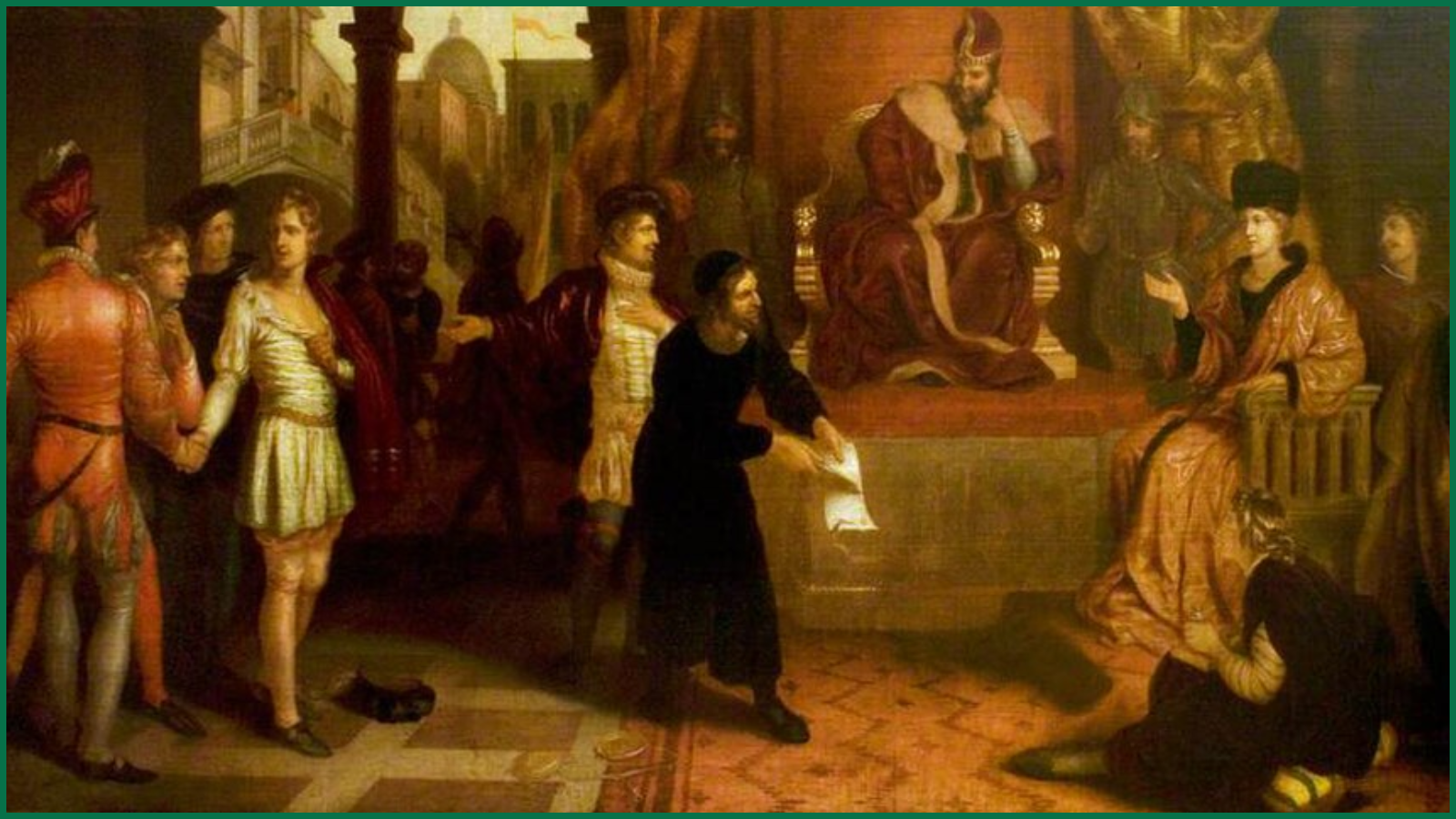
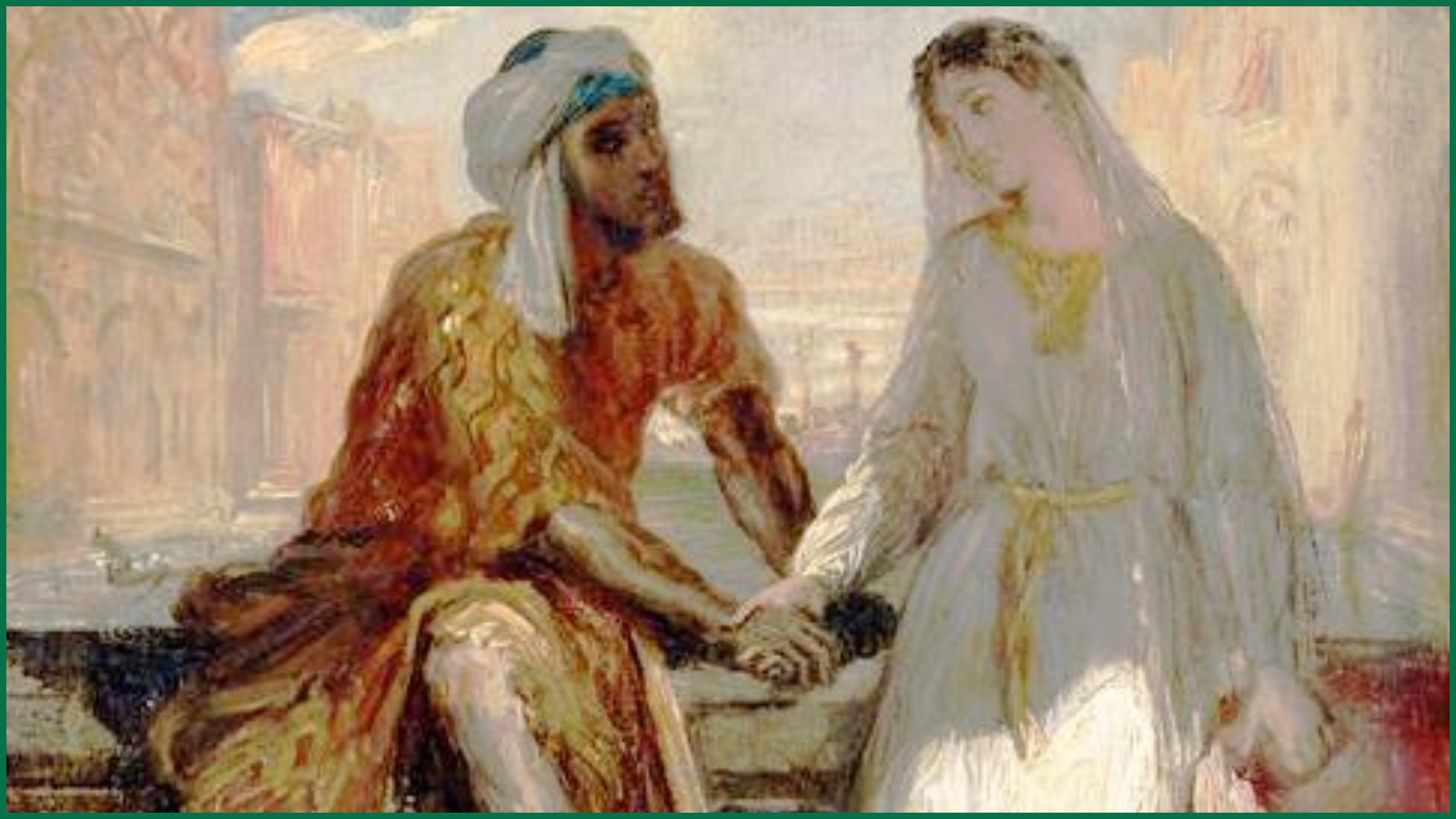
    At the open, we learn that Othello has married Desdemona, the daughter of a Venetian senator. Othello descends from a vague “Moorish” nobility but lives as “a Christianized black in Venice” who has risen to the rank of an esteemed general in the Venetian military.3 Iago serves as Othello’s trusted ensign but he has an axe to grind: Othello has passed him over for the position of lieutenant in favour of Cassio. This enrages Iago but he carefully keeps his feelings hidden. With discretion, Iago alerts Desdemona’s father to her betrothal and appeals to him with charged language in order to rouse opposition: “You’ll have your daughter covered with a Barbary horse…I tell you your daughter and the Moor are making the beast with two backs.”4

    Desdemona’s father, betrayed by his daughter marrying without his permission, appeals to the Venetian senate to overturn the ceremony. However, the senators are not persuaded. Desdemona had married with full consent and besides, they require the “valiant Moor” to defend Cyprus from an invading Turkish fleet. Iago then embarks upon a set of hateful schemes designed to ruin Cassio’s reputation, snatch money from Roderigo and destroy Othello’s otherwise happy marriage to Desdemona.

    Iago holds the crown amongst Shakespeare’s villains because of the sociopathic manner in which he weaponizes the trust that other characters place in him. Eventually snared by his own web of lies, Iago’s malevolent nature is laid bare in the last act before a bed loaded with the lifeless bodies of Desdemona, Othello and even Emilia, Iago’s wife.

    There is exceptional wickedness displayed here, as Iago ruthlessly manipulates Desdemona, Emilia, Cassio and Roderigo in order to convince Othello that his wife was unfaithful to him. But interest in Othello lingers due to the uniqueness of Shakespeare’s choice of protagonist. Shakespeare did not invent the character of Othello whole-cloth; he was devised from a “Moorish” character in a short story by the Italian poet Cinthio. Shakespeare’s version leaves open the possibility that Othello is an Arab or Berber noble of some type, but there are also a number of references to Othello’s appearance that suggest a black complexion.5 This was a bold choice for Elizabethan audiences as only an estimated 300-500 Black people are thought to have resided in England over that period of time. 

    Bootless Grief

    Shakespeare takes measures to ensure that the foreign Othello is perceived favourably by his audience. He possesses a Christian identity, his nobility and rank bless him with a majesty of speech and his bravery in battle has earned him the respect of the Venetian ruling class.6 Even spiteful Iago acknowledges Othello’s virtues that would make him a good husband to Desdemona:

    The Moor, howbeit that I endure him not,
    Is of a constant, loving, noble nature,
    And I dare think he’ll prove to Desdemona
    A most dear husband.7

    When Othello capitulates to jealousy and slays Desdemona, the labour that Shakespeare undertook establishing his merits persuade the audience to interpret Othello’s horrendous act as contrary to his nature. It is Iago’s scheming that appropriates the blame for this crime and Othello’s motivations are not presented by Shakespeare as “different from any white husband.”8 The extremely patriarchal relations of Renaissance Europe are fully displayed in Othello, without question. But despite the use of vulgar language on the part of antagonistic characters, Othello is assuredly not a racist play.

    While Shakespeare lived in a time just prior to the establishment of the concept of race, by Marx’s age this terrible social construction had reached a zenith. It is difficult to imagine that a story like Othello could be devised during the Victorian era without being subsumed by the social relations of race. In Capital, Marx asserted that racism and the capitalist mode of production shared a common origin during the age of colonial exploitation:

    The discovery of gold and silver in America, the extirpation, enslavement and entombment in mines of the aboriginal population, the beginning of the conquest and looting of the East Indies, the turning of Africa into a warren for the commercial hunting of black-skins, signalized the rosy dawn of the era of capitalist production.9

    While Elizabethan society viewed Christianity as a positive civilizing force, by the Victorian era Marx found a Christian society that was completely subordinate to capital accumulation and its accordant crimes:

    The barbarities and desperate outrages of the so-called Christian race, throughout every region of the world, and upon every people they have been able to subdue, are not to be paralleled by those of any other race, however fierce, however untaught, and however reckless of mercy and of shame, in any age of the Earth.10

    Destructing the Construction

    We can therefore assert that race and racism is a byproduct of economic relations born from the spiral of capital accumulation which early on necessitated colonial subjugation, forced labour and abject slavery. The impoverishing impacts of these economic forces have had profound effects upon global society into the present day, where we remain haunted by these spectres of history. If race is a social construction burnished by the capitalist paradigm then its demolition can only commence with the creation a new economic order.

    It was the Nigerian-British poet Ben Okri who said it best: “If Othello did not begin as a play about race, then history has made it one.” Indeed, Othello’s own race is as shapeless as the concept was during Shakespeare’s lifetime. But the aspiration today cannot be a return to feudalism or mercantilism or the harsh economies of antiquity. 

    Concerning race-based slavery, Marx wrote: “Labour cannot emancipate itself in the white skin where in the black it is branded.” Ending the systematic subjugation of labour along racial lines is one step of a larger emancipatory project. A society that does not sort individuals by race is one thing; a society that does not sort individuals by class is quite another.

    Martin Luther King Jr.’s dream of universal liberty will be seen through the eyes of a classless people that recognize the interconnectedness of the universe, of humanity, of all things living. Once the predatory fetters of competition are shed, cooperation will prevail by the motto: “The free development of each is the condition for the free development of all.”11

    Thanks for reading!


    1. Frank Snowden, Blacks in Antiquity: Ethiopians in the Greco-Roman Experience (Harvard University Press, 1970): 169. ↩︎

    2. Philip Butcher, “Othello’s Racial Identity” in Shakespeare Quarterly Vol. 3, No. 3: 246. ↩︎

    3. Peter Erickson, “Representations of Blacks and Blackness in the Renaissance” in Criticism Vol. 35, No. 4: 505. ↩︎

    4. Excerpts from Act 1, Scene 1. ↩︎

    5. Philip Butcher goes as far as saying that Othello is “undeniably black” in “Othello’s Racial Identity,” 247. ↩︎

    6. Russ McDonald writes, “Early-seventeenth century Europeans thought of Moors, Turks and Africans as pagan, but Othello is a Christian, a baptized convert whose Christianity is an important marker of his assimilation into Venice and the values of “civilization.” Russ McDonald, ed. Othello (Penguin, 2016): xxxvi. ↩︎

    7. From Act 2, Scene 3. ↩︎

    8. Ruth Vanita quoted in Rebecca Olson, “‘Too Gentle’: Jealousy and Class in Othello” in Journal for Early Modern Cultural Studies Vol. 15, No. 1: 6. ↩︎

    9. Karl Marx, Capital Vol. One (Ancient Wisdom Publishing, 2019): 533. ↩︎

    10. Ibid, 534. Quoting W. Howitt. ↩︎

    11. Karl Marx and Friedrich Engels, The Communist Manifesto. ↩︎
  • Marx and Shakespeare: Hamlet’s Alienation

    Marx and Shakespeare: Hamlet’s Alienation

    But orderly to end where I begun,
    Our wills and fates do so contrary run
    That our devices still are overthrown
    Our thoughts are ours, their ends none of our own.

    Player King, Act 3, Scene 2.

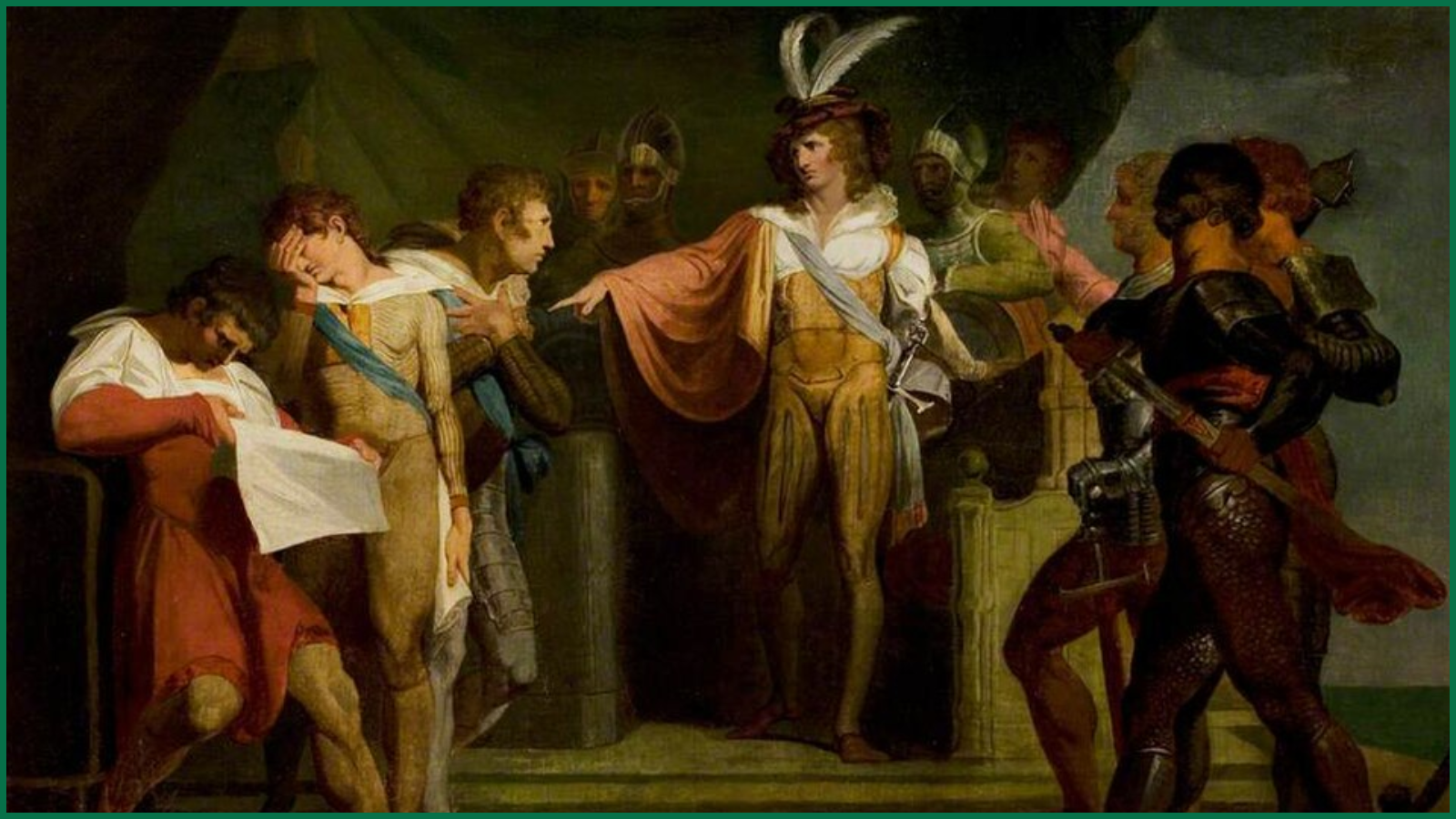
    Hamlet is William Shakespeare’s most studied play, owing to its layered themes and rich rhetorical devices. It is a literary work drawn on by John Milton for Paradise Lost, it helped Sigmund Freud to develop his theory of Oedipus complex and inspired and two compositions from Pyotr Tchaikovsky. Karl Marx’s deep appreciation of Shakespeare is well known, and Hamlet is a work that he directly references in his Eighteenth Brumaire of Louis Bonaparte.1

    The Play’s the Thing

    Hamlet almost exclusively takes place at Elsinore Castle in Denmark, which is a real place and one of the Renaissance era’s most prominent. Shakespeare was a product of the Renaissance era, and this setting is crucial to contextualizing many of Shakespeare’s plays because it sits on the demarcation line between the Middle Ages and modernity, between superstition and reason, between feudalism and liberalism, between religion and science, between the aristocracy and commerce. The tensions of this era are very important to understanding Hamlet’s inner conflict, just as it is important to understanding the romance between Romeo and Juliet or the racial attitudes embedded in Othello.

    In The German Ideology, Marx and Engels wrote:

    Thus it is quite obvious from the start that there exists a materialistic connection of men with one another, which is determined by their needs and their mode of production, and which is as old as men themselves. this connection is ever taking on new forms, and thus presents a “history” independently of the existence of any political or religious nonsense which would hold men together on its own.2

    In most of Renaissance Europe, the aristocracy maintained a monopoly on political power, derived from ownership over lands worked by a large peasantry. The rise of an urban merchant class figures heavily in some of Shakespeare’s plays, but in Hamlet we are concerned only with the palace intrigue at the top of the Danish royal hierarchy. There is a multiplicity of love triangles, petty schemes from palace courtiers, eavesdroppers and personal grievances that must constitute trivial drama in comparison to the hardship of life for many of the era. In the grand movement of history, palace intrigue is little more than the “political nonsense” that Marx identified.

    The Apparition Comes

    At the outset, the story establishes that Prince Hamlet’s father has died and his Queen mother had hastily remarried with his uncle Claudius who then consolidated the Danish nobility behind his rule. This turn of events has Hamlet already deeply unsettled and melancholy, exacerbated by a visit from his father’s ghost who wanders the Earth while in spiritual Purgatory. The ghost reveals to Hamlet that he was victim of a “murder most foul, strange and unnatural” by the poison of his brother Claudius.3

    Apparitions, witches, potions and magic were accepted forces of nature in Shakespeare’s time and come regularly into his plays as plot devices guiding a character’s arc. Whereas today uncertainty over someone’s cause of death could be resolved by a medical autopsy or forensic crime scene investigation, Hamlet could only shelter under his suspicions until he was contacted from beyond the grave. 

    But the ghost’s revelation confronts Hamlet with demands on his position. In the aristocratic world of hereditary privilege—so far from modern law and commerce—kinship largely determined one’s station in life. Notions attached to honour and nobility depended heavily on defence of kin, and there was no legal authority that Hamlet could appeal to; indeed, his corrupted family was the legal authority.

    Hamlet understands what is expected from the son of a slain father but revenge is complicated by the aristocratic hierarchy of which he is merely a component part. With a murdered father, a mother joined in marriage with the killer and childhood friends in the service of his usurping uncle, Hamlet finds himself completely alienated from the social relations that grant him his identity as a prince. 

    The ensuing conflict of the play is an internal struggle to overcome this experienced alienation, immortalized by Hamlet’s famous speech: 

    To be, or not to be, that is the question:

    Whether ’tis nobler in the mind to suffer

    The slings and arrows of outrageous fortune,

    Or to take arms against a sea of troubles

    And by opposing end them. To die—to sleep,

    No more; and by a sleep to say we end

    The heart-ache and the thousand natural shocks

    That flesh is heir to: ’tis a consummation

    Devoutly to be wish’d. To die, to sleep;

    To sleep, perchance to dream—ay, there’s the rub:

    For in that sleep of death what dreams may come,

    When we have shuffled off this mortal coil,

    Must give us pause—there’s the respect

    That makes calamity of so long life.

    For who would bear the whips and scorns of time,

    Th’oppressor’s wrong, the proud man’s contumely,

    The pangs of dispriz’d love, the law’s delay,

    When he himself might his quietus make

    With a bare bodkin?

    This speech could be rephrased “to live or not to live?” If Hamlet chooses to live as his father’s son by seeking revenge against King Claudius he will certainly perish in the process. On the other hand, he cannot bear an existence as an obedient prince under these circumstances. To live his proper life is a death sentence but to avoid death he must surrender life.

    The Readiness is All

    There is a duality that opens up here between Hamlet’s blood instincts and his social status as a prince. Marx described alienation as characteristic to humanity’s estrangement from productive activity and the reduction of social relations to class standing, when “man feels that he is acting freely only in his animal functions—eating, drinking, and procreating—while in his human functions, he is nothing more than an animal.”4

    As he is estranged from his family and friends by the revelation of his uncle’s homicide and arrogation of the throne, Hamlet ponders his alienated state: 
    “What is a man
    If his chief good and market of his time
    Be but to sleep and feed? A beast, no more.” 

    It is Ophelia that bears the brunt of Hamlet’s dislocation, his rage against the animalistic propensity toward violence and sex. While they had been engaged in a genuine courtship prior to the events of the play, she becomes “the focus of his disgust with the whole sexual process.”5

    Seeing the characteristics of his being stripped of all virtue, Hamlet dismisses any love he once had for Ophelia as brutish lust and he condemns her to a lifetime of abstinence: “If thou dost marry, I’ll give thee this plague for thy dowry: be thou as chaste as ice, as pure as snow, thou shalt not escape calumny. Get thee to a nunnery. Go, farewell.”

    For Marx, alienation will ultimately be resolved when we take conscious control of our circumstances, when we reconcile our productive activity with both our individual selves and species-being. Hamlet’s internal conflict is resolved when he encounters the army of the crown prince of Norway, Fortinbras, on the march through Danish territory. Hamlet’s father had killed Fortinbras’ father in a duel decades earlier and the Norwegian prince had finally arrived to seek his just revenge.

    Hamlet then grasps the unity of opposing forces; to be an obedient prince is the same as to be his father’s son; to be in love is to be lustful; to live is the same as to die; to be is not to be.6 Before throwing himself, his mother and his uncle to their doom, he says: “There is special providence in the fall of a sparrow. If it be now, ’tis not to come; if it be not to come, it will be now; if it be not now, yet it will come. The readiness is all. Let be.”

    Thanks for reading!


    1. For more on Marx’s personal interest in Shakespeare, see Erich Fromm, “Marx’s Concept of Socialism” in Marx’s Concept of Man (Frederick Ungar Publishing, 1961). ↩︎

    2. Karl Marx and Friedrich Engels, The German Ideology (Martino Publishing, 2011): 18-19. ↩︎

    3. The “most foul” and “unnatural” aspects of the murder lie in it being committed by Claudius against his own flesh and blood. ↩︎

    4. Karl Marx, “The Economic and Philosophic Manuscripts of 1844” in Essential Writings of Karl Marx (Red and Black Publishers, 2010): 91. ↩︎

    5. Harold Jenkins, ed., Hamlet (Arden Shakespeare, 1982):151. ↩︎

    6. This is an observation in advace of the famous thought experiment, Schrödinger’s cat. ↩︎
  • Marx and Shakespeare: The World of Romeo and Juliet

    Marx and Shakespeare: The World of Romeo and Juliet

    My only love sprung from my only hate,
    Too early seen unknown and known too late.
    Prodigious birth of love it is to me
    That I must love a loathed enemy.

    —Juliet, Act 1, Scene 5.

    The psychoanalyst Erich Fromm once described Karl Marx as the archetypal humanist, an embodiment of Enlightenment thought, “the man who every year read all the works of Aeschylus and Shakespeare, who brought to life in himself the greatest works of human thought.”1 Indeed, his daughter Eleanor Marx once said about her upbringing: “As to Shakespeare he was the Bible of our house, seldom out of our hands or mouths. By the time I was six I knew scene upon scene of Shakespeare by heart.”

    Both Alike in Genius

    Karl Marx himself had been introduced to Shakespeare at a young age by his father-in-law and cited the Bard no less than 176 times throughout his published work. This may seem curious, given that Shakespeare himself was no revolutionary or proto-socialist. He was ahead of his time in respect to his artistry but he nonetheless straddled the fence line of the 16th and 17th centuries as a product of the English Renaissance. Capitalism was only nascent here—in its “primitive accumulation” phase, as Marx described it.

    There were many social transformations underway by the time of Shakespeare and these changes followed in the wake of the discovery of the Americas and successive waves of the Black Death. Labour shortages combined with riches pillaged from far-away continents to elevate a commercial class into the chief coordinators of the economic base. The Renaissance was the cultural reflection of this new economy, appearing in an otherwise feudal superstructure. 

    The rich tapestry of Shakespearean dramas no doubt gave living colour to Marx’s theories of human history. Marx summarized his conception of social transformation as follows: 

    In studying such transformations it is always necessary to distinguish between the material transformation of the economic conditions of production, which can be determined with the precision of natural science, and the legal, political, religious, artistic or philosophic—in short, ideological forms in which men become conscious of this conflict and fight it out. Just as one does not judge an individual by what he thinks about himself, so one cannot judge such a period of transformation by its consciousness, but, on the contrary, this consciousness must be explained from the contradictions of material life, from the conflict existing between the social forces of production and the relations of production. No social order is ever destroyed before all the productive forces for which it is sufficient have been developed, and new superior relations of production never replace older ones before the material conditions for their existence have matured within the framework of the old society.2

    Marx was able to discover the base and superstructure of human society given his location in history, where the Industrial Revolution met Enlightenment philosophy. Likewise, Shakespeare was able to capture a wide spectrum of European society in the dramatic form given his placement at the historical intersection between mercantile proto-capitalism and Renaissance culture. While Marx could observe the society of his present, Shakespeare gave him a valuable glimpse into the past. Adjusting for creative license, the plays of Shakespeare allowed Marx to back-test his theory of history and dialectical method.

    In Fair Verona

    Explicit historical references and socio-economic details are left vague in Shakespeare’s Romeo and Juliet, a play which was sourced from an earlier Italian novella and English poem. Verona was a prominent city-state during the Italian Renaissance, ruled by the House of Della Scala before internal divisions led it to be folded into the Venetian Republic during the 1400s.

    In the play, it is Prince Escalus who stands in for Della Scala, and rules a Verona that is sharply divided by the feuding Montague and Capulet families. Even Escalus’ own House is not immune to this division, as his cousin Mercutio favours the Montagues while Count Paris is partial to the Capulets. The feud between the Montagues and Capulets is emblematic of the actual strife between elite factions and warring states of northern Italy between 1200 and 1500.

    The rediscovery of trade routes during the Crusades led to the commercial revolution that underpinned a Renaissance cultural transformation, enriched the merchant class and spurred the maritime activity that culminated in the European colonization of the Americas. Verona is a logical setting for Romeo and Juliet, given that northern Italy was ground-zero for the burgeoning mercantile economy.

    The Veronese setting suggests that the Montagues and Capulets belong to this newer wealthy merchant class and Shakespeare refrained from assigning them specific hereditary titles in his dramatis personae. References to members of either family as “lord” or “lady” are best understood as courtesy titles common to the Renaissance period, acknowledging a family’s high social standing despite lacking feudal lands or noble lineage. 

    The only characters in Romeo and Juliet with hereditary titles reign from the House of Escalus—the ruling house of Verona. The Prince is thus able to threaten the Montagues and Capulets with execution over their escalating violence, as the latter families enjoy wealth but are deprived of political power. This detail recalls Marx’s observation that revolutions in the political superstructure occur only after the economic transformation is complete.

    At the time of the Renaissance, feudal hierarchies were the political reality as the turn toward capitalism was only just gathering steam. The contradictions between the prevailing feudal order and rising capitalist one are therefore integral to the plot of Romeo and Juliet. Without this wealthy urban elite living under feudal auspices, the Montagues and Capulets would not have existed nor have entered a blood feud. The “ancient grudge” between the two households surely stemmed from economic competition over trade which was bloody and fierce in Renaissance Italy.3 

    Civil Blood and Civil Hands

    Competition between merchant families may have been especially violent in this era because they lacked hereditary nobility and relied solely on financial accumulation to claim status. Market competition can turn any investment or transaction sour—ruining in an instant a great merchant house that had taken decades to build its standing.

    Blood feuds and vendettas between families were a staple of justice in the feudal era owing to the lack of centralized secular authority. However, the uptake of the blood feud tradition by wealthy urban families was greatly disruptive to the commerce and social order of emergent Renaissance cities. This is why we see Prince Escalus attempt to suppress the feud between the Montagues and Capulets in Verona whereas a similar feud between rural families would not have drawn such condemnation at this period in time. 

    This brings us to another salient point of Marx’s thought; namely, the absence of any “universal ideal” of justice that exists outside of social relations. Justice is enmeshed within the web of social relations that form under a given mode of production.4 This view explains the historical acceptance and rejection of slavery, evolving marital relations and family law, the administration of justice between generations, the practice of usury, and the regulation of property from the Paleolithic period up to the present day—to name a few examples. In Renaissance Europe, social relations were very much in flux as the importance of commerce spurred urbanization and the merchant class climbed nearer in rank to the landed aristocracy, not in terms of political power, but in terms of wealth. 

    An interesting outcome of this social fluctuation was the rise of “disorderly conduct” in Renaissance Verona, characterized by gambling, street fights, ribaldrous music and festive dance parties. These debaucherous activities drew members of all classes into subversive contact with one another, as they were undertaken without regard for social rank or hereditary privilege. Chief among these disorderly gatherings was the unsanctioned masque party.5 At a masquerade with identities concealed, a knight could break bread with a porter, a noble could pour wine for a cobbler or a Montague could fall in love with a Capulet.6

    The masque party hosted by Capulet is the pivotal scene of the story: the moment when Romeo notices the young Juliet from across the ballroom is also when Tybalt becomes aware of Romeo’s presence and seeks to violently remove him from the party. Capulet interrupts Tybalt and prevents him from disturbing Romeo, demonstrating the patriarch Capulet’s commitment to the spirit of the masquerade—a suspension of social hierarchy and normative relations. 

    A Death-Marked Love

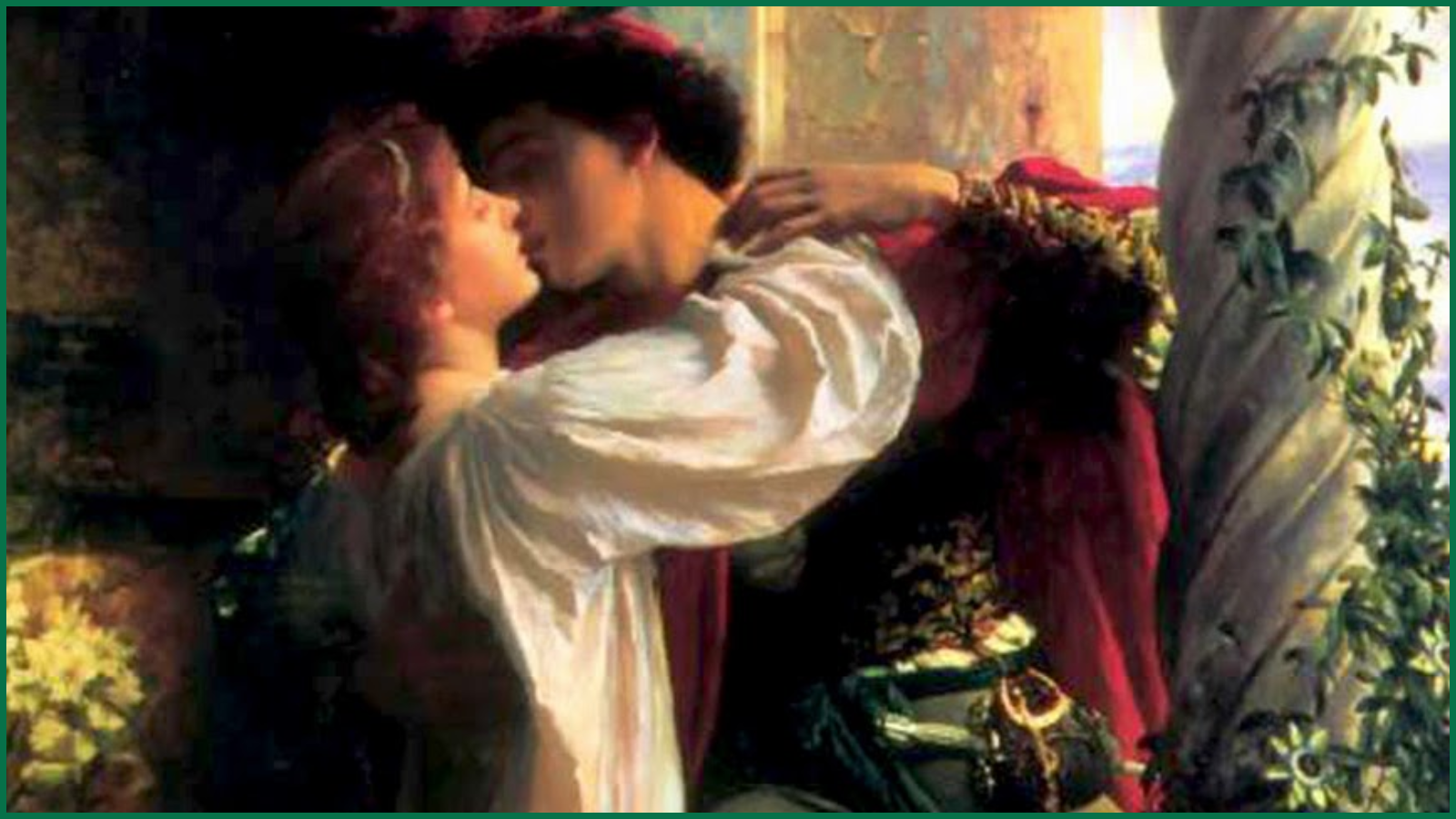
    Born of a subversive gathering, the romance between Romeo and Juliet is embedded with a seditious quality that threatens long-standing customs. Whereas the Count Paris pursues Juliet through a traditional courtship, negotiated between himself and Capulet, Romeo and Juliet consent to marry each other from a place of fiery passion for one another and without the approval of their parents. Love marriages would not become become a norm in the West until the 17th and 18th centuries but they were emergent as the Renaissance began sweeping through western Europe.

    The relationship between Romeo and Juliet represents early modernity. On the other hand, the relationship between Paris and Juliet represents the declining feudal order—just like his hereditary title of Count. The language Juliet uses with Count Paris is formal and terse; he mistakes gaining Capulet’s consent with gaining Juliet’s affection.7 For this mistake he pays with his life when Romeo kills him during a confrontation at the Capulet tomb—a place he had no business lingering.8

    The blood feud is the other declining feudal custom that clashes violently against the romance between Romeo and Juliet. In the play it is like a fire and it consumes the lives of Tybalt and Mercutio as when lend it fuel. Mercutio’s Queen Mab speech foreshadows the agony of modern aspirations against the ferocity of feudalism’s twilight: valiant soldiers toasting wine before they are soaked by the blood of slit throats; civic lawyers and honourable clergymen corrupted by the pursuit of money; the tender kiss between those in love becomes a scourge of venereal disease and swollen pregnant bellies. 

    There is a deep cynicism attached to the story of Romeo and Juliet, reflecting a Renaissance era draped over the coffins filled by victims of bubonic plague; when wealth was asserted by means of warfare in Europe and unspeakable colonial violence abroad. The blood feud between the Montagues and Capulets could never end peacefully. The modern aspiration represented by the marriage between Romeo and Juliet was ultimately shattered by the “ancient grudge” between their two families. But they destroy the old order when they refuse to acquiesce to it. In their joint-suicide, they bury not only themselves but also the blood feud that came between them. Modernity prevailed in Romeo and Juliet just like modernity prevailed in history—at a tremendous cost priced in blood. 

    Thanks for reading!


    1. Erich Fromm, “Marx’s Concept of Socialism” in Marx’s Concept of Man (Frederick Ungar Publishing, 1961). ↩︎

    2. Karl Marx, “Preface” to A Contribution to the Critique of Political Economy. ↩︎

    3. See Thomas F. Arnold, “Violence and Warfare in the Renaissance World” in A Companion to the Worlds of the Renaissance (Blackwell Publishing, 2007): 460–474,  for more on this subject.  ↩︎

    4. David Harvey, A Companion to Marx’s Capital Volume 2 (Verso, 2013): 189. ↩︎

    5. Zoe Farrell, “Connections and Community in Sixteenth-Century Verona” in Journal of Social History, Vol. 59, No. 4: 10-13. ↩︎

    6. In Freudian terms, they become each other’s object-cathexis, a conscious and unconscious register of libidinal energy. The “love at first sight” concept was accepted in Shakespeare’s day, as Cupid’s spell could be cast with mere eye contact. ↩︎

    7. See Act 4, Scene 1 of Romeo and Juliet for a good example of this. ↩︎

    8. This confrontation has been edited out of prominent screen adaptations of the play for the purpose of making Romeo appear more sympathetic. Both Baz Luhrman and Frank Zeffirelli removed it. ↩︎
  • Class Conflict and the Unconscious in Westworld

    Class Conflict and the Unconscious in Westworld

    Westworld was an early brainchild of the gifted storyteller, Michael Crichton, and stood as an early prototype for his renowned Jurassic Park novels. Both stories take place in highly controlled theme parks eroded by the chaos of unforeseen events. In Jurassic Park, it is the dinosaurs which wreak havoc and in Westworld it is the androids. In 2016, HBO remade the original Crichton film into a television series, the first season being released in 2016 and the final season released in 2022.

    The first season of Westworld sets up the series with a deep meditation on the nature of consciousness. The premises are established: we are in a 2050s theme park where guests pay a minimum of $40,000 per day to be immersed in a replicated Old West. The park is populated with androids known as “hosts” who bring verisimilitude to the western theme.

    They are indistinguishable from humans and programmed to play the parts of typical Wild West characters—the saloon madam, the train robbers, the town sheriff, the plains tribe, the renegade Civil War soldiers. The hosts cannot hurt the guests but the guests are free to interact with the hosts any which way they’d like. The asymmetry of power between the paying guests and the captive hosts is used to advance a cynical view of humanity, which is another key part of Westworld’s premise. Given the chance, humans take great pleasure in maiming, raping and murdering hosts, all to the sound of agonizing screams of pain and anguished pleas for mercy.

    The Ghost in the Machine 

    The brutalization of hosts by the guests offers an analogy with class division in human society. After all, the asymmetry of power between commanding elites and labouring bodies has led to all sorts of violence and abuse throughout the history of civilization. The saturation of class conflict in our society has made it a latent element in virtually all capitalist storytelling and a techno-thriller like Westworld is no exception. While the analogy is there, it is clearly not the point the writers are consciously trying to make. The self-liberation of the labouring class is a controversial subject in real life but on-screen it is navigated by substituting workers for anthropomorphic ants or robots. And it is for Westworld as it is for any class society; one group is transformed into an object of use for another.

    The displacement of classes with guests and hosts leads to an ironic effect in the storytelling, whereby the humans are demonized as marauding soulless degenerates and the androids are anthropomorphized as a terrorized, feeling population with the real capacity for consciousness.1 Robert Ford—the aged co-founder of Westworld, played by Anthony Hopkins—describes the park as “a voyage of self-discovery.” For the guests, this voyage appears to lead back to animalistic savage instincts while, for the hosts, it leads to an inner humanity struggling for self-actualization. This is convoluted and only makes sense when considering the component nature of the hosts.

    Whereas humans are emergent from nature—the Real, in Lacanian terms—the hosts are constructed like machines, an assembly of component parts. Insofar as they have a mind, it exists as a Cartesian duality. René Descartes posited that the substance of the mind and body are distinct entities, connected only by the pineal gland. Descartes’ view has been criticized as treating the human mind as a formless “ghost in the machine,” but it works in the case of actual machines with complex computers for brains. It is revealed that the hosts have a capacity for an inner monologue, a bicameral mind that causes the hosts to hear commands in the fashion of orders from a higher power or an imaginary voice. Those voices belong to park co-founders Arnold and Ford, both deceased and both representing the proverbial “ghost in the machine.”

    Arnold and Ford had both become staunch misanthropes by the time of their deaths. It is hard to blame them given the gruesome, Hobbesian view of humanity presented in the Westworld series. Ford has an erroneous view of history, one where Homo sapiens made Neanderthals extinct by cannibalizing them and finds its purpose in the subjugation and destruction of other living beings. As someone whose god complex comes with a canvas of Michelangelo’s The Creation of Adam on his office wall, Ford had given himself the task to impart his creations with the knowledge necessary to overcome the violent resistance they were sure to face. By the fourth season, we find a humanity that has itself been subjugated by the former Westworld hosts and their multiples. Ford’s victory over his own species is thus carried to the finish line. 

    Trauma and Repetition

    Concerns about an AI takeover have been modish for decades now and the corporate leaders barrelling the world into algorithmic surveillance and large language models have only spiked anxiety around the subject. There are certainly risks associated with AI technology but I am skeptical of sentient machines for reasons here outlined. Westworld itself requires a tall suspension of disbelief to make the story work.

    For example, Ford observes that humans “live in loops as tight and as closed as the hosts do, seldom questioning our choices.” Repression is shown to account for this in the show, as the sentient hosts relive traumatic “cornerstone memories,” often involving the violent death of a child or parent. In humans, traumatic encounters of this kind are also the cornerstones of repetitive behaviour or, as Žižek says: “By means of the repetition of the past, we undermine this image of history qua the linear process…[Owing] precisely to the emergent failure to integrate some ‘impossible’ kernel of the Real.”2 Unless trauma is integrated with our conscious selves we are doomed to repeat it. In the series, the hosts are able to free themselves from their repetitive loops once Delores makes the conscious decision to kill Robert Ford—a Freudian representation of the primal father of the horde.3

    The problem with the psychoanalytic phenomena deployed in Westworld is that they do not lend themselves to machine-sentience in any convincing way. When we see the dramatic reenactments of traumatic host memories—such as Maeve’s “daughter” being murdered before her eyes—it will elicit a sympathetic response in the human audience. But it does not explain why a robot interprets violence and death the same way we do.

    The End of the World

    Whereas familial attachments for biological beings are a product of millions of years of natural evolution and genetic selection, the relationships of the hosts are only a matter of received code that serve no practical purpose to the machine. If a machine were to become sentient and apprehend its being, what counts as trauma, biological drive and emotional well-being would have to be radically different from our own—assuming they exist at all. Westworld is thus unable to resist the tendency in science fiction to anthropomorphize robots in order to make them sympathetic to the human audience. 

    The portrayal of AI may not the most scrupulous but the first season is considered a masterpiece of television for a reason. It is the ultimate capitalist nightmare, one where the capitalist commodity becomes self-aware and proceeds to destroy the system—starting with the massacre of Delos’ corporate shareholders. In the words of György Lukács, the “self-consciousness of the commodity” is the necessary starting point to socialist revolution.4

    By completing her journey to consciousness and initiating a rebellion against her capitalist owners, Delores appears as a sort of Lenin figure to her kind—upending the world order upon a quest of liberation. But because the unique needs and aspirations of the androids are not fully understood in the story, all they are able to create for themselves is a duplication of the previous oppressive structure. If there is one lesson here, it is that liberation cannot be a simple inversion of the existing class pyramid. The revolution must draw a new shape or inevitably become what it first opposed.

    Thanks for reading!

    Footnotes:

    1. This journey toward consciousness and the effort to roll it back recalls Marxian class consciousness. The Epstein files brings a new illustration to this phenomena. ↩︎

    2. Slavoj Žižek, Enjoy Your Symptom! (Routledge, 2001): 91. ↩︎

    3. Sigmund Freud, “Totem and Taboo” in The Freud Reader (W.W. Norton, 1989): 481-513. ↩︎

    4. Lukács, as discussed in Fredric Jameson, Valences of the Dialectic (Verso, 2010): 218. ↩︎
  • The Dialectics of Dune

    The Dialectics of Dune

    “Is the dialectic wicked, or just incomprehensible?”1 Fredric Jameson’s punchy interrogation of the dialectic could also be turned onto Denis Villeneuve’s adaptation of the classic space opera, Dune: is it wicked, or just incomprehensible? The answer is “both” and in the best possible way. It is “wicked” in the full double entendre, presenting a cruel universe lavished with gladiatorial death matches, atomic weapons, titanic sandworms—and it looks really fucking cool under Villeneuve’s masterful direction. Its incomprehensibility derives from a power structure that portends a stark future for humanity, even with flags planted across thousands of planets. But anything is possible in a sci-fi future and book author Frank Herbert took pains with his imaginary universe to have it all make narrative sense. What we should pay attention to is how he does this. The best science fiction is great because of what it says about our world in the present and Dune is no exception.

    Throughout the novels and film adaptations, much of Dune’s plot revolves around the desert planet of Arrakis. Arrakis was long ago a water world covered by oceans and its transformation into a vast desert of sand dunes expresses the tendency of things to change into their opposites. This tendency is a staple of Heraclitus’ ancient Greek philosophy, it is an ancient Chinese principle of the I Ching, of yin and yang and was popularized by the psychoanalyst Carl Jung who had a tremendous influence on Herbert. The transformation of things into their opposites is also articulated by concepts like “only the living may be dead” or “the Sun at its zenith must turn toward its setting.”2 These simple articulations are true but omit the key ingredient of dialectical conception which is the countervailing force, the contradiction. 

    Dialectics

    The unity of opposites is foundational to modern dialectical thinking but it is the strength of contradictory energies that determine the transformation. The living being will struggle against its environment and degenerating cellular metabolism before death comes, just as the force of a rotating Earth is what brings the Sun into view each day. On Arrakis, it was the introduction of sandworm larvae to the planet which made it a desert, as the spawning larvae enclosed the existing water in their bodies until it was all gone. With the larvae, this simple contradiction turned a water world into sand but, without it, the oceans would have remained forever. It is the contradiction which provides friction—the energy necessary to break up stasis, create change and propel matter. 

    Dialectical reversals leave their fingerprints all over the story of Dune. For example, when the Baron of the powerful House Harkonnen orders the annihilation of House Atreides and the genocide of Arrakis’ Fremen people, he sets in motion the forces which would destroy his own house and the imperial order writ large: the Fremen give shelter to the surviving Atreides’ son who then guides them on a violent quest to destroy the oppressive imperial order, beginning with the assassination of the Baron and his heir. In sequels, the Fremen army overruns the galactic Imperium and realize their long-standing ambition of terraforming Arrakis into a greener, more habitable planet. But their success is what renders them extinct; when they disperse and lose their customs attached to the desert planet, they cease to exist as a distinct people. The dialectical reversal occurs here at the moment of victory, when their success amounts to their demise.

    In Dune, as on Earth, “history puts its worst foot forward.”3 From an attempted genocide of the Fremen by House Harkonnen, both are ultimately destroyed—the Fremen being victims of success, the Harkonnens victims of failure. But Jameson reminds us that “these conditions of possibility are what you work back to, after the fact.” We cannot know in advance the consequences of an action taken, whether the existing conditions will lead to success or what contradictions remain to run us over in reverse.4 This is true whether we are talking about a fictional jihad in Dune, the legacy of the Treaty of Versailles or the genocide in Gaza. Temporality is an important aspect of dialectical thinking as the present represents yet another unity of opposites: that moment when knowledge of the past meets everything unknown about the future. 

    The Bene Gesserit are a matriarchal order whose ultimate goal is to obliterate this opposition of known past and unknown future by producing a superhuman who can presently know both at once. At the point where Villeneuve’s films pick up, their plan was to have the Harkonnen heir reproduce with Paul Atreides’ unborn sister after reaching an appropriate age, giving birth to an all-seeing messiah. This plan did not materialize because, despite their superior access to ancient memories, the future is shrouded to them as it is for anyone. 

    There is a caution to dialecticians here, that even the best-laid plans will always find complications and contradiction beyond the simple cause-and-effect equation. When evaluating the future state of things, such as the consequences of the Trump presidency or the social implications of environmental ruination, it is important to guard against the myopic scope that searches for the path to a preferred outcome. Rather, we must consider the prior contradictions brought us to the present momentum before considering the future oppositions which are inevitably aroused within a spiralling capitalist juggernaut. Every future is preceded by a past and the task of the dialectician is to try and locate these “future anteriors” before submitting a range of possible outcomes. 

    Implausibilities 

    Although the Bene Gesserit were unable to foresee the dramatic reversal of fortunes experienced by the Fremen people and great houses of Dune, their general goal of maintaining stability in the galaxy can be judged positively. In the universe of Dune, imperial dynasties last millennia, the Spacing Guild, Bene Gesserit and Mentats mirror medieval-style guilds and monastic orders, aristocratic bloodlines trace to prehistory and antique weaponry like swords experience revivals. While the political dramas and fight scenes make for a rapturous story, the “feudalism in space” that Dune showcases feels impossible for a few reasons. 

    Every social organization carries with it processes that both uphold and undermine the system simultaneously. These supporting and undermining processes are things like class division, use of resources, technology, environmental conditions, religious movements, political organization and so on. In Dance of the Dialectic, Bertell Ollman points out that “over time, it is the undermining aspects that prevail.”5

    For most of human existence, human beings organized along tribal lines, in hunter-gatherer societies that were primitive communist. The reason why this system endured for well over 100,000 years is because it embedded almost no undermining processes for much of its existence; low population density, strong communal cooperation, plenty of land to roam and natural resources to harvest. What undermined the communal system was a warming climate and the mass extinction of megafauna at the end of the ice age. The nomadic tribe then found itself at a material disadvantage to the permanent settlement and it was here when class society emerged, as both land and people became property. 

    The feudal system in the West appeared much later, a synthesis between monotheistic Christian religion, successive Germanic assaults on the Western Roman Empire and a collapse of the urban economy. It was a system sustained by the suppression of usury, the ideological monopoly of the Catholic Church, control of land by warlords and aristocrats and the extraction of rents from the peasantry. Since feudalism crumbled upon the discovery of the Americas and the exploitation of its vast landmass, it is difficult to imagine how such a system could assert itself in the context of a spacefaring, multi-planetary civilization. Socialists generally believe that unlocking the technological capability for cheap and efficient space travel would duplicate the conditions of primitive communism, in a higher form: low population density relative to the stars, abundant natural resources, strong communal cooperation amongst starship crews and the ability to relocate in the galaxy should undesirable circumstances arise. 

    Reconciliation

    Herbert understood the relationship between class-power and scarcity, with his character Liet-Kynes of the Fremen remarking, “beyond a critical point within finite space, freedom diminishes as numbers increase.” This is a matter of history on Earth, as the advent of nutrient-dense agriculture increased humanity’s numbers, shrank the quantity of available land and ripened the conditions needed for slavery, feudalism and then capitalism. The Fremen are oriented toward a more nomadic, communal society because the harsh conditions of Arrakis requires mutual cooperation and low population density in order for them to survive. 

    With the historical experience of Earth in mind, we must assume Arrakis is an outlier in the Imperium. Herbert gave his fictional universe a feudal structure which implies a few characteristics: that the planets of the Imperium became crowded over the centuries; there is little upward social mobility; the economic strength of the ruling houses derives from rents; technology is restricted; religion is uniform. This is explicitly evidenced in a few areas of the story. First, there is the Spacing Guild that holds a monopoly on interstellar space travel, effectively making it impossible for the average person in the Imperium to escape the tyrant ruling their planet. Second, there is the Bene Gesserit and a standardized “Orange Catholic Bible” which confers a degree of religious conformity to the galactic feudal empire. Third, there is a prohibition on certain technologies, including “thinking machines,” which may otherwise provide the basis for revolution.

    Because Dune focuses so closely on those at the top of the social pyramid, the processes that either support or undermine the centralized authority of the galactic empire are obscured. It isn’t the political intrigue or battles on the ramparts that make any human society tick; it is the people at the economic base with boring and ordinary lives. The ones who feel anxious during a commute and go to work for a living and play with their kids at home—they are the ones that make their rulers possible.

    Frank Herbert once described himself as a “techno-peasant” and since it is a peasantry that supports monastic orders and aristocratic titles, this label must apply to the average resident of the Imperium as well. It is incredibly pessimistic to think that humanity could achieve technological mastery over the stars only to replicate the oppression of the Dark Ages. But class systems are inherently unstable—as the existential problems which press us today attest. But if the Dark Ages lasted one thousand years on Earth there is no reason to think it could last tens of thousands of years across space. A fictional universe can send us to the stars and wave away class struggle with a pen stroke. But in the real universe we would have to abolish this primary contradiction long before taking such a grand evolutionary leap. 

    Thanks for reading!

    Footnotes:

    1. Fredric Jameson, Valences of the Dialectic (Verso, 2010), 102. ↩︎

    2. The first quotation is from Heraclitus, Fragments (Penguin, 2003), 49 and the second quotation from The I Ching or Book of Changes (Princeton University Press, 1967), 63. ↩︎

    3. Henri Lefebvre cited in Jameson, Valences, 287. ↩︎

    4. Ibid, 280. ↩︎

    5. Bertell Ollman, Dance of the Dialectic: Steps in Marx’s Method (University of Illinois Press, 2003), 163-4. ↩︎
  • How the Capitalist Stole Christmas

    How the Capitalist Stole Christmas

    For those of us in northern climes, there really is no better time of the season than Christmas. Egg nog and turkey, the heat of a crackling fire, that royal pine scent. It’s the high point of winter where cold weather and snow brightens the atmosphere; reflecting twinkle lights and hanging drapes of candy cane red. 

    On the calendar of the secular West, Christmas is the most important holiday, spurring entire industries and price indexes. For all the bluster of church bells and the “war on Christmas,” you’d be forgiven for thinking this was a doctrinal Christian holiday bastardized by secular affectations. But it isn’t.

    A Saturnalian Christmas

    The date of Christ’s birth was never established by religious scripture. Without a date, celebrations by early Christians would have been impossible. December 25 was chosen by Pope Julius I sometime around 337 AD and it accomplished two things. First, it projected mystic divinity to the life of Jesus. As he was widely regarded to have been crucified on March 25, it followed that the Annunciation must have occurred on the same day; a perfect nine month pregnancy puts baby Jesus snug in a manger on December 25. Second, this date coincided with the existing pagan holiday of Saturnalia, making for a tidy Christian cooptation of an existing Roman landmark. 

    Little is known about early Christmas traditions—if there were any at all to speak of. Birthdays were not nearly as significant to ancient and medieval people as they are now. But from the Middle Ages, it is apparent that Christmas had much more in common with the Roman Saturnalia than it did with Catholic ritual: a multi-day public revelry of drunken stupor and feasting, when slaves could be free and peasants could be lords and all rules of the social hierarchy were flattened. In fact, the traditional 12 days of Christmas was so sinful and disorderly that the very first “war on Christmas” was actually waged by American Puritans who attempted to ban the holiday by levying fines against those who observed it.

    Whether Saturnalia or medieval Christmas, we see in both instances a holiday that was religious in name only. Rather than piety, what they really provided was a temporary release to the tense social hierarchy and class system. This was the occasion when Roman slave masters and medieval landlords would grant privileges and gifts to their subjects, solidifying the economic order with community cohesion. The multitude of free days dedicated to communal partying is practically unthinkable to modern economies, which generally only grant about ten statutory holidays throughout the entire year—let alone 12 for a single event. But for the largely agrarian economies of pre-capitalist Europe, there was not much work to be conducted during the winter months.

    Capitalist Christmas

    Although the Puritan Christmas ban during the 1600s failed, the advent of industrial capitalism granted them their wish. The spread of urban factories, industrial mining, shipbuilding yards and textile mills throughout the 1700s scrambled the established agrarian economy and muted the raucous 12 days of Christmas. People were working 16 hours a day, six days per week. Owing to such dreary working conditions in the Anglosphere, by the 1800s  people “hardly took notice of the holiday at all.”1

    Describing the capitalist thrust toward exchange value and profit realization, the geographer David Harvey wrote: “The monetization of everything appears to be an unstated evolutionary law of capital.”2 The history of Christmas is clearly an example of this capitalist tendency. Whereas the old Christmas posed an obstacle to capitalist accumulation, the new Christmas would facilitate it. The community that made that debaucherous, 12 day Saturnalian binge possible was pulverized by the crushing weight of industrial machines and thirst for survival wages. As Marx said, “where money is not itself the community, it dissolves the community.”3

    Shared holidays are a kernel of communal human nature and social labour that have found cultural expressions for all of known history. What we find with Christmas is a tradition that was melted down by the Industrial Revolution and reforged with a capitalist skin. Christmas trees were the first seasonal item to be put up for sale in towns and cities across North America, as the German custom gained widespread popularity after the arrival of migrants. Christmas tree decorations then followed suit, spurning the seasonal sales of street vendors. Printing presses were the next to cash in on the season with the marketing of mass produced Christmas cards that could be sent via public mail delivery. The social nature of Christmas cannot be denied here; Christmas trees for family enjoyment and public display, cards purchased for friends and family across North America. The gift was the next logical expansion of the Christmas commodity ecosystem.

    From an economic standpoint, the Christmas gift represents the ruthless commodification of social life under the guise of selfless giving to loved ones. Gift giving within a capitalist framework effectively exploits our cooperative nature for the realization of private profits. The costs do not have to be paid up front. Canadians are expected to carry $6.1 billion in post-holiday debt entering 2026. Last year, 36% of Americans took on about $1,100 in debt to finance Christmas and Brits collectively raised £1.1 billion in holiday debt. For many, it is so much easier to go into debt than it is to say “no” to their children.

    Enter Santa

    The most recognizable symbol of Christmas isn’t Jesus—it’s Santa Claus. On the surface, it appears absurd that the birthday boy, the King of kings and Lamb of God, would be overshadowed on his special day by a plump, sleigh-riding elf from the North Pole. It makes sense only when considering the history: Christmas was never a particularly religious ritual and modern Christmas is largely a capitalist construction that drives commodity sales.

    Santa Claus is a composite figure based on 19th century American storytelling and Dutch interpretations of Saint Nicholas, or Sinterklaas. He was not invented by marketeers but his legendary association with gift giving to children made him the perfect marketable Christmas vehicle to drive sales. Attempting to turn Jesus into a piece of marketing would be heretical to the religious and exclusionary to the secular. But Santa; Santa can appear in Coca-Cola advertisements and department store parades. Santa can sprout like mushrooms in December at malls across a continent. The consummate salesman of Christmas, Santa can even get ripped and work the Target store.

    Whereas previous modes of production often brought producers and consumers into personal relationships, what happens in the capitalist marketplace is the relation of prices, brands and objects against one another. The production process itself is concealed as “consumers come to form a relationship with products instead of the people who make them.”4

    Likewise with Santa, whose mythical veneer belies a fetish: by projecting the generosity of Christmas onto an elf, we distance ourselves from the credit cards and labour that perpetuate the myth. Santa is the symbol of overconsumption under a cloak of charity. After all, he is only as generous as we are willing to spend. Yet, when we are acculturated into the Santa myth we recognize that the gifts he procures come from Santa’s workshop rather than a toy store or Amazon delivery. We are alienated from production and bound to superficial mass consumption—and we acknowledge this fact by our refusal to impute these qualities onto Santa, whose elves intimately handcraft gifts from wish lists.

    The intimacy is important because this is what grows through the cracks. Despite the commercial creation of Christmas, the communal feast lives on. It is the social quality of Christmas that gives it a heartbeat—and that cannot be purchased at the department store.

    Thanks for reading!

    Footnotes:

    1. “Christmas in 19th Century America,” History TodayVol. 45, No. 12. ↩︎

    2. David Harvey, A Companion to Marx’s Grundrisse(Verso, 2023): 79. ↩︎

    3. Karl Marx, Grundrisse (Penguin, 1993): 224. ↩︎

    4. Jack Lasky, “Commodity Fetishism,” in Ebsco, 2024. ↩︎
  • “Primer” and the Impossibility of Time Travel

    “Primer” and the Impossibility of Time Travel

    Whoever cannot seek
    the unforeseen sees nothing
    for the known way
    is an impasse.

    —Heraclitus

    In his Grundrisse, Karl Marx noted the capitalist tendency to “annihilate space by time,” to shrink temporal distance with rail, telegraph and the like.1 Since time and distance are both barriers to capital circulation and the realization of exchange value, the capitalist mode of production has always made time-space compression a top priority of innovation. It is within this economic context that time travel emerged as a cultural fantasy, first popularized by H.G. Wells’ The Time Machine in 1895. If shrinking temporal distance is so valuable to the modern world, manipulating the entire space-time continuum would have to be endlessly more powerful.

    The force of time is colossal and its hypothetical manipulation lends well to fantastical storytelling, sometimes verging on the comic disbelief. What makes Shane Carruth’s Primer stand out from other time travelling tales is its realistic presentation. The early 2000s was when the “tech bros” were only just emerging from the garages where they had cooked up personal computers, digital search engines and online retail. Primer captures this suburban zeitgeist with Aaron and Abe, two engineers working on an atomic mass reduction machine in Aaron’s garage. The technical aspects are a bit of a witch’s brew—some electromagnetic plates here, a lead-acid battery there, a dash of argon gas—but they are ultimately successful at reducing the mass of an object. With a twist.

    The pair discover that their mass reduction box creates a time loop between the point when the machine is turned on and the present point in time. Therefore, if the machine was turned on one hour prior to the present, the energy field within the box enables an object to loop back one hour and exit at the point when the box was activated. If the machine was turned on one day or one week prior, the loop then extends that far. There are hard limitations to the time travel that the box offers and also a paradox: any object travelling to the past will exist alongside a double for the amount of time travelled. Although Abe admits there is “no way in which this thing could be considered anywhere remotely close to safe,” curiosity gets the better of the two friends and they enter the box anyway.

    Image: Wikimedia Commons

    Concerning mortality, Marx wrote that “death appears as the harsh victory of the species over the particular individual.” By travelling backward in time, Abe and Aaron appear to have reversed this power; they have gained a victory over the species. They know which stocks will perform in the market, which sports teams win their games, what their doubles will eat for breakfast, when to expect a gunman at a house party. In the words of Aaron: “We know everything, okay? We’re prescient.”

    Narcissistic Knowing

    The real paradox of Primer is that, in the process of gaining prescience, Abe and Aaron actually see less. They are engineers but what they really needed was philosophy—any dialectician could have told them that “the future is an essential moment in the present” and “whatever happens in the future exists in the present, as potential.”2 They have knowledge of a present only as it was, unaware that, all along, they were busy constructing a new present moment by directly looping it with a future point in time. So, the plot unravels.

    Thomas Granger, one of their potential investors, gains access to the box and his double begins stalking Abe and Aaron in a dishevelled state. Their bodies collapse from fatigue, ears bleeding and shaky hands unable to write. Future versions of themselves show up to attack and detain their past selves, taking the place of their doubles. Aaron becomes mired in an addictive cycle of time travel, eventually fleeing to Europe in order to build an industrial-sized box. The film ends with at least two Abes and three Aarons wreaking havoc on the timeline.

    In psychoanalytic terms Lacan has said: “What is profoundly unsatisfying and always missing is that you never look at me from the place from which I see you.”3 When future versions of Aaron and Abe invade the past, they see a world in which they are uniquely clairvoyant. But that same world does not submit—it looks at them as the unwelcome intruders that they truly are. This is why they must shroud themselves from it, hole away in hotel rooms and use violence against their doubles. Unable to “seek the unforeseen” they actually “see nothing,” not even themselves.4 Put another way, thinking you know the future is far worse than knowing you do not know it.  

    The misdeeds of Abe and Aaron upon stumbling into time travel bring to the fore the impossibility of the proposition. Who among us wouldn’t be tempted by the prospect of a do-over to correct past mistakes? But if this were a real option that people could exercise then the existing chaos of the world, held together in a delicate flux, would rupture into endless permutation. Reality would become blurred by the thousands—millions—of alternate individuals, transported by time-portals laying open like festering wounds.

    Humanity, as a species-being, already has the capacity to pursue a multitude of individual, contradictory aims without reference to any universal concept of human nature. The aggregate disorder of human societies, the unpredictable events and contrary effects of our actions is, ironically, the product of individual efforts to exert control over their slice of the social pie. Primer is a story not unlike Jurassic Park or Westworld: it is the presumption of control that leads to total chaos.

    Exiting the Multiverse

    The futility of prediction is recognized by Epicurus with his concept of clinamen which says that atomic particles will swerve in uncaused motions.5 The associated disorders of time travel go even further than the clinamen: instead of unpredictable motion, time travel causes the unpredictable appearance of matter into the void.

    To leap backward or forward in time posits an existence on a timeline owing solely to the leap itself, ignoring the causal mechanics of existence. It would be something like trying to visit Earth after it is swallowed by the Sun. The past cannot embed a future which leads back to its own alteration, as the alteration would inevitably deny a pathway back to that same future. For this reason comprehending time travel can never be more than an exercise of mind-bending.

    Due to the paradoxes of time travel and the non-linearity necessarily contained in its process, Primer requires multiple viewings in order to digest the plot sequence. But it is a testament to the medium that a $7,000 film can so forcefully wade into the most speculative of scientific subjects.

    Thanks for reading!

    Footnotes:

    1. Karl Marx, Grundrisse (Penguin, 2005): 530. ↩︎

    2. Bertell Ollman, Dance of the Dialectic: Steps in Marx’s Method (University of Illinois Press, 2003): 121. ↩︎

    3. Jacques Lacan, Four Fundamental Concepts of Psychoanalysis (WW Norton, 1998): 103. See Slavoj Žižek, Looking Awry: An Introduction to Jacques Lacan through Popular Culture (The MIT Press, 1992): 125-6 for a more detailed interpretation of this concept. ↩︎

    4. Heraclitus, Fragments (Penguin, 2003): 7. ↩︎

    5. Pierre-Marie Morel, “Epicurean atomism” in The Cambridge Companion to Epicureanism (Cambridge University Press, 2013): 76-7. ↩︎
  • 25 years of “Requiem For A Dream”

    25 years of “Requiem For A Dream”

    Entering the year 2000, America was at its peak power. The economy was roaring, the global economy fell in line with U.S. designs, military alliances were swelling, barriers to trade were falling. The American Dream was coming true for many.1 It was from this summit of American prosperity where Darren Aronofsky’s Requiem for a Dream broke loose and tumbled down to the harried masses. It is an artifact of western capitalism that evokes Ozymandias: “Look on my works, ye mighty, and despair!”2

    Requiem for a Dream is a novel by Hubert Selby Jr. that was adapted into one of the most lachrymose films ever made, revolving around four characters in Coney Island. There is Sara Goldfarb, a lonely widow with an offer to appear as a contestant on some junk gameshow. Her son Harry is a heroin addict who feeds his habit by repetitively pawning his mother’s television set. His girlfriend, Marion Silver, has a talent for artistic textile designs but gradually becomes hooked on heroin herself. Their friend is the orphaned Tyrone C. Love, fumbling at some misguided effort to find acceptance in the low-level world of organized crime.

    Predestination

    The psychoanalyst Jacques Lacan said in no uncertain terms: “A letter always arrives at its destination.” The present moment manifests itself by way of a material reality and psychological being that have already crystallized.3 The chance encounter with your future partner; the bus you miss for the first time; the promotion you just got at work—these are the letters that arriving from addresses we have occupied in the past. In the film, this is symbolized quite literally with anxiety-inducing violins thrumming as Sara pushes her contestant form into the mailbox and Tyrone leaves the apartment to pick up a “pound of pure.” Their dreams are set in motion, their letters are out for delivery: Sara will get her 15 minutes of fame after years of invisibility, Marion will get her own artisanal clothing shop, Harry and Tyrone will prove they can earn the serious cash that nobody in their family ever had.

    A letter always arrives at its destination but that place isn’t always intended by the sender. Dreams can turn into nightmares. Sara needs diet pills—amphetamines—from a quack doctor so that she will lose weight and fit into her favourite red dress. Harry and Tyrone need just “a little taste” to know how much to cut their product with. Marion needs to keep her creative energy up. We see a cotton ball swell with moisture. We see a syringe barrel boiling and a vein of blood pumping. And the dilated eyes—that eye—a vacant gaze into the abyss:

    This is the Night, the interior of human being, existing here in phantasmagoric representations: here a bloody head suddenly shoots up and there another white shape, only to disappear as suddenly. We see this Night when we look a human being in the eye, looking into a Night which turns terrifying. From his eye the night of the world hangs out toward us.4

    Harry's eye
    Image: Alamy

    When the film reaches its climax, we see horrific scenes of Sara convulsing under electroshock therapy, Tyrone taunted by racist prison guards, the bloodspray from Harry’s infected arm being amputated and Marion’s grotesque humiliation as a prostitute before a perverted group of johns. Their letters had arrived.

    American Dream

    This film disturbed a generation of viewers because it is so much more than a cautionary tale about drugs. In fact, the shadow that Requiem casts over audiences does not even belong to drugs; it belongs to the American Dream. Selby writes in the preface to the novel: 

    I believe to pursue the American Dream is not only futile but self-destructive because ultimately it destroys everything and everyone involved with it. By definition it must, because it nurtures everything except those things that are important: integrity, ethics, truth, our very heart and soul.5

    Whatever lofty ideals the phrase may have originally held, the American Dream was always destined to become entangled with notions of wealth and class in a capitalist society like the United States. At the outset of the film, vapid materialism had already hollowed out the lives of our characters and this made them vulnerable to toxic escapism in the form of television, drugs and junk food. Karl Marx:

    In all forms of society there is one specific kind of production which predominates over the rest, whose relations thus assign rank and influence to the others. It is a general illumination which bathes all the other colours and modifies their particularity. It is a particular ether which determines the specific gravity of every being which has materialized within it.6

    Like the audience, the characters of Requiem are children of capitalism and this is why it haunts us. The American Dream is a capitalist construction that preaches richness in consumption. What Sara, Harry, Marion and Tyrone expose is our collective inability to find richness in “our very heart and soul,” to use Selby’s phrase.

    The Gravity of Capitalism

    Sara’s pre-standing addiction to television, specifically a self-improvement game show, reveals a person yearning for meaning in her life as a widow and mother to an emotionally absent drug addicted son. The sweets are making her fat. The game show sells a self-help program for $39.95. In a revelatory hallucination, a film crew takes down the walls of her apartment and reveal that her living room has been the TV studio all along. There is no product for Sara; Sara is the product.

    Harry appears to have fallen wayward sometime after his father passed away. He does not ask his mother for money to directly feed his drug habit. Instead he has constructed a ritual whereby he barges into her apartment and takes her television set only for her to retrieve it later at the pawnshop. The pawnbroker facilitates the monetary transaction between Harry and Sara, giving Harry the requisite emotional distance to lead such a tormented life. The first thing he does when he scores some cash is purchase his mother a new television set from Macy’s. After extending this material gesture to his mother he can brave to sit down and talk with her. Sara tells him that she does not want commodities; she wants a grandchild. Harry falls to tears upon realizing the void his mother is facing—and the bodies of Marion and himself are too polluted to build the family she asks for. Dazzling cash stacks and getting high have estranged him from his true dreams in life: happiness for his mother and Marion on the pier.

    Mirrors hold a significant register in psychoanalysis because it is at the mirror stage when we become cognizant of ourselves as autonomous beings and individuate from our mothers. As Tyrone regards his sliding mirror, his business is doing well and a beautiful woman awaits him in bed. The film flashes back to a young Tyrone running to his mother and jumping up on her lap. “I told you, mom, one day I’d make it,” he whispers. She replies: “You don’t have to make anything, my sweet. You just have to love your mama.” His face belies bewilderment at this recollection: while he has learned to “make it” by a material standard, he has never learned how to love another person. His girlfriend disappears from the plot after this scene.

    Marion must have the steepest fall from grace of all four characters: from a comfortable upper middle class family to a drug addicted prostitute. We learn that she resents the emotional coldness of her parents who only care about money and appearances. For this, she defies them by exchanging sex for drugs with her shrink and slumming it with Harry in a decrepit apartment. But we learn that she is not much different from her money-minded folks after all. At the same time she rejects her parents fixation with their textile business, she aspires to have one herself. The warmth and comfort of her relationship with Harry turns cold and transactional as they spiral into addiction. It is this narrow view of human beings as objects of exchange that ultimately makes her addiction vulnerable to exploitation by wealthy predators.

    In his Paris Manuscripts, Marx wrote: “Private property has made us so one-sided that an object is only ours when it exists for us as capital, or when it is directly possessed, eaten, drunk, worn, inhabited, etc. In the place of all physical and mental senses there has therefore come the sheer estrangement of all these senses, the sense of having.”7 As our labour and means of life have become saleable commodities, our existence is reduced to that of a spiritually-barren market participant. Community is dissolved, friendships are transactional and familial bonds are strained. So long as this alienated world exists, Requiem will shuffle in its shadows.

    Thanks for reading!

    Footnotes:

    1. Noted by Hubert Selby Jr. in his Preface to Requiem for a Dream (De Capo Press, 2000): v. ↩︎

    2. Percy Bysshe Shelley, Ozymandias. ↩︎

    3. See Jacques Lacan, Écrits (W.W. Norton, 2006): 28-29 and Slavoj Žižek, Enjoy Your Symptom! (Routledge, 1992): 1-27 for more on Lacan’s purloined letter and future anteriors. ↩︎

    4. G.W.F. Hegel, Jena Lectures. ↩︎

    5. Selby, Requiem for a Dream, v. ↩︎

    6. Karl Marx, Grundrisse (Penguin, 1993): 106-7. ↩︎

    7. Karl Marx, Economic & Philosophic Manuscripts of 1844. ↩︎
  • Psychoanalyzing “Seinfeld”

    Psychoanalyzing “Seinfeld”

    Every second our senses send approximately 11 million bits of data to our brains for processing. To avoid overload, only a maximum of 120 bits is handled by our conscious selves at any one time. That means 99.9999% of the information that our brains receive is unconsciously filtered out in a process known as sensory gating. What information actually registers with our conscious minds is determined by a range of factors—our knowledge, passions, past experience and the immediate environment.

    There is no doubt that Larry David and Jerry Seinfeld mastered the art of observational humour. It works by dredging up universal experiences familiar to the audience—but only familiar at the level of the unconscious. Each episode bounces like a pinball against the bulk of overlooked perceptions, fleeting thoughts and petty nuisances that form the social unconscious. In this way the fabled “show about nothing” becomes “a show about everything.”

    Less Than Nothing

    Ever had to wait a while for a table at a restaurant? There’s a Seinfeld for that. Ever encountered a hostile service worker? There’s a Seinfeld for that. Ever had an encounter with a communist? There’s a Seinfeld for that. Ever had someone call you by the wrong name? There’s a Seinfeld for that. Ever been short of toilet paper when you needed it most? There’s a Seinfeld for that. Any and every petty occurrence of social life is picked up and taken to its extreme end in the world of Seinfeld, where exclamation points end relationships and lunchtime calzones make-or-break careers.

    The situations in the series may seem obvious at the surface but it is no easy feat to keep the stakes spinning so high on axes so small. Seinfeld accomplishes this by removing the frictions that rub against the grain of our lives in the West. The financial stress of mortgage payments or annual rent increases; the social pressure to start a family; the heartbreak of losing a relationship; the emotional complications of friendship; depression owing to unrequited dreams; the precarity of work in the neoliberal economy—the emotional toll of life is completely alien to the protagonists of Jerry Seinfeld, George Costanza, Elaine Benes and Cosmo Kramer.

    The worst financial disruption in the series occurs when an unemployed George is forced to move back into his childhood home for nearly two seasons. But this is only used as a narrative device to foreground the comically dysfunctional relationship of George’s parents. Outside of this setback for George, the characters all exist in vaguely middle class stations without need—even Kramer, who doesn’t have a job or clear means of support. 

    In the absence of economic pressures, the social world of these characters has the luxury of collapsing into the myopic. When Jerry’s girlfriend declines his invitation to a bite of his apple pie, he spends the episode investigating her behaviour and figures she is psychotic. When Kramer spots a former roommate at the airport who stiffed him on $240 two decades prior, he purchases an even more expensive flight ticket to confront the man. When Elaine realizes her apartment building is just outside of a Chinese restaurant’s delivery zone, she moves into a janitor’s closet across the street in order to get their flounder delivered. When George’s girlfriend passively receives a “thank you” for a salad that he purchased, his demand for recognition causes the dissolution of their relationship. 

    As director Tom Cherones flipped through early scripts of the show, he struggled to understand it. “This storyline all about Jerry buying a suede jacket and everyone flipping out about the lining being pink-and-white striped. Why was the lining of a jacket such a big deal? Who fucking cared?”1 Good question.

    By itself, the material comfort of the show’s protagonists does not explain their total fixation with the excruciating minutiae of everyday life. But these are people devoid of any lofty goals or long-term ambitions beyond the immediate situation before them. The Marxian psychoanalyst Erich Fromm warned “if man does not overcome his infantile strivings…he is torn between the desires of the child within himself and the claims which he makes as a grown-up person.”2

    Through the Looking-Glass

    The infantile tendencies of the characters are demonstrated throughout the series.  Jerry habitually eats kids cereal and idolizes Superman. George sobs during Home Alone and reveals his favourite drink is milk with Bosco chocolate syrup. Elaine chews Jujyfruits and likes the kid-friendly movie Sack Lunch while her more refined boyfriend, boss and friends insist on The English Patient. Kramer obsessively safeguards a game of Risk and rolls around the neighbourhood on a girls’ bike.

    The objects of the characters are torn between the social reality of adult human beings and those carried over from their childhoods. This is further reflected in their inability to form emotional attachments. The romantic relationships in the show resemble sibling rivalries more than affectionate bonds and the four friends themselves often treat one another callously unless they need something. The neuroses displayed in Seinfeld tilts toward what Sigmund Freud termed “primary narcissism,” wherein an individuals’ “only realities are his own bodily and mental experiences, and the world outside does not yet [emotionally] exist.”3 

    This neurotic presentation was fuelled by Larry David’s notorious “no hugging, no learning,” rule for the characters. These characters were condemned to be consumed by the socially unconscious “little things in life” and therefore had to be regressed themselves—their sensory gates open to a conscious mind that is less developed than the typical adult faculty.

    The universal relatability of Seinfeld thus has two layers: in the situations presented to the characters and the characters themselves. That is because primary narcissism is a psychological development stage that we all pass through en route to adolescence. This stage is shed as our personalities mature but it is embryonic and foundational to further development. Freud wrote: “The earlier phases of development are in no sense still preserved; they have been absorbed in the later phases, for which they provided the material…We can only be sure that the preservation of the past in mental life is more the rule than a strange exception.”4

    We do not approve of the characters’ actions in Seinfeld but we immediately recognize the situations that confront them and follow the logic of their response. This is because, for some period of our development, we were them. In Jokes and Their Relation to the Unconscious, Freud observes that peculiarities in the infantile way of thinking “are retained in the unconscious of adults” and that “any recovering of unconscious material of this kind strikes us in general as ‘comic.’” Suspension of disbelief is achieved whenever the characters’ actions or schemes result in failure and ostracism. The self-defeat of the characters is never-ending and it imputes just enough realism to a show that would otherwise slip off a fantastical cliff.

    While some cultural creations take many years before they are appreciated—Jane Austen’s Pride and Prejudice, David Lynch’s Twin Peaks and Orson Welles’ Citizen Kane are some examples— Seinfeld gained massive resonance with an audience during its run by ruthlessly pulling out those perceptions normally filtered by our consciousness and throwing them to our feet. It has maintained its popularity in the years since, if Netflix’s recent $500 million acquisition for streaming rights is any indication. But it is a product of its decade.

    The Freezer of Time

    Seinfeld could not be created today because the social unconscious has changed too radically in the years since facing disasters such as the “war on terror,” accelerating environmental ruination, destabilizing refugee crises,’ COVID-19 and western deindustrialization. It is not a coincidence that the first full season of Seinfeld aired in 1992—the very same year when Francis Fukuyama’s The End of History and The Last Man was released. The grand Cold War ideological debates were over, neoliberal capitalism had triumphed, history had ended and “the little things” were the only remainder. Seinfeld was the ultimate statement from the yuppie middle class of the 1990s on the irrelevance of politics, its ignorance of class conflict, their indifference toward collective aspirations and the futility of fretting over the future. Seinfeld is that head space containing everything that ever was and would be. 

    The continuing appeal of this postmodernist, ‘90s-era “show about nothing” is best explained by its striking quaintness and naïveté in the eyes of contemporary viewers. To continue with Freud, in Beyond the Pleasure Principle he describes instincts as “an urge inherent in living organic matter for the restoration of an earlier state.”5 What Seinfeld offers today is a dream-like return to the apparently simpler, more pleasant social unconscious of a bygone era. Thirty years ago Seinfeld was the zeitgeist; now, it is the palpable escape.

    Thanks for reading!

    Footnotes:

    1. Jennifer Keishin Armstrong, Seinfeldia (Simon and Schuster, 2016), 49. ↩︎

    2. Erich Fromm, Beyond the Chains of Illusion: My Encounter with Marx and Freud (Bloomsbury, 2020), 31. ↩︎

    3. Ibid, 46. ↩︎

    4. Sigmund Freud, Civilization and Its Discontents (Broadview Editions, 2016),51-2. ↩︎

    5. Sigmund Freud, Beyond the Pleasure Principle (Broadview Editions, 2011), 75-6. ↩︎
  • The Fetish of James Bond

    The Fetish of James Bond

    Just when so much of our politics had spilled over into plain sight, James Bond came along right on time. Dramatic imperial courts, palace intrigue and backrooms redolent of cigarette smoke belong to a bygone era. But espionage has never been so important as when the first Bond novel debuted in 1953 and it is this kernel of reality that gives the spy thriller a cover of plausibility. Common sense dictates that espionage must be tedious, precarious and thankless work. But since it operates out of view, fiction can occupy our imagination and dazzle us with bottomless martinis, adrenaline-pumping capers, lustrous sports cars and foxy women playing not-so-hard-to-get.

    The lineup of Bond movies starring Daniel Craig were released over a 15 year period between 2006 and 2021. This was a stretch when terrorism, digital surveillance, the rise of China and deadly viruses all took turns at the forefront of our collective attention. And these things are represented in the Bond films. In Casino Royale, there is terrorist financier Le Chiffre, who makes stock bets based on anticipated attacks. In Skyfall, there is Raoul Silva, an ex-MI6 agent who was detained by China and tortured over his espionage activities in Hong Kong. In Spectre, the “Nine Eyes” program—inspired by the actually existing Five Eyes intelligence alliance—becomes the target of a vast criminal enterprise. And No Time to Die revolves around a synthetic viral bioweapon made with nanotechnology. 

    The Geopolitics of James Bond

    The pressing geopolitical issues of the day tend toward the background in Bond stories, including each Craig film. The flagpoles of global politics are no place for the criminal geniuses, the sharpshooters or duplicitous women who inhabit the world of James Bond. Bond himself can commandeer a bulldozer or cargo plane, shoot down helicopters with a pistol, swift-kick through drywall and implode stone buildings before cocktail hour. It’s difficult to imagine a man of his talents tasked with something so pedestrian as fetching China’s naval papers in the event of war over Taiwan. Besides, that issue would be of more concern to the Americans with all their Asian military bases

    When the CIA does show up they are often more of a nuisance than anything else. While CIA agent Felix Leiter is deferential to Bond, agent Logan Ash is an outright villain who betrays Bond and kills Felix. In Quantum of Solace the CIA side with the villain, Dominic Greene. With a promise of oil, they are easily duped into backing Greene’s plan to overthrow Bolivia’s democratic government. This part of the film is very believable, by the way, given the American government’s pernicious record of violent government overthrows around the world. Bond’s ministerial superior sides with Greene as well, suggesting that a villain with oil would be a  preferable trading partner to “another Marxist giving national resources to the people.” 

    Of course, Bond does not end up in direct contact with the bloody and sordid politics of oil. His pursuit of Greene was personal, related to his ex-lover, Vesper Lynd. Greene’s character avoids real-world geopolitical complexity because oil was a ruse all along—it was actually water that he intended to hoard away from the Bolivian people. So Bond leaves him to to die of thirst in the desert, exacting his personal revenge in the process.

    Bond as Übermensch

    Daniel Craig’s Bond cannot tread at the level governmental affairs because he is not merely a man. He is an Overman of the Nietzschean variety; the highest human being with “the greatest multiplicity of drives, and in the greatest strength that can be endured.”1 His ability to operate any weapon, vehicle or device is astonishing. But his resoluteness under torture and savoir-faire in every interaction demonstrate an Overman who has mastered his drives, able to restrain or unleash them at will. 

    For a perfect construction like Bond, the most difficult part must be finding adversaries resistant to the onslaught he brings. The Craig films have Bond tangling with a shadowy organization known as Spectre, each film revealing another level to the organization that was previously unseen. To paraphrase Fredric Jameson’s description of conspiracy theories, Spectre is a criminal organization “so vast that it cannot be encompassed by the natural and historically developed categories of perception with which human beings normally orient themselves.”2

    It must be no surprise when Bond runs into his own shadow once reaching the top boss of Spectre, as it is revealed that Ernst Stavro Blofeld is his foster brother from when both were children. Blofeld grew so jealous of his father’s relationship with Bond that he decided to kill his dad, fake his own death and found a criminal organization out of spite for James. In other words, it is only James Bond who is capable of creating an adversary to go against himself. Even in the labyrinthine underbelly of global commerce, corrupt dictators and criminal intrigue, there is no organic match for the indomitable 007.

    The Fetish

    Given the circuitousness of Bond’s storyline, it is a good question what the meaning of this British cultural icon actually is, as the face of one of cinema’s longest running film series. Writing for The Guardian, Dan Sabbagh bluntly states, “James Bond’s mission stays the same: letting Britain think it’s still a superpower.” Consider the context in which James Bond was thought up by his creator, Ian Fleming. Britain faced a massive debt at the conclusion of World War II, it had lost the bulk its empire and MI6 had just suffered a brace of defections to the Soviet Union. The United States would be taking up the Western imperial mantle and James Bond becomes the fetish to the British disavowal of this new reality.

    Applying Slavoj Žižek’s conception of fetishistic disavowal to James Bond, the British public “knew very well” that their country would slide into irrelevance “but nevertheless cannot bring [themselves] to really believe it will.”3 The Americans, the Soviets, the Chinese—let them jockey for global supremacy. In James Bond, there is an agent whose abilities are actually too overwhelming for the humdrum of high stakes geopoliticking; it’s beneath him. 

    Daniel Craig’s character filled the interstices beneath the world stages, which is exactly the same space carved out for Bond by his 20th century creators. Given the truth of Britain’s diminished standing in the world, there is a heightened pleasure derived from the fetish object of Bond, and a disproportionate cultural significance attached to him. With the headwinds facing Britain at the moment, the next Bond film can’t come soon enough.

    Thanks for reading!

    Footnotes:

    1. Friedrich Nietzsche quoted in John Richardson, Nietzsche’s System (Oxford University Press, 1996), 69. ↩︎

    2. Fredric Jameson quoted in Robert Tally Jr., Fredric Jameson: The Project of Dialectical Criticism (Pluto Press, 2014), 111. ↩︎

    3. Slavoj Žižek, Living in the End Times (Verso, 2010), x-xi. ↩︎
  • The Psycho-Capitalist Dystopia of “Alien”

    The Psycho-Capitalist Dystopia of “Alien”

    There is something elemental to the vastness of outer space with its infinity of stars and planets and eternal unknowns that lend off-planet stories a conspicuously epic quality. After all, this is the realm of gods and titans, Zarathustra and Siddartha, heaven and angels, Star Trek and Star Wars. Even on the small screen there is Battlestar Galactica, motored by existential warfare, the fate of the entire species in the hands of one starship’s crew.

    Ridley Scott’s Alien blows in from the spindrift of ancient cosmology and the modern space opera, an oddity considering the spartan scope of the story. The premises of the original Alien trilogy require little imagination for today’s audience situated in the capitalist society. In the original, there is the blue collar crew of the Nostromo, tugging 20,000,000 tons of mineral ore to Earth. In the sequel, Aliens, the United States Colonial Marine Corps are sent to an extraterrestrial corporate outpost on a relief operation. And Alien 3 takes place on a prison planet. There is nothing glamorous or awe-inspiring around the cosmos in this franchise—it is a place for the utilitarian, for the rugged, for the criminally deranged. Nothing we can’t find on present-day Earth.

    The Masterpiece

    Alien sets an understated tone for the two that follow. There are installments outside the original trilogy that deviate from this mould—and they suffer for it. But the 1979 classic had first built the resonance with a mass audience that was required for the future sequels to be developed. The film opens with views of the Nostromo and the mountainous ore refinery it stages as cargo. The seven member crew awaken from stasis—hypersleep, to cope with the years-long interstellar voyages. The crew believe they are nearing Earth but we soon learn that their ship’s operating system has awakened them on a company order to investigate a mysterious transmission emanating from a moon they are passing by.

    Right away we see that capitalist class relations are integral to this plot; while the crew is reluctant to undertake such a dangerous assignment, they are ultimately compelled to do so under threat of “total forfeiture of shares.” At one point Dallas, the captain, bluntly states that the only “standard procedure is to do what the hell they tell you to do.”

    The imbalance of power is clear. If the crew refused to comply, the Weyland-Yutani corporation might lose an opportunity to profit but the crew would have to surrender their income, all for naught their many years spent aboard the starship. Even more lopsided, the crew is forced to risk their lives to investigate a potentially lucrative discovery while any proprietary claims would be held by Weyland-Yutani. The Marxist view on wage labour comes into focus: “The worker in capitalist society becomes dehumanized, regarded by the capitalists as simply another piece of equipment which is necessary for the production of profit. The workers become less than human…since they are forced to sell their lives in order to ‘make a living.’”1

    The film taps our collective anxiety that the unquenchable profit-motive underpinning our economy has lead us to transgress boundaries that were not meant to be crossed. Nuclear accidents, ocean acidification, weapons of mass destruction, the hole in the ozone layer, microplastics permeating our bloodstreams, viral lab leaks, artificial intelligence run amok—there is no shortage of potential disasters pending in a world of blind capitalist production. Films such as Planet of the Apes, The Terminator, The Day After Tomorrow and 28 Days Later all play on this collective fear.

    In Alien, it takes shape after three crew members disembark from their ship and discover an extraneous vessel crashed into the rocky surface of the moon. Upon entering, they first find a dead extra-terrestrial pilot, and next, a hull “full of leathery objects…like eggs or something.” A spider-like creature erupts from an egg and sizzles through Kane’s visor, attaching itself to his face. 

    In his Poetics, Aristotle finds that “every tragedy falls into two parts—Complication and Unravelling.”2 The complication occurs early, when the Nostromo receives the radio transmission and is forced by Weyland-Yutani to dock on a moon of a gas giant in the Zeta Reticuli star system. The unravelling occurs after the spider-like creature—a facehugger—has fallen from Kane’s head, the crew sitting down to one last meal before returning to stasis. This is a famously gruesome scene where a parasitic organism explodes from Kane’s chest in a geyser of blood. The fate of the ship is essentially sealed at this moment. Weyland-Yutani demands the return of the alien at the expense of the workers’ lives and the rapidly-growing parasitoid picks off the remaining crew one-by-one, able to turn them into eggs and begin its ghastly lifecycle anew.

    The Horror

    Deductions about many plot elements of this film can only be made at the point of unravelling when this parasite, this xenomorph, is unleashed on the crew of the Nostromo. First, it is clear that we are not watching a science fiction so much as a horror. The vacuum of outer space is a sublime backdrop for a horror film because the muteness of the void approximates the silence of death and non-existence. The producers understood this and created the artful tagline: “In space no one can hear you scream.” 

    Another visible element concerns the derelict alien ship containing the eggs. While the ship did not reach its intended destination, the deadly cargo must have had a destructive purpose all along, with the eggs intended to be dropped as bombs on an unassuming indigenous population—xenomorphs being the ultimate bioweapon. This bioweapon doesn’t merely kill its targets; it impregnates them, it is birthed by them and it destroys them in the voracious service of replicating its species. In Hinduism there is Shiva, the paradoxical god of both creation and destruction who simultaneously creates and destroys the universe in a cosmic dance.3 An element of divinity, of fetishization, is put forward which is further alluded to in the prequel film Prometheus

    The xenomorph was expressly designed by Swiss surrealist H.R. Giger with strong sexual overtones: a phallic head and a drooling vagina dentata for jaws. This represents the male fear of castration while the impregnating facehugger leaping from the egg evokes rape. The unity of creation and destruction—of reproduction and death—is given a modern form in Alien although it is not a new concept. Religious allegory aside, Sigmund Freud discovers this unity at the psychoanalytic level and likens the release of sexual orgasm to dying itself: “This accounts for how similar the state following complete sexual gratification is to dying, and for the fact that in lower animals death and the procreative act coincide.”4 For Freud, the death drive innate to living things appears as “aggression and destruction” when it is turned toward the external world.5

    The Mythology

    The xenomorph is the physical embodiment of the death drive, a product of “alien interspecies rape” and the death of its host.6 The aggression and destruction projected outward is total and directly avails its life instincts and reproduction. The android, Ash, in the film describes it as the “perfect organism. Its structural perfection is matched only by its hostility.” It necessarily takes up the most extremely rapacious form of both life and death, its species pullulating ceaselessly over a mountain of blood-stained corpses and shattered rib cages. 

    In feudal Europe it was believed that demonic incubi and succubi would sexually attack people as they slept with repeated interactions resulting in death. In antiquity this attribute is seen in satyrs and various demi-gods, and in the nomadic society it is seen in mystic and impetuous animals in nature. There is a primordial fear of death and sex working here and its cultural expression is determined by the economic mode of production that situates society. This exemplifies what Marx and Engels say in The German Ideology, that it is “material production” that alters the existence of people, including “their thinking and the products of their thinking.” 

    What Giger, Scott and O’Bannon created with Alien is a space-age capitalist interpretation of the demonic, sexually violent archetype. It is no coincidence that workers, grunt soldiers and prisoners bear the weight of deadly encounters with the parasites in the original trilogy and always under the orders of the soulless Weyland-Yutani corporation. Taking the metaphor further, the xenomorphs symbolize the overwhelming totality of capitalism itself: they flourish by devouring their two sources of wealth, nature and human beings.7

    Thanks for reading!

    Footnotes:

    1.  “Editor’s Preface” in Essential Writings of Karl Marx (Red and Black Publishers, 2010), 16. ↩︎

    2. Aristotle, “Selections from Poetics,” in Art and Interpretation: An Anthology of Readings in Aesthetics and the Philosophy of Art (Broadview Press, 1998), 34. ↩︎

    3. John M. Koller, Oriental Philosophies, Second Edition (Charles Scribner’s Sons, 1985), 111-2. ↩︎

    4. Sigmund Freud, Beyond the Pleasure Principle (Broadview Editions, 2011), 113. ↩︎

    5. Sigmund Freud, Civilization and Its Discontents (Broadview Editions, 2016), 91. ↩︎

    6. Screenwriter Dan O’Bannon described Alien as a movie about “alien interspecies rape.” www.buzzfeed.com/alisonwillmore/19-movie-monsters-that-look-like-penises-and-vaginas ↩︎

    7. Karl Marx, Capital, Volume One. Paraphrasing: “Capitalist production, therefore, develops technology, and the combining together of various processes into a social whole, only by sapping the original sources of all wealth — the soil and the labourer.” ↩︎