
There is something elemental to the vastness of outer space with its infinity of stars and planets and eternal unknowns that lend off-planet stories a conspicuously epic quality. After all, this is the realm of gods and titans, Zarathustra and Siddartha, heaven and angels, Star Trek and Star Wars. Even on the small screen there is Battlestar Galactica, motored by existential warfare, the fate of the entire species in the hands of one starship’s crew.
Ridley Scott’s Alien blows in from the spindrift of ancient cosmology and the modern space opera, an oddity considering the spartan scope of the story. The premises of the original Alien trilogy require little imagination for today’s audience situated in the capitalist society. In the original, there is the blue collar crew of the Nostromo, tugging 20,000,000 tons of mineral ore to Earth. In the sequel, Aliens, the United States Colonial Marine Corps are sent to an extraterrestrial corporate outpost on a relief operation. And Alien 3 takes place on a prison planet. There is nothing glamorous or awe-inspiring around the cosmos in this franchise—it is a place for the utilitarian, for the rugged, for the criminally deranged. Nothing we can’t find on present-day Earth.
The Masterpiece
Alien sets an understated tone for the two that follow. There are installments outside the original trilogy that deviate from this mould—and they suffer for it. But the 1979 classic had first built the resonance with a mass audience that was required for the future sequels to be developed. The film opens with views of the Nostromo and the mountainous ore refinery it stages as cargo. The seven member crew awaken from stasis—hypersleep, to cope with the years-long interstellar voyages. The crew believe they are nearing Earth but we soon learn that their ship’s operating system has awakened them on a company order to investigate a mysterious transmission emanating from a moon they are passing by.
Right away we see that capitalist class relations are integral to this plot; while the crew is reluctant to undertake such a dangerous assignment, they are ultimately compelled to do so under threat of “total forfeiture of shares.” At one point Dallas, the captain, bluntly states that the only “standard procedure is to do what the hell they tell you to do.”
The imbalance of power is clear. If the crew refused to comply, the Weyland-Yutani corporation might lose an opportunity to profit but the crew would have to surrender their income, all for naught their many years spent aboard the starship. Even more lopsided, the crew is forced to risk their lives to investigate a potentially lucrative discovery while any proprietary claims would be held by Weyland-Yutani. The Marxist view on wage labour comes into focus: “The worker in capitalist society becomes dehumanized, regarded by the capitalists as simply another piece of equipment which is necessary for the production of profit. The workers become less than human…since they are forced to sell their lives in order to ‘make a living.’”1
The film taps our collective anxiety that the unquenchable profit-motive underpinning our economy has lead us to transgress boundaries that were not meant to be crossed. Nuclear accidents, ocean acidification, weapons of mass destruction, the hole in the ozone layer, microplastics permeating our bloodstreams, viral lab leaks, artificial intelligence run amok—there is no shortage of potential disasters pending in a world of blind capitalist production. Films such as Planet of the Apes, The Terminator, The Day After Tomorrow and 28 Days Later all play on this collective fear.
In Alien, it takes shape after three crew members disembark from their ship and discover an extraneous vessel crashed into the rocky surface of the moon. Upon entering, they first find a dead extra-terrestrial pilot, and next, a hull “full of leathery objects…like eggs or something.” A spider-like creature erupts from an egg and sizzles through Kane’s visor, attaching itself to his face.
In his Poetics, Aristotle finds that “every tragedy falls into two parts—Complication and Unravelling.”2 The complication occurs early, when the Nostromo receives the radio transmission and is forced by Weyland-Yutani to dock on a moon of a gas giant in the Zeta Reticuli star system. The unravelling occurs after the spider-like creature—a facehugger—has fallen from Kane’s head, the crew sitting down to one last meal before returning to stasis. This is a famously gruesome scene where a parasitic organism explodes from Kane’s chest in a geyser of blood. The fate of the ship is essentially sealed at this moment. Weyland-Yutani demands the return of the alien at the expense of the workers’ lives and the rapidly-growing parasitoid picks off the remaining crew one-by-one, able to turn them into eggs and begin its ghastly lifecycle anew.
The Horror
Deductions about many plot elements of this film can only be made at the point of unravelling when this parasite, this xenomorph, is unleashed on the crew of the Nostromo. First, it is clear that we are not watching a science fiction so much as a horror. The vacuum of outer space is a sublime backdrop for a horror film because the muteness of the void approximates the silence of death and non-existence. The producers understood this and created the artful tagline: “In space no one can hear you scream.”
Another visible element concerns the derelict alien ship containing the eggs. While the ship did not reach its intended destination, the deadly cargo must have had a destructive purpose all along, with the eggs intended to be dropped as bombs on an unassuming indigenous population—xenomorphs being the ultimate bioweapon. This bioweapon doesn’t merely kill its targets; it impregnates them, it is birthed by them and it destroys them in the voracious service of replicating its species. In Hinduism there is Shiva, the paradoxical god of both creation and destruction who simultaneously creates and destroys the universe in a cosmic dance.3 An element of divinity, of fetishization, is put forward which is further alluded to in the prequel film Prometheus.
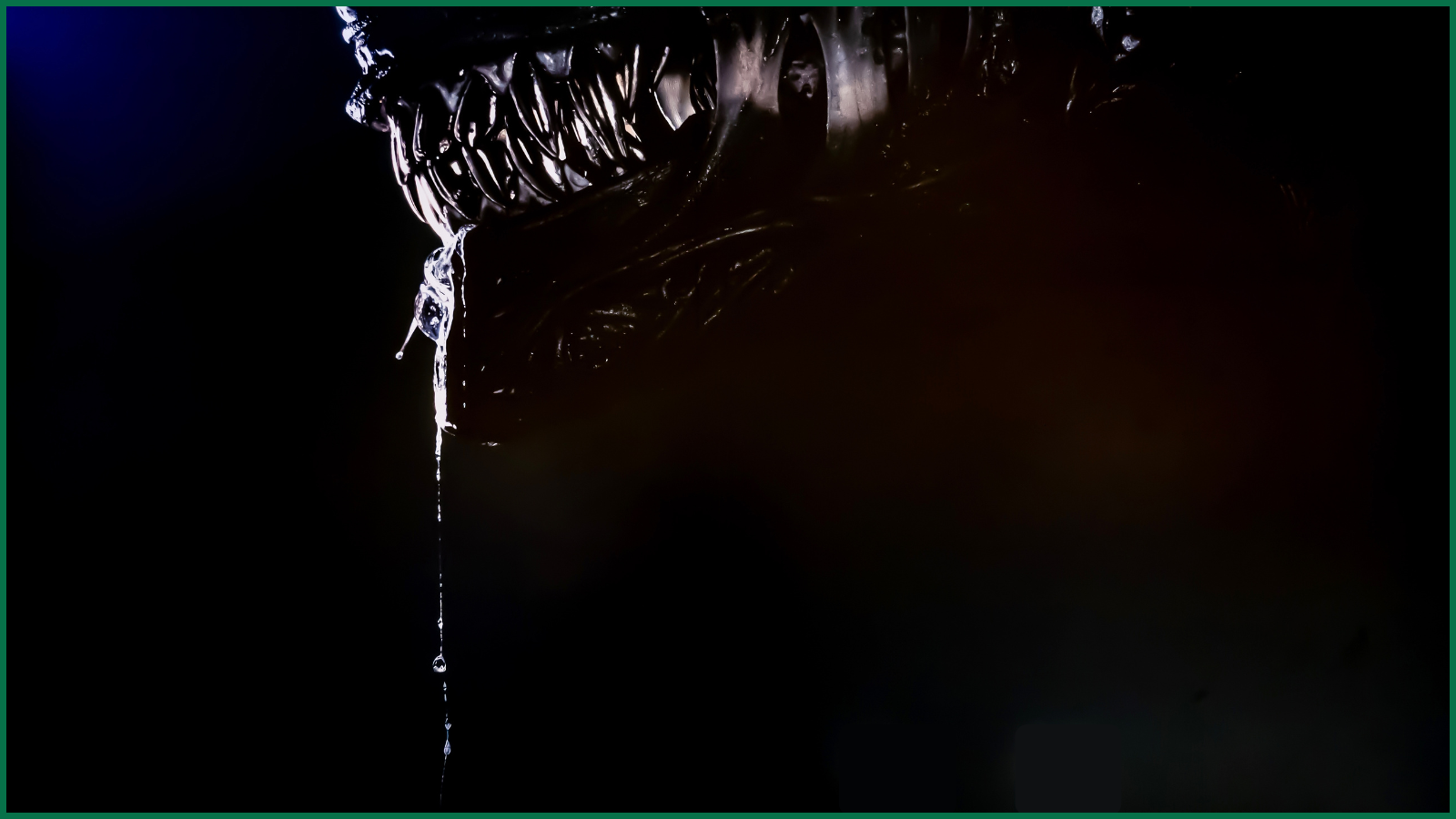
The xenomorph was expressly designed by Swiss surrealist H.R. Giger with strong sexual overtones: a phallic head and a drooling vagina dentata for jaws. This represents the male fear of castration while the impregnating facehugger leaping from the egg evokes rape. The unity of creation and destruction—of reproduction and death—is given a modern form in Alien although it is not a new concept. Religious allegory aside, Sigmund Freud discovers this unity at the psychoanalytic level and likens the release of sexual orgasm to dying itself: “This accounts for how similar the state following complete sexual gratification is to dying, and for the fact that in lower animals death and the procreative act coincide.”4 For Freud, the death drive innate to living things appears as “aggression and destruction” when it is turned toward the external world.5
The Mythology
The xenomorph is the physical embodiment of the death drive, a product of “alien interspecies rape” and the death of its host.6 The aggression and destruction projected outward is total and directly avails its life instincts and reproduction. The android, Ash, in the film describes it as the “perfect organism. Its structural perfection is matched only by its hostility.” It necessarily takes up the most extremely rapacious form of both life and death, its species pullulating ceaselessly over a mountain of blood-stained corpses and shattered rib cages.
In feudal Europe it was believed that demonic incubi and succubi would sexually attack people as they slept with repeated interactions resulting in death. In antiquity this attribute is seen in satyrs and various demi-gods, and in the nomadic society it is seen in mystic and impetuous animals in nature. There is a primordial fear of death and sex working here and its cultural expression is determined by the economic mode of production that situates society. This exemplifies what Marx and Engels say in The German Ideology, that it is “material production” that alters the existence of people, including “their thinking and the products of their thinking.”
What Giger, Scott and O’Bannon created with Alien is a space-age capitalist interpretation of the demonic, sexually violent archetype. It is no coincidence that workers, grunt soldiers and prisoners bear the weight of deadly encounters with the parasites in the original trilogy and always under the orders of the soulless Weyland-Yutani corporation. Taking the metaphor further, the xenomorphs symbolize the overwhelming totality of capitalism itself: they flourish by devouring their two sources of wealth, nature and human beings.7
Thanks for reading!

Footnotes:
“Editor’s Preface” in Essential Writings of Karl Marx (Red and Black Publishers, 2010), 16. ↩︎
Aristotle, “Selections from Poetics,” in Art and Interpretation: An Anthology of Readings in Aesthetics and the Philosophy of Art (Broadview Press, 1998), 34. ↩︎
John M. Koller, Oriental Philosophies, Second Edition (Charles Scribner’s Sons, 1985), 111-2. ↩︎
Sigmund Freud, Beyond the Pleasure Principle (Broadview Editions, 2011), 113. ↩︎
Sigmund Freud, Civilization and Its Discontents (Broadview Editions, 2016), 91. ↩︎
Screenwriter Dan O’Bannon described Alien as a movie about “alien interspecies rape.” www.buzzfeed.com/alisonwillmore/19-movie-monsters-that-look-like-penises-and-vaginas ↩︎
Karl Marx, Capital, Volume One. Paraphrasing: “Capitalist production, therefore, develops technology, and the combining together of various processes into a social whole, only by sapping the original sources of all wealth — the soil and the labourer.” ↩︎