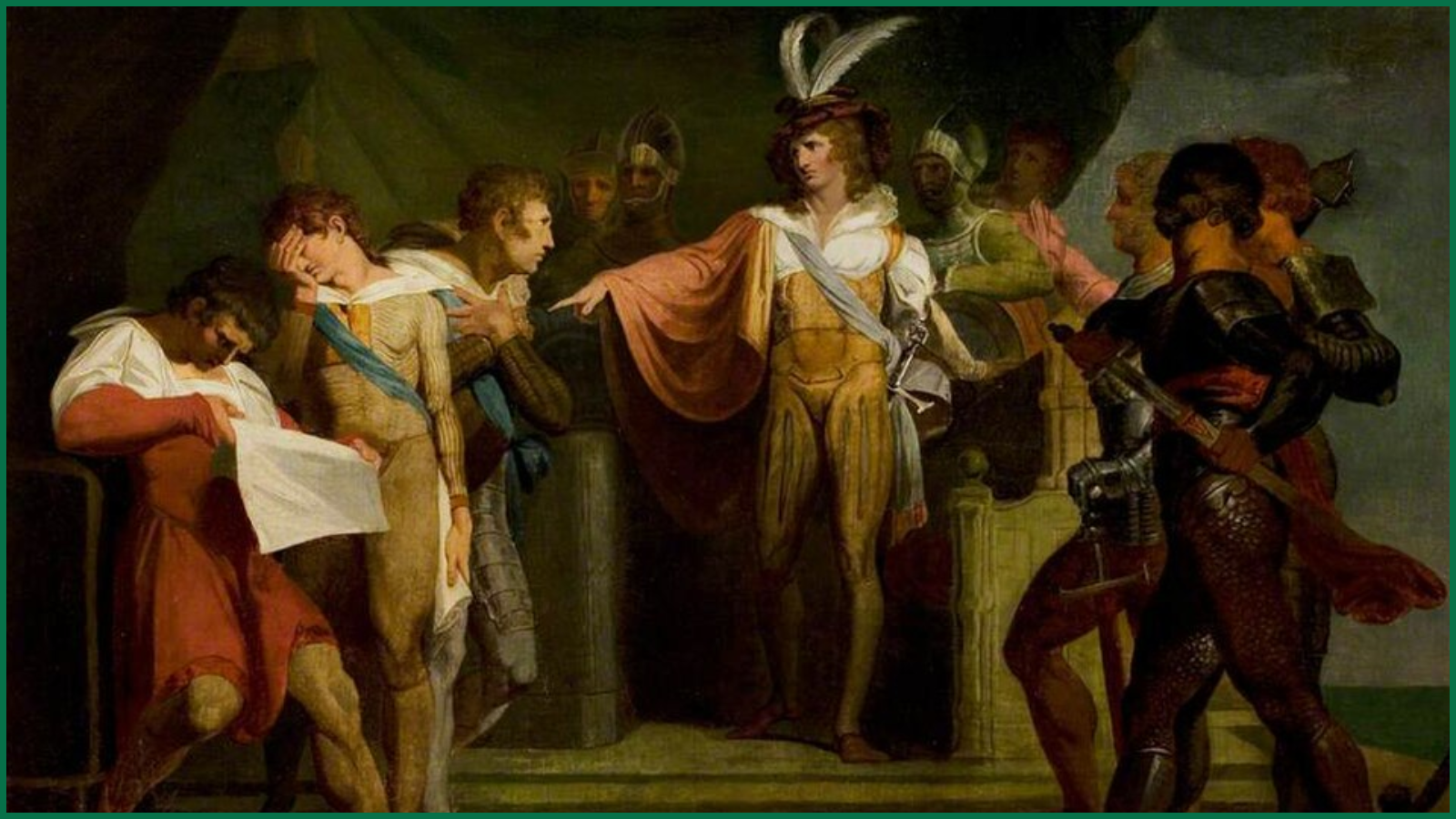
If ever the sensible Benedick bear it,
pluck off the bull’s horns and set them in my forehead,
and let me be vilely painted, and in such great letters
as they write “Here is good horse to hire”
let them signify under my sign
“Here you may see Benedick the married man.”—Benedick, Act 1, Scene 1.
One thing that Marx and Shakespeare had in common was living through periods of quantum leaps in culture and thought. The Renaissance was the cultural expression formed by increasing commerce, urbanization and loosening feudal bonds, and codified by painters like Leonardo Da Vinci, sculptors like Michelangelo and playwrights like Shakespeare.
The Industrial Revolution, on the other hand, spurned an interest in science and rapid change reflected in the biological theories of Charles Darwin, the social theories of Karl Marx and the psychoanalytic proposals of Sigmund Freud. Closer to the present, we have seen developments in mass communications and recording technologies give space to pioneering musicians like The Beatles and Bob Dylan, while the digital age has seen the rise of the viral clip and the podcast. Marx and Shakespeare trailed the material changes of society, as all revolutions in thought and culture tend to do.
Cultural productions are artifacts. They are crystallized objects transmitting historical information about the society that produced it—the psychology, the politics, the economy, the zeitgeist. In Much Ado About Nothing, Shakespeare gives the subject of romance, love and marriage a light, comedic touch in contrast to his treatment of these subjects in crushing tragedies like Romeo and Juliet and Othello.
Chivalry in the Court
Saying nothing of emotional attraction, marriage evolved to institutionalize sexual reproduction and hereditary transmission of property. In Friedrich Engels’ The Origin of the Family, Private Property and the State, he notes that during the Middle Ages “the pairing marriage” was most often a “matter of convenience which was arranged by the parents.” Passion, on the other hand, “heads straight for adultery, and all the poets of love celebrated adultery.”1
What Engels refers to is the culture of courtly love that developed among the feudal nobility, in particular the knights and ladies of the court. Engulfed by jousting matches and the dangers of battle, knights would dedicate their pursuits to a noble woman as part of the chivalric culture.2 Courtly love took place outside the bonds of marriage, layering erotic desire with both courtesy and surreptitiousness.
Like many of Shakespeare’s plays, Much Ado About Nothing cannot be understood without contextualizing the feudal culture that the Renaissance emerged from. The rise of gunpowder had steadily diminished the scope of knighthood until it was little more than an honorific title. But the complicated culture of furtive romance and noble courtship residually remained, even as society was moving toward voluntary marriages based on love. Infidelity, once packaged as a chivalric passion, is seen across Shakespeare’s work as an ominous presence dragged down the aisle beneath the bridal gown.
By the Renaissance period, it was armed soldiers waging battle, and the story picks up with news that Don Pedro and his men would be arriving in Messina after a successful battle. Benedick is among the arriving entourage and he carries an intense fear of being cuckolded—so much so, that he vows to never marry a woman: “Because I will not do them the wrong to mistrust any, I will do myself the right to trust none. And the fine is, for which I may go finer, I will live a bachelor.”
The Timeless Art of Seduction
Benedick’s intransigence toward marriage mark him for a sort of prank, whereby Don Pedro and his men lead him to believe that the governor’s niece, Beatrice, is in love with him. At the same time, Beatrice is led to believe that Benedick harbours feelings for her. It is a fabrication but it works, and Beatrice and Benedick are both privately delighted to be the object of the other’s affections. The speed by which Benedick accepts Beatrice’s feelings leads one to believe that Benedick’s aversion to marriage all along may have been a fear of rejection.
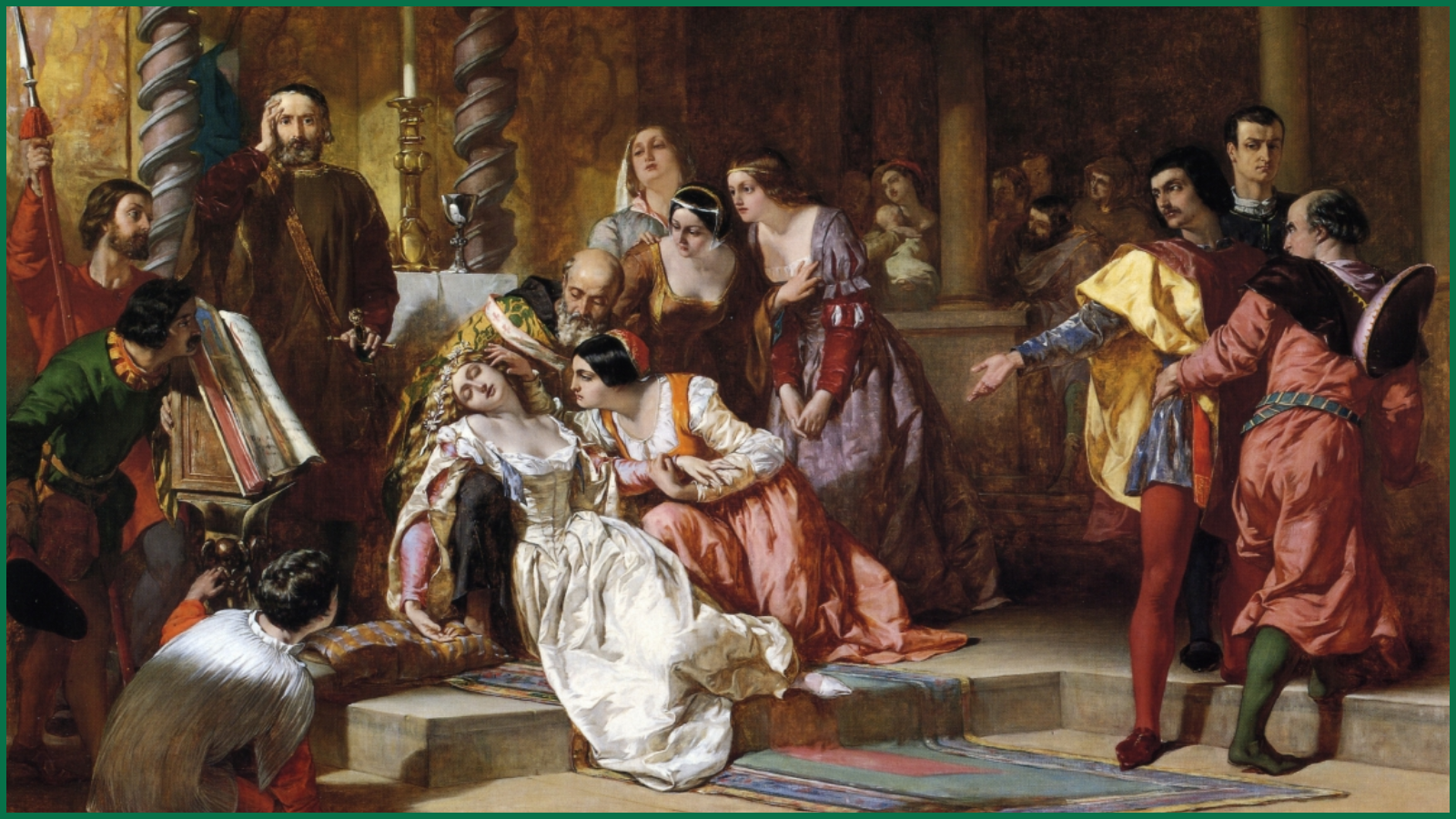
In a parallel storyline, Claudio courts the governor’s daughter, Hero. This is thrown off course by Don Pedro’s jealous—and illegitimate—brother, Don John. Don John orchestrates a scheme whereby a member of his entourage advances on a chambermaid, with Claudio as a witness through the window. Claudio believes it is actually Hero being seduced and he denounces her at the altar the next day:
Would you not swear,
All that see her, that she were a maid
By these exterior shows? But she is none.
She knows the heat of a luxurious bed.
Her blush is guiltiness, not modesty.—Claudio, Act 4, Scene 1.
Being a comedy, the plot lines resolve through turns and ultimately conclude with the happy marriages of Benedick to Beatrice and Claudio to Hero. The scheming and side quests were, in the end, “much ado about nothing.”3 What this story does indicate is the immense anxiety and wicked humour around the prospect of female infidelity, primarily told from the point of view of the male characters. It peels back the social attitudes underpinning English coverture, which effectively rendered wives the property of their husbands.
Romance during the age of chivalry was replaced in the modern age with something far more transactional and economical and potentially humiliating. Shakespeare’s play reflects the social anxieties of the commercial revolution as it transformed courtly love into the modern marriage.
The historical construction of romance and marriage was largely passed down from a position of male accommodation, however. Gender relations since the advent of class society has been a disaster. This is because the economic scarcity created by property relations—through slavery, serfdom and meagre wage labour—has squeezed the bulk of humanity onto the lower rungs of the economic hierarchy, and women were largely pushed off the ladder altogether. Recent movement toward gender equality has burst into the open only since capitalism has demanded the labour-power of more and more people, men and women alike.4
Universal Exploitation
As the economic inequality between men and women have shrunk, so have the legal and cultural discriminations. But they cannot be done away under a system that freely discriminates against all people on the basis of economic class. In The Communist Manifesto, Marx and Engels wrote: “Our bourgeois, not content with having wives and daughters of their proletarians at their disposal, not to speak of common prostitutes, take the greatest pleasure in seducing each other’s wives.”5 The latter bit about “seducing each other’s wives” is clearly what fixates Benedick and Claudio in Much Ado About Nothing.
But think about the financial elites with proletarian wives and daughters “at their disposal.” Think about Jeffrey Epstein and associates feasting on the bodies of working class children. Think about Thomas Jefferson’s sexual exploitation of enslaved women. Think about Harvey Weinstein and the “quid pro quos” demanded of aspiring actresses.
Sexual exploitation is the sharpest edge on the Luciferian tower of economic exploitation. But the solution isn’t to smooth the edges—it’s to get rid of the tower. Given the current reality of exploitation in Shakespeare’s world and our own, we cannot expect the double standards set between rich and poor, whites and non-whites, men and women to disappear outright. They won’t.
For all the fixations of the male characters in Much Ado, it is Don Pedro’s attendant who implores the ladies of the court to forgive the transgressions of men even though they are unwilling to do the same in kind. He sings:
Sigh no more, ladies, sigh no more.
Men were deceivers ever,
One foot in sea, and one on shore.
To one thing constant never.
Then sigh not so, but let them go,
And be you blithe and bonny,
Converting all your sounds of woe
Into hey nonny, nonny.—Balthasar, Act 2, Scene 3.
Thanks for reading!

Friedrich Engels, “The Monogamous Family” in Origins of the Family, Private Property, and the State. ↩︎
It should be noted that detailed information and artifacts of this chivalric culture are disputed and sketchy. The historians that Engels leaned on drew heavily from the poetry of Provençal troubadours. ↩︎
Of interest is Shakespeare’s usage of “nothing,” which carried a triple entendre: it is nothing, as we would say today, and it also denotes “no-thing” between the legs of a woman. Additionally it was homophonic to “noting” in Elizabethan English—with “noting” being a colloquial term for gossip and rumour. ↩︎
David Harvey elaborates on the massive integration of the human population into the global capitalist system in Seventeen Contradictions and the End of Capitalism (Oxford University Press, 2014): 108. ↩︎
Karl Marx and Friedrich Engels, The Communist Manifesto (Arcturus, 2017): 79. ↩︎