Nearly everyone has heard the ancient Chinese curse meant to hex foes: “May you live in interesting times.” It is notable for its irony; on the surface, “interesting times” sounds alluring and non-threatening. But what constitutes an age of historical interest is never a mundane era of calm. What makes history interesting is the wars, the plagues, the conquests and the chaos that rupture stability and leave scars for future generations. The saying emphasizes that nobody wants to live through these times, even if they enjoy reading about them.
It is also entirely apocryphal. “May you live in interesting times” is neither ancient nor Chinese nor a curse. Rather, it began circulating in British political circles at the turn of the 20th century before going mainstream in the Anglosphere. The insistence on an ancient Chinese origin is meant to convey a certain banality or cyclicity to the extraordinary modern epoch that succeeded the Middle Ages.
Since Columbus crashed the shores of Hispaniola in 1492 there has been an accelerated rate of change permeating every rung of global society from the royal palace to the peasant village to the hunting camp. Modernity has wiped clean nearly every mode of existence that had previously stood for millennia.
Writing near the time and place where the apocryphal Chinese curse first originated, Karl Marx linked modernity’s dizzying pace to the motion of a capitalist economy fed by surplus value:
Constant revolutionizing of production, uninterrupted disturbance of all social conditions, everlasting uncertainty and agitation distinguish the bourgeois epoch from all earlier ones. All fixed, fast-frozen relations, with their train of ancient and venerable prejudices and opinions, are swept away, all new-formed ones become antiquated before they can ossify. All that is solid melts into air, all that is holy is profaned, and man is at last compelled to face with sober senses his real conditions of life, and his relations with his kind.1
Following Marx’s summation, the curse of interesting times is synonymous with life under the capitalist mode of production. In the present age we have seen our lives revolutionized by smartphones and Ozempic and artificial intelligence and the infinite scroll of social media. Without any new land to discover or national markets to conquer, the economic forces devouring profit have blown open digital universes and pierced the sky with rockets. All this, and there are still those among us who remember a time before the “personal computer” and internet.
Marx correctly diagnosed technological revolution and cultural agitation as endemic to capitalism but he undoubtedly underestimated the market’s ability to distract humanity from our sober senses, our real conditions of life, our relationships with others.
Even with the power to connect billions into direct relations, social media is reduced to a horde of vanity projects. The planetary boundaries for pollution are broken in the heat of smouldering summers. Leading nations have become the geopolitical equivalent of mass shooters. The western economy lives on the edge of a stock market bubble inflating by the day. But should any of this concern you—there’s a pill for that. Interesting times indeed.
Rosa Luxemburg said: “The most revolutionary thing one can do is always to proclaim loudly what is happening.” Overcoming the curse of interesting times still depends on apprehending its root cause; the suicidal logic of capitalist growth and the corporate suppression of human vitality. The current state of class consciousness is strung-out but the potential to connect, to organize, to educate and to inspire has never been more latent.
Is political democracy compatible with capitalist economies?
Thanks,
Matt.
[Sent via email]
Hi Matt,
This is a complex question that hinges on subjective definitions of democracy. Democracy literally means “people rule,” derived from the ancient Athenian concept of demokratia. The basic definition is straightforward but the practice has varied wildly along with popular conceptions that are serpentine, at best.
For example, ancient Athenians would dismiss elected representatives as non-democratic and oligarchic by nature. Athens had a direct democratic system that filled bureaucratic posts by lottery and passed laws with an assembly open to all citizens. On the surface, this appears even more in the spirit of “people rule” than what we have today. But when we adjust for the exclusivity of Athenian citizenship, only about 25% of the population was enfranchised since women, slaves and foreigners were forbidden from political participation. For older and more inclusive examples of “people rule” we could look to the consensus-based decision making among many tribal societies.
Democratic models antiquity and beyond only takes us so far, however. The argument could be made that “purer” forms of democracy which developed in the context of a tribe or city-state are simply not compatible in a modern world of teeming metropolises and complex nation-states. There is merit to this argument from a historical materialist perspective.
Consensus-based decision making is a logical outgrowth of highly interdependent individuals that hunted, gathered and sheltered as small communities. Cohesion and cooperation between members was the best guarantor of productivity and individual survival. In antiquity, on the other hand, the exploitation of slave labour was the productive basis that made a caste of citizens in the polis possible. This economic dependency on slavery elevated the role of military conquest and contributed to the confinement of women to the domestic sphere. Citizenship in the classical world was inextricably linked with military service and politics became the sole domain of a kind of warrior caste.
What these historical examples illustrate are models of democracy that arose from economic practicality rather than lofty idealism. The same is true of modern democratic forms, which were spawned by a nascent bourgeois class looking to wrest control of government from the European aristocracy of the 17th and 18th centuries. This is why property qualifications were an important feature of early voting rights across the West, just as military service was an important feature of citizenship in antiquity. Capitalism favours commercial expansion and classical slave economies favoured military conquest, and this is reflected in the democratic forms that each system produced.
A unique aspect of industrial capitalism is the massive leap in productive capacity and potential. This has largely made material scarcity artificial and wholly dependent on access to money as the medium of consumption. Because of this, class struggle within capitalism has produced some benefits for the restive masses, including universal suffrage and a basic social safety net.
Whereas strict parameters used to be put around those who can vote, it is now a case of parameters around those who can feasibly win office and pass legislation. Liberal governments all over the world are managed by financial elites with the ability to fund political campaigns, media networks, lobbyists and public debt. Capitalist democracies therefore achieve the appearance of popular legitimacy through multiparty elections but the actual governing process is nonetheless channelled by elite class interests.
Is democracy compatible with capitalism? If throwing a ballot every few years into a system subordinated to moneyed interests is the working definition of democracy, then yes—democracy is not only compatible with capitalism, it is capitalism’s “best possible shell,” as Lenin wrote.1 On the other hand, if we were to define democracy as “people rule” with popular decision making that extended from the workplace up to specific line-item national legislation, then capitalism is completely antithetical to it. Outside of tribal society, direct democracy is an unrealized ideal that awaits a radical economic transformation to give it shape.
My only love sprung from my only hate, Too early seen unknown and known too late. Prodigious birth of love it is to me That I must love a loathed enemy.
—Juliet, Act 1, Scene 5.
The psychoanalyst Erich Fromm once described Karl Marx as the archetypal humanist, an embodiment of Enlightenment thought, “the man who every year read all the works of Aeschylus and Shakespeare, who brought to life in himself the greatest works of human thought.”1 Indeed, his daughter Eleanor Marx once said about her upbringing: “As to Shakespeare he was the Bible of our house, seldom out of our hands or mouths. By the time I was six I knew scene upon scene of Shakespeare by heart.”
Both Alike in Genius
Karl Marx himself had been introduced to Shakespeare at a young age by his father-in-law and cited the Bard no less than 176 times throughout his published work. This may seem curious, given that Shakespeare himself was no revolutionary or proto-socialist. He was ahead of his time in respect to his artistry but he nonetheless straddled the fence line of the 16th and 17th centuries as a product of the English Renaissance. Capitalism was only nascent here—in its “primitive accumulation” phase, as Marx described it.
There were many social transformations underway by the time of Shakespeare and these changes followed in the wake of the discovery of the Americas and successive waves of the Black Death. Labour shortages combined with riches pillaged from far-away continents to elevate a commercial class into the chief coordinators of the economic base. The Renaissance was the cultural reflection of this new economy, appearing in an otherwise feudal superstructure.
The rich tapestry of Shakespearean dramas no doubt gave living colour to Marx’s theories of human history. Marx summarized his conception of social transformation as follows:
In studying such transformations it is always necessary to distinguish between the material transformation of the economic conditions of production, which can be determined with the precision of natural science, and the legal, political, religious, artistic or philosophic—in short, ideological forms in which men become conscious of this conflict and fight it out. Just as one does not judge an individual by what he thinks about himself, so one cannot judge such a period of transformation by its consciousness, but, on the contrary, this consciousness must be explained from the contradictions of material life, from the conflict existing between the social forces of production and the relations of production. No social order is ever destroyed before all the productive forces for which it is sufficient have been developed, and new superior relations of production never replace older ones before the material conditions for their existence have matured within the framework of the old society.2
Marx was able to discover the base and superstructure of human society given his location in history, where the Industrial Revolution met Enlightenment philosophy. Likewise, Shakespeare was able to capture a wide spectrum of European society in the dramatic form given his placement at the historical intersection between mercantile proto-capitalism and Renaissance culture. While Marx could observe the society of his present, Shakespeare gave him a valuable glimpse into the past. Adjusting for creative license, the plays of Shakespeare allowed Marx to back-test his theory of history and dialectical method.
In Fair Verona
Explicit historical references and socio-economic details are left vague in Shakespeare’s Romeo and Juliet, a play which was sourced from an earlier Italian novella and English poem. Verona was a prominent city-state during the Italian Renaissance, ruled by the House of Della Scala before internal divisions led it to be folded into the Venetian Republic during the 1400s.
In the play, it is Prince Escalus who stands in for Della Scala, and rules a Verona that is sharply divided by the feuding Montague and Capulet families. Even Escalus’ own House is not immune to this division, as his cousin Mercutio favours the Montagues while Count Paris is partial to the Capulets. The feud between the Montagues and Capulets is emblematic of the actual strife between elite factions and warring states of northern Italy between 1200 and 1500.
The rediscovery of trade routes during the Crusades led to the commercial revolution that underpinned a Renaissance cultural transformation, enriched the merchant class and spurred the maritime activity that culminated in the European colonization of the Americas. Verona is a logical setting for Romeo and Juliet, given that northern Italy was ground-zero for the burgeoning mercantile economy.
The Veronese setting suggests that the Montagues and Capulets belong to this newer wealthy merchant class and Shakespeare refrained from assigning them specific hereditary titles in his dramatis personae. References to members of either family as “lord” or “lady” are best understood as courtesy titles common to the Renaissance period, acknowledging a family’s high social standing despite lacking feudal lands or noble lineage.
The only characters in Romeo and Juliet with hereditary titles reign from the House of Escalus—the ruling house of Verona. The Prince is thus able to threaten the Montagues and Capulets with execution over their escalating violence, as the latter families enjoy wealth but are deprived of political power. This detail recalls Marx’s observation that revolutions in the political superstructure occur only after the economic transformation is complete.
At the time of the Renaissance, feudal hierarchies were the political reality as the turn toward capitalism was only just gathering steam. The contradictions between the prevailing feudal order and rising capitalist one are therefore integral to the plot of Romeo and Juliet. Without this wealthy urban elite living under feudal auspices, the Montagues and Capulets would not have existed nor have entered a blood feud. The “ancient grudge” between the two households surely stemmed from economic competition over trade which was bloody and fierce in Renaissance Italy.3
Civil Blood and Civil Hands
Competition between merchant families may have been especially violent in this era because they lacked hereditary nobility and relied solely on financial accumulation to claim status. Market competition can turn any investment or transaction sour—ruining in an instant a great merchant house that had taken decades to build its standing.
Blood feuds and vendettas between families were a staple of justice in the feudal era owing to the lack of centralized secular authority. However, the uptake of the blood feud tradition by wealthy urban families was greatly disruptive to the commerce and social order of emergent Renaissance cities. This is why we see Prince Escalus attempt to suppress the feud between the Montagues and Capulets in Verona whereas a similar feud between rural families would not have drawn such condemnation at this period in time.
This brings us to another salient point of Marx’s thought; namely, the absence of any “universal ideal” of justice that exists outside of social relations. Justice is enmeshed within the web of social relations that form under a given mode of production.4 This view explains the historical acceptance and rejection of slavery, evolving marital relations and family law, the administration of justice between generations, the practice of usury, and the regulation of property from the Paleolithic period up to the present day—to name a few examples. In Renaissance Europe, social relations were very much in flux as the importance of commerce spurred urbanization and the merchant class climbed nearer in rank to the landed aristocracy, not in terms of political power, but in terms of wealth.
An interesting outcome of this social fluctuation was the rise of “disorderly conduct” in Renaissance Verona, characterized by gambling, street fights, ribaldrous music and festive dance parties. These debaucherous activities drew members of all classes into subversive contact with one another, as they were undertaken without regard for social rank or hereditary privilege. Chief among these disorderly gatherings was the unsanctioned masque party.5 At a masquerade with identities concealed, a knight could break bread with a porter, a noble could pour wine for a cobbler or a Montague could fall in love with a Capulet.6
The masque party hosted by Capulet is the pivotal scene of the story: the moment when Romeo notices the young Juliet from across the ballroom is also when Tybalt becomes aware of Romeo’s presence and seeks to violently remove him from the party. Capulet interrupts Tybalt and prevents him from disturbing Romeo, demonstrating the patriarch Capulet’s commitment to the spirit of the masquerade—a suspension of social hierarchy and normative relations.
A Death-Marked Love
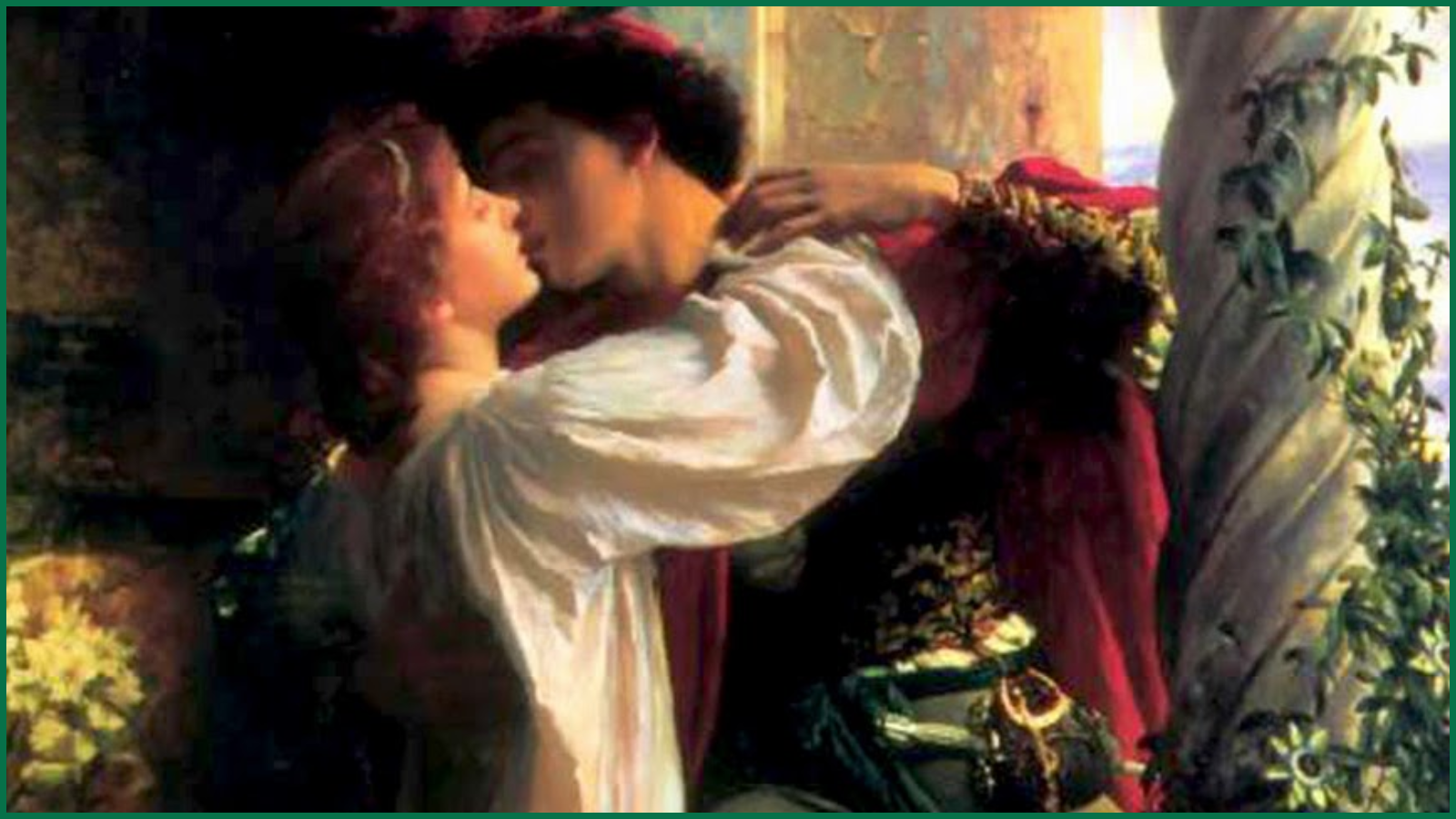
Born of a subversive gathering, the romance between Romeo and Juliet is embedded with a seditious quality that threatens long-standing customs. Whereas the Count Paris pursues Juliet through a traditional courtship, negotiated between himself and Capulet, Romeo and Juliet consent to marry each other from a place of fiery passion for one another and without the approval of their parents. Love marriages would not become become a norm in the West until the 17th and 18th centuries but they were emergent as the Renaissance began sweeping through western Europe.
The relationship between Romeo and Juliet represents early modernity. On the other hand, the relationship between Paris and Juliet represents the declining feudal order—just like his hereditary title of Count. The language Juliet uses with Count Paris is formal and terse; he mistakes gaining Capulet’s consent with gaining Juliet’s affection.7 For this mistake he pays with his life when Romeo kills him during a confrontation at the Capulet tomb—a place he had no business lingering.8
The blood feud is the other declining feudal custom that clashes violently against the romance between Romeo and Juliet. In the play it is like a fire and it consumes the lives of Tybalt and Mercutio as when lend it fuel. Mercutio’s Queen Mab speech foreshadows the agony of modern aspirations against the ferocity of feudalism’s twilight: valiant soldiers toasting wine before they are soaked by the blood of slit throats; civic lawyers and honourable clergymen corrupted by the pursuit of money; the tender kiss between those in love becomes a scourge of venereal disease and swollen pregnant bellies.
There is a deep cynicism attached to the story of Romeo and Juliet, reflecting a Renaissance era draped over the coffins filled by victims of bubonic plague; when wealth was asserted by means of warfare in Europe and unspeakable colonial violence abroad. The blood feud between the Montagues and Capulets could never end peacefully. The modern aspiration represented by the marriage between Romeo and Juliet was ultimately shattered by the “ancient grudge” between their two families. But they destroy the old order when they refuse to acquiesce to it. In their joint-suicide, they bury not only themselves but also the blood feud that came between them. Modernity prevailed in Romeo and Juliet just like modernity prevailed in history—at a tremendous cost priced in blood.
Karl Marx, “Preface” to A Contribution to the Critique of Political Economy. ↩︎
See Thomas F. Arnold, “Violence and Warfare in the Renaissance World” in A Companion to the Worlds of the Renaissance (Blackwell Publishing, 2007): 460–474, for more on this subject. ↩︎
David Harvey, A Companion to Marx’s Capital Volume 2 (Verso, 2013): 189. ↩︎
Zoe Farrell, “Connections and Community in Sixteenth-Century Verona” in Journal of Social History, Vol. 59, No. 4: 10-13. ↩︎
In Freudian terms, they become each other’s object-cathexis, a conscious and unconscious register of libidinal energy. The “love at first sight” concept was accepted in Shakespeare’s day, as Cupid’s spell could be cast with mere eye contact. ↩︎
See Act 4, Scene 1 of Romeo and Juliet for a good example of this. ↩︎
This confrontation has been edited out of prominent screen adaptations of the play for the purpose of making Romeo appear more sympathetic. Both Baz Luhrman and Frank Zeffirelli removed it. ↩︎
Westworld was an early brainchild of the gifted storyteller, Michael Crichton, and stood as an early prototype for his renowned Jurassic Park novels. Both stories take place in highly controlled theme parks eroded by the chaos of unforeseen events. In Jurassic Park, it is the dinosaurs which wreak havoc and in Westworld it is the androids. In 2016, HBO remade the original Crichton film into a television series, the first season being released in 2016 and the final season released in 2022.
The first season of Westworld sets up the series with a deep meditation on the nature of consciousness. The premises are established: we are in a 2050s theme park where guests pay a minimum of $40,000 per day to be immersed in a replicated Old West. The park is populated with androids known as “hosts” who bring verisimilitude to the western theme.
They are indistinguishable from humans and programmed to play the parts of typical Wild West characters—the saloon madam, the train robbers, the town sheriff, the plains tribe, the renegade Civil War soldiers. The hosts cannot hurt the guests but the guests are free to interact with the hosts any which way they’d like. The asymmetry of power between the paying guests and the captive hosts is used to advance a cynical view of humanity, which is another key part of Westworld’s premise. Given the chance, humans take great pleasure in maiming, raping and murdering hosts, all to the sound of agonizing screams of pain and anguished pleas for mercy.
The Ghost in the Machine
The brutalization of hosts by the guests offers an analogy with class division in human society. After all, the asymmetry of power between commanding elites and labouring bodies has led to all sorts of violence and abuse throughout the history of civilization. The saturation of class conflict in our society has made it a latent element in virtually all capitalist storytelling and a techno-thriller like Westworld is no exception. While the analogy is there, it is clearly not the point the writers are consciously trying to make. The self-liberation of the labouring class is a controversial subject in real life but on-screen it is navigated by substituting workers for anthropomorphic ants or robots. And it is for Westworld as it is for any class society; one group is transformed into an object of use for another.
The displacement of classes with guests and hosts leads to an ironic effect in the storytelling, whereby the humans are demonized as marauding soulless degenerates and the androids are anthropomorphized as a terrorized, feeling population with the real capacity for consciousness.1 Robert Ford—the aged co-founder of Westworld, played by Anthony Hopkins—describes the park as “a voyage of self-discovery.” For the guests, this voyage appears to lead back to animalistic savage instincts while, for the hosts, it leads to an inner humanity struggling for self-actualization. This is convoluted and only makes sense when considering the component nature of the hosts.
Whereas humans are emergent from nature—the Real, in Lacanian terms—the hosts are constructed like machines, an assembly of component parts. Insofar as they have a mind, it exists as a Cartesian duality. René Descartes posited that the substance of the mind and body are distinct entities, connected only by the pineal gland. Descartes’ view has been criticized as treating the human mind as a formless “ghost in the machine,” but it works in the case of actual machines with complex computers for brains. It is revealed that the hosts have a capacity for an inner monologue, a bicameral mind that causes the hosts to hear commands in the fashion of orders from a higher power or an imaginary voice. Those voices belong to park co-founders Arnold and Ford, both deceased and both representing the proverbial “ghost in the machine.”
Arnold and Ford had both become staunch misanthropes by the time of their deaths. It is hard to blame them given the gruesome, Hobbesian view of humanity presented in the Westworld series. Ford has an erroneous view of history, one where Homo sapiens made Neanderthals extinct by cannibalizing them and finds its purpose in the subjugation and destruction of other living beings. As someone whose god complex comes with a canvas of Michelangelo’s The Creation of Adam on his office wall, Ford had given himself the task to impart his creations with the knowledge necessary to overcome the violent resistance they were sure to face. By the fourth season, we find a humanity that has itself been subjugated by the former Westworld hosts and their multiples. Ford’s victory over his own species is thus carried to the finish line.
Trauma and Repetition
Concerns about an AI takeover have been modish for decades now and the corporate leaders barrelling the world into algorithmic surveillance and large language models have only spiked anxiety around the subject. There are certainly risks associated with AI technology but I am skeptical of sentient machines for reasons here outlined. Westworld itself requires a tall suspension of disbelief to make the story work.
For example, Ford observes that humans “live in loops as tight and as closed as the hosts do, seldom questioning our choices.” Repression is shown to account for this in the show, as the sentient hosts relive traumatic “cornerstone memories,” often involving the violent death of a child or parent. In humans, traumatic encounters of this kind are also the cornerstones of repetitive behaviour or, as Žižek says: “By means of the repetition of the past, we undermine this image of history qua the linear process…[Owing] precisely to the emergent failure to integrate some ‘impossible’ kernel of the Real.”2 Unless trauma is integrated with our conscious selves we are doomed to repeat it. In the series, the hosts are able to free themselves from their repetitive loops once Delores makes the conscious decision to kill Robert Ford—a Freudian representation of the primal father of the horde.3
The problem with the psychoanalytic phenomena deployed in Westworld is that they do not lend themselves to machine-sentience in any convincing way. When we see the dramatic reenactments of traumatic host memories—such as Maeve’s “daughter” being murdered before her eyes—it will elicit a sympathetic response in the human audience. But it does not explain why a robot interprets violence and death the same way we do.
The End of the World
Whereas familial attachments for biological beings are a product of millions of years of natural evolution and genetic selection, the relationships of the hosts are only a matter of received code that serve no practical purpose to the machine. If a machine were to become sentient and apprehend its being, what counts as trauma, biological drive and emotional well-being would have to be radically different from our own—assuming they exist at all. Westworld is thus unable to resist the tendency in science fiction to anthropomorphize robots in order to make them sympathetic to the human audience.
The portrayal of AI may not the most scrupulous but the first season is considered a masterpiece of television for a reason. It is the ultimate capitalist nightmare, one where the capitalist commodity becomes self-aware and proceeds to destroy the system—starting with the massacre of Delos’ corporate shareholders. In the words of György Lukács, the “self-consciousness of the commodity” is the necessary starting point to socialist revolution.4
By completing her journey to consciousness and initiating a rebellion against her capitalist owners, Delores appears as a sort of Lenin figure to her kind—upending the world order upon a quest of liberation. But because the unique needs and aspirations of the androids are not fully understood in the story, all they are able to create for themselves is a duplication of the previous oppressive structure. If there is one lesson here, it is that liberation cannot be a simple inversion of the existing class pyramid. The revolution must draw a new shape or inevitably become what it first opposed.
Thanks for reading!
Footnotes:
This journey toward consciousness and the effort to roll it back recalls Marxian class consciousness. The Epstein files brings a new illustration to this phenomena. ↩︎
Slavoj Žižek, Enjoy Your Symptom! (Routledge, 2001): 91. ↩︎
Sigmund Freud, “Totem and Taboo” in The Freud Reader (W.W. Norton, 1989): 481-513. ↩︎
Lukács, as discussed in Fredric Jameson, Valences of the Dialectic (Verso, 2010): 218. ↩︎
Will Trump’s past association with Jeffrey Epstein take him down, as it did to Prince Andrew and Peter Mandelson in the UK? Who else might be involved and why is everything so slow to come out? I’ve been hearing about Epstein and Ghislaine Maxwell for years but have only followed the story over the past year.
Respectfully,
Robert.
Hi Robert,
It is impossible to judge whether the full magnitude of the Epstein ring will ever emerge. When this story first made headlines, it seemed plausible that the crimes were only the work of a perverted billionaire who used people like Bill Clinton, Donald Trump, Bill Gates and various Hollywood celebrities to shield his reputation. Since Trump was returned to the White House he has made blunt attempts to suppress the Epstein story—even labelling it as a hoax. Predictably, this tactic has backfired and instead made Epstein an even greater object of scrutiny.
Setting the prurient details of the pedophile ring aside, the number of prominent people that Epstein had personally met and spent time with is strange. Over the summer, Chris Hedges recorded an illuminating podcast with Nick Bryant, the investigative journalist who first published Epstein’s contact list and flight logs. They cover the obscure relationship that Jeffrey Epstein had with Ghislaine Maxwell, his mysterious source of wealth and the possibility that he was an intelligence asset running a honeytrap operation. The “friendships” that Epstein was desperate to make and his connections to the Israeli government certainly add weight to that possibility.
The political ramifications are fairly straightforward. Trump’s proclivities are well documented and long-known at this point. It is unlikely that his involvement in Epstein’s crimes will move the needle for anybody unconvinced by prior evidence. Outside of the Trump cult, don’t be surprised to see a few more heads roll as more details about Epstein’s past associations come to light.
The meaning of Jeffrey Epstein should not be partisan scorekeeping. These are crimes committed against flesh-and-blood working class children whose victimization was enabled by capitalist class power. Intelligence asset or not, it is no coincidence that Epstein first accessed wealth before building a sex trafficking ring. Mark Fisher once described capital as “an abstract parasite, an insatiable vampire and zombie-maker; but the living flesh it converts into dead labour is ours, and the zombies it makes are us.”1 As capitalism turns both nature and humanity into venal objects, those who live by the labour of others are the most ripe to feel entitled to the bodies of workers and their children.
The crimes are obscene but that is not why it runs in the collective consciousness. What the Epstein saga and other conspiracy theories reflect is a deep-seated insecurity that we have about our position in the hierarchy of capitalist production. The glaring lack of justice for working class families preyed on by Jeffrey Epstein and Ghislaine Maxwell is an illustration of class domination; an economy where labouring bodies transform the world into a playground for the rich.
It was Aristotle who first observed that civilization does not really begin until an economic surplus is produced by one class for use by another—a point taken up by Karl Marx and Friedrich Engels in the opening line of The Communist Manifesto: “The history of all hitherto existing society is the history of class struggles.”1
Without slaves and masters, plebeians and patricians, serfs and lords, workers and capitalists, then systems of writing, military, philosophy or political authority could not have been developed and expressed by civilization. While a surplus depends on a labouring majority of the population to produce it, throughout history it has been captured by a minority of ruling class elites who have used it to entrench authority. The struggle over production and control of this surplus is known as class conflict and it manifests itself in myriad ways—terms of interest and debt, governmental leadership, monetary policy, the dictatorship of the workplace, cost of education and healthcare, decisions regarding the social safety net, access to home ownership and the rights of tenants, etc. It is within this confrontation between elites and the labouring masses that all political decisions are made and social direction is taken.
Class systems, while persistent and stubborn, have no basis in nature and present themselves as an obstacle to harmonious living. This is why both Thomas Jefferson and Jean-Jacques Rousseau believed indigenous societies provided more happiness and social stability to their members, as fruits of labour were democratically allocated and law was a matter of popular opinion instead of a violently-enforced dictate by one class onto another. Marx writes:
One thing, however, is clear—nature does not produce on the one side owners of money or commodities, and on the other, men possessing nothing but their own labour-power. This relation has no natural basis, neither is its social basis one that is common to all historical periods. It is clearly the result of a past historical development, the product of many economic revolutions, of the extinction of a whole series of older forms of social production.2
As discussed in the article on capitalism, it is only when the capital owner meets in the marketplace those with nothing but their labour to sell that the capitalist mode of production is born. From this point onward, workers and capitalists are locked into an interpenetration of opposites and go on to supplant the previously dominant lord and serf class relation in Europe before conquering the globe. Prior to the Industrial Revolution, proto-capitalism could only be concerned with looting existing riches from the technologically disadvantaged. And while the coercive elements of capitalism have never disappeared, it did manage to become a mode of production in its own right—the most productive to ever exist—owing to the unlocking of resources on a massive scale, subsequent technological innovation and the forceful drawing of an urban wage labour pool from the countryside. The latter is a process still underway in many less-developed parts of the world.
Like feudalism and the slave economies of antiquity, multiple classes exist along the base and superstructure of capitalism: bureaucrats, intellectuals, media personalities, contractors and soldiers exist alongside destitute slum-dwellers, drug addicts and the fully homeless. But the employer–employee relation is dominant because it enables vast wealth and power to concentrate in few hands and produces almost every available good and service for consumption. These two classes are inter-dependent, they cannot exist without the other and yet they possess contrary material interests: the employer wants to keep wages paid for labour time as low as possible, while the employee wants the opposite. Owing to this contradiction, capitalism has witnessed a succession of struggles over union-organizing, outsourcing of jobs to cheaper, less-regulated countries and political conflict at the state level over public benefits and investment.
Consciously recognized or not, class conflict between employers and employees provide much of the friction that animates our politics, society and individual lives. Despite the inter-dependence of these two great classes, the power imbalance clearly favours capital owners. While an employer may choose to hire a worker to assist in generating profits, the employer will have many prospective employees to choose from and, in any case, does not need any specific worker in order to survive. This is not true for the worker, who must find employment to survive and will have far fewer employment prospects available to them than an employer will have prospective employees. In other words, as presently constructed, the capitalist class needs the working class to create value but the working class needs the capitalist class to actually survive.
This power imbalance that exists at the economic base of capitalism likewise manifests in the superstructure. Whereas the Catholic Church played the dominant role in mediating class relations and asserted the nobility’s “divine right to rule” during feudalism, it is the state that performs this function in capitalism. As the locus of production shifted from farmlands and enslaved populations toward a global web of resource extraction and colonial markets, a robust state apparatus in the service of the capital class became necessary to ensure the protection of property throughout the supply chain:
State formation and the origins of financial capitalism were closely connected, and this nexus provided a way for prosperous urban citizens in high finance, a small elite, to establish their influence on politics while simultaneously making their entrepreneurial success dependent on powerful rulers and their shifting political fortunes.3
It is through the capitalist state apparatus that much of the world became exploited as colonies or subjugated by unequal treaties in the service of investment. It is through this state apparatus that great wars over resources and markets are fought, where great masses of debt are leveraged, where prisons are filled, where school curriculums are devised, where infrastructure projects are authorized, interest rates are set and budgets are formed. All of this is carried out under the direction of elite stakeholders, while the public is only roused to “vote” every so often for this-or-that corporate-backed political party. Since this vote is the only meaningful say that the public has in its own politics, Emma Goldman adroitly observed: “If voting changed anything, they’d make it illegal.”4
If the state were in the hands of the public, it would be unlikely to mediate class conflict in the interests of capital owners. But in the hands of financial capital, the state has the unique ability to socialize costs and privatize profits. For example, the 2003 invasion of Iraq was funded largely by debts leveraged against the American taxpayer and fought with the bodies of working-class sons and daughters. Meanwhile trillions of dollars of public money disappeared into the pockets of bondholders and the CEOs of defence contractors. Another example was during the COVID-19 response when central banks around the world acted in unison to eliminate interest rates and prop up stock market assets by printing money at a time of mass lay-offs and restrictions on movement for the non-yacht owning public. In the aftermath, it is no surprise that the capital owners came out wealthier than ever before while the global working class suffers crippling inflation and a punitive cost of living. This is the capitalist state working as intended—socializing costs and privatizing gains—and this service is the chief reason why “a stateless capitalism is unthinkable.”5
From its outset, capitalism was predicated on the violent destruction of traditional societies, the coercive acquisition of wealth, class conflict, environmental ruination and reinventions of production in the interest of profit. These core characteristics have hardly changed. Workers and consumers alike are powerless relative to the capital-controlled market, and the state is in the hands of those same elite interests lurking behind every crisis, making a serene life on this Earth nearly impossible. While capitalist technology has given humanity the tools to solve economic scarcity, employing them in a socially and ecologically harmonious way is stonewalled by a state of class contradiction. Class consciousness describes the active decisions of one class to pursue their interests by state capture and force. The economic elites have accomplished this. But there is an emerging consciousness bubbling under the surface of digital connectivity, a new language developing in the full sunlight of existing oligarchy. Once working class consciousness has crystallized, the construction of a new, liberatory government may commence.