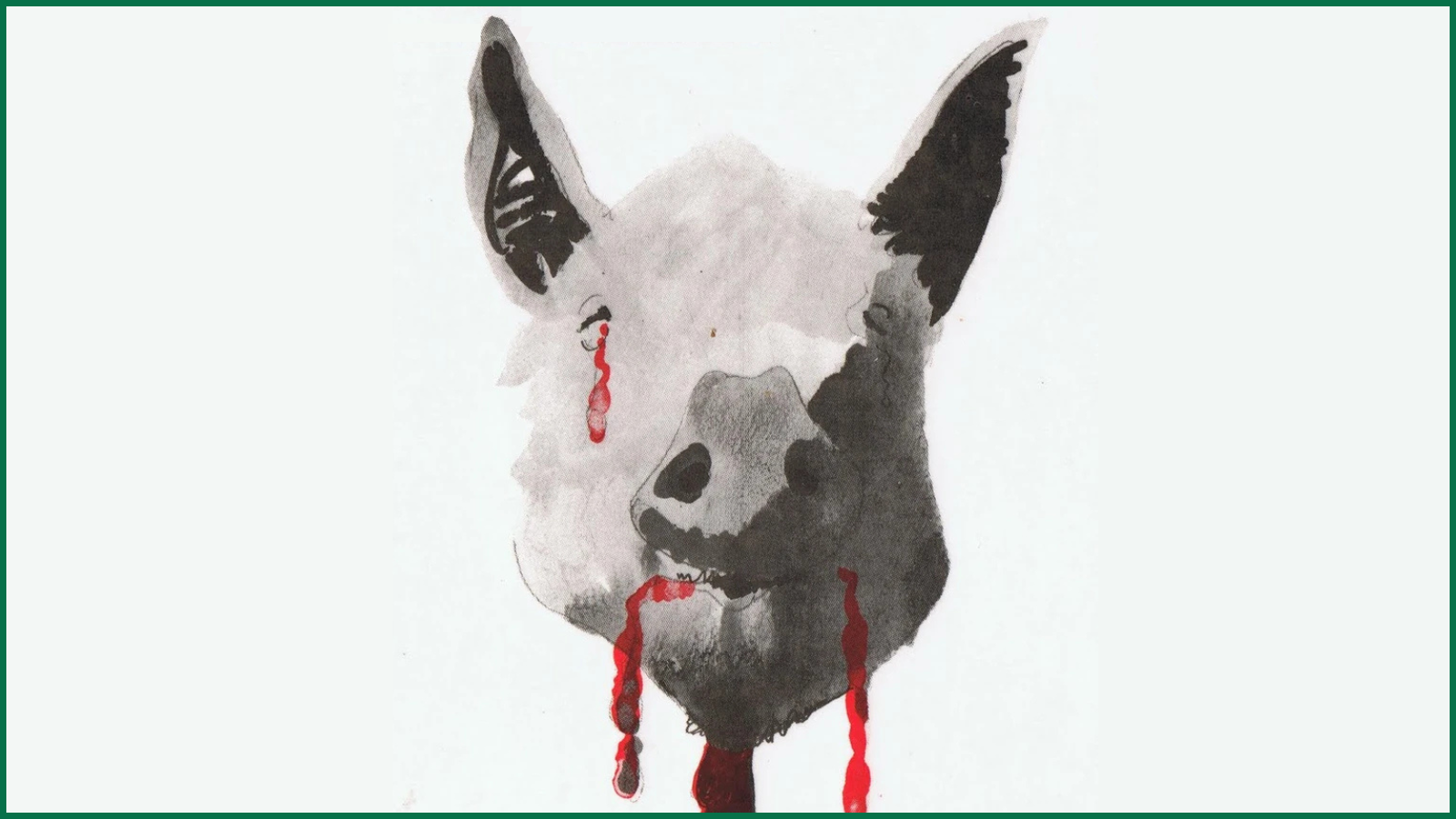
It seems the right will do anything but name capitalists as their enemy. While “globalism” can mean many things—including recognizing the global impact of local actions—the right tends to use the term as a sort of conspiratorial umbrella with which to shade their centrist opponents. In this vein, a globalist is someone who advocates trading off national sovereignty to a multinational governing body, such as the European Union or United Nations. Previous years have seen fixation with the World Economic Forum and their “Great Reset Initiative,” an alleged scheme to end personal property ownership through mind-controlling vaccines and outright seizure.
From a Marxist perspective, the frustrating aspect of the right wing globalist conception is the truth embedded within it. Globalization is characterized by multinational firms outsourcing employment, corporate-drafted free trade agreements, international warfare and the financial takeover of the economy by hedge funds, asset managers and banks. These trends have been a chimera for the left for some decades now, and past protests in Quebec, Seattle and New York attest.
The membership of corporate clubs like the WEF is drawn directly from the global capitalist ruling class. Meanwhile, international trade agreements like the USMCA and political organizations like the UN and OECD are subsidiary to the reality of global commerce and economic interdependence. In other words, “globalism” is a mental image projected by the actually existing liberal capitalist economic order. The right seeks to alter the image while the left wants to smash the projector.
Incredibly, Karl Marx and Friedrich Engels perfectly diagnosed the problem in 1848:
The bourgeoisie has through its exploitation of the world market given a cosmopolitan character to production and consumption in every country. To the great chagrin of Reactionists, it has drawn from under the feet of industry the national ground on which it stood. All old-established national industries have been destroyed or are daily being destroyed. They are dislodged by new industries, whose introduction becomes a life and death question for all civilized nations, by industries that no longer work up indigenous raw material, but raw material drawn from the remotest zones; industries whose products are consumed, not only at home, but in every quarter of the globe. In place of the old wants, satisfied by the production of the country, we find new wants, requiring for their satisfaction the products of distant lands and climes. In place of the old local and national seclusion and self-sufficiency, we have intercourse in every direction, universal interdependence of nations. National one-sidedness and narrow-mindedness become more and more impossible, and from the numerous national and local literatures, there arises a world literature.1
The “great chagrin of Reactionists” toward globalization during Marx’s lifetime has clearly never gone away—it is the root of the “globalist” slur. Many millions of people around the world rightfully bemoan the loss of local industries and a cosmopolitan economy that rapidly revolutionizes culture. But the right has never wrapped their arms around the problem, as evidenced by reflexive conservative support for corporate-friendly rates of taxation and deregulation that lubricate the globalization machine.
The reason why corporate-funded media and think tanks are so hostile to socialism is because it is the only remedy to what ails the capitalist economy. Unfair trade and the outsourcing of labour and capital is impossible under a system of nationalized finance, rational economic planning, public ownership of strategic industries and worker owned enterprises. Exceptionally low rates of taxation on workers are also possible under a system that allocates public sector surpluses toward infrastructure, as China proves. Facts are stubborn things and capitalism will one day have a final reckoning that puts an end to the contrived “globalist” contention once and for all.
“Fancy thinking the Beast was something you could hunt and kill! You knew, didn’t you? I’m part of you? Close, close! I’m the reason why things are what they are.”
—William Golding, Lord of the Flies.
For anyone thinking that Putin had overstepped boundaries when he invaded Ukraine, it turns out he was only ahead of the curve. Since that time we’ve had genocidal warfare visit Palestine, a president kidnapped from Venezuela, a starvation blockade imposed on Cuba and a criminal aerial bombardment come to Iran. Multiple crimes, in other words, and committed by successive presidential administrations of the West’s flagship state. No wonder the United Nations Secretary-General recently denounced international relations as a “law of the jungle.”
The Jungle Book
It must be a vestige of colonial history that conjures images of undulating spear tips and blood-stained fur whenever the jungle is invoked. This sort of iconography probably accounts for the jungle island setting of William Golding’s Lord of the Flies, the story about a group of schoolboys who get marooned during a military evacuation amidst a nuclear war. Initially, the boys are quite “civilized.” They elect a chief, hold orderly assemblies using a conch shell and maintain a signal fire to attract rescuers. But it doesn’t take long for these trappings of civilization to melt away under the tropical heat. Conflict divides the boys when the signal fire goes out and the hunting of a pig arouses primitive instincts, culminating in a spree of orgiastic violence. The aggressive faction of boys consumes the other by way of floggings and outright murder, and they eventually set the island on fire in an effort to flush out their first elected chief.
The great pre-Socratic philosopher Heraclitus wrote: “Fire of all things is the judge and ravisher.” We see this in Lord of the Flies, with the signal fire representing civilized order and the brush fire representing the desperate plunge into chaos and savagery. Golding possessed a cynical view of human nature that sees people animated by sadistic impulses in the service of selfish interests and power. This is a common position on human nature, also articulated by Chinese legalist philosophy and Thomas Hobbes’ “war of all against all” that characterizes life in a state of nature. Sigmund Freud adopted this position in his later writings as well, asserting the existence of a “primary mutual hostility of human beings” which civilization must tame by setting “limits to man’s aggressive instincts.”1
One commonality between Golding, Hobbes, Freud and the Chinese legalists is that they were all heavily influenced by the demoniacal experience of warfare.2 Witnessing first-hand the human capacity for violence leaves scars on the human psyche that are well documented. Through allegory, Golding asserts that Satan’s captain, Beelzebub—the Lord of the Flies—is not an external supernatural force, but is actually a force inside us, a force within. Freud appeals to the death instinct in order to explain human aggression, similar to Hobbes and the legalists who view aggression as a simple fact of our nature.
Human Nature?
Once that view of human nature is accepted, it is explained that human beings enter a social contract and form civilization as a refuge from our own terrifying base instincts. Violence and corruption in the world can be chalked up to inherently brutal instincts that inevitably infect all of our carefully designed social institutions and best laid plans. Although civilization can never be perfect, it remains the thin red line between orderly society and the violent anarchy of nature.
The only problem with that argument is that it isn’t true. There is real world evidence that rejects the cynics and supports a view that humans are naturally cooperative rather than hostile: in 1965 a group of six teenage boys from Tonga found themselves stranded on a remote Pacific island. Far from descending into an orgy of violence, they built shelter and divided chores. They worked together and planted a garden, hunted feral chickens, collected rainwater in deadwood and rotated cooking duties. They maintained a fire and strummed a makeshift guitar and sang songs in the evenings to lift their mood.
The experience of the Tongan castaways gels with Raymond Kelly’s “Prehistoric warlessness” hypothesis, asserting that conflict and violence between human groups was virtually non-existent up until the Neolithic Revolution.3 That does not mean that there were no instances of homicide or executions within groups—nobody has that answer—but systematic warfare was simply not a feature of the Paleolithic economy that dominated human evolution for hundreds of thousands of years. This is because incredibly low population densities, combined with relatively high natural abundance, provided no incentive for humans to engage in inter-tribal violence.
In our actual state of nature, warfare offered little gain in terms of resources but had the potential to destroy both warring parties with only a few casualties on both sides. It was therefore preferential to seek new territories on which to hunt and gather rather than fight over them. This is what explains human migrations out of Africa and our species’ rapid spread around the globe.
In a footnote, Karl Marx argues that philosophers “must first deal with human nature in general, and then with human nature as modified in each historical epoch.”4 Our human nature in general demands that we eat, drink, breathe, shelter, reproduce, etc. Modern human behaviour, such as language, art, music, abstract thought, planning and tool making arose to meet those needs. We can recognize that the universal behavioural traits of humans could not have been achievable in a Hobbesian “war of all against all” state of nature—every one of them required positive social intercourse in order to become characteristic of our species. It follows that cooperation in the context of low population density and relative natural abundance was the state of nature that defined our prehistoric evolution and are suggestive of “human nature in general.”
Civilization of Corruption
On the other side of the ledger is “human nature as modified in each historical epoch.” While our general characteristics concretized during the epoch of primitive communism, the expression of human behaviour began to vary wildly as environmental changes led to sedentary living, resource scarcity and class divisions that gradually permeating the social structure. The biological demands on human beings led us to developing a potential for many behavioural expressions—including turning our hunting spears on one another. But this potential for warfare and organized violence went unfulfilled until population growth and sedentism made it an economic necessity for one group to defend territory against another. From the Neolithic Revolution onward, a technological arms race and complex division of labour emerged to satisfy our biological needs. The resulting base and superstructure is history.
Jean-Jacques Rousseau rightly scolded Hobbes for taking modern, “civilized” people and ascribing their flaws to nature.5 The philosophical question is this: does human nature corrupt civilization or does civilization corrupt human nature? Marx and Rousseau affirmed the latter, and that is also where the preponderance of anthropological evidence lies. It is not our nature that commands a world plagued by corruption, greed, ecological destruction and warfare. Indeed, our ability to recognize these things as defects affirms a natural revulsion towards them. Although we have the capacity for greed and violence, we also have instincts that lead us toward love, generosity and cooperation.
Resource scarcity has prodded human beings into unleashing some of their worst potentialities. The good news about our current capitalist mode of production is that scarcity has become largely artificial by way of tremendous leaps in productive technology. It is entirely possible to defeat scarcity with a new, cooperative mode of production that finally unleashes our best potentialities. Until then, we are ruled by a Lord of the Flies, but not in the way that Golding imagined. The Lord of the Flies is not an internal, but an external force; an alien process of capital accumulation and rigged market forces that determines our class standing and incentivizes our worst behaviours.
Thanks for reading!
Footnotes:
Sigmund Freud, The Freud Reader edited by Peter Gay (W.W. Norton, 1989): 750. ↩︎
Specifically World War II, the English Civil War, World War I and the Warring States period of China, respectively. ↩︎
Raymond C. Kelly, “The evolution of lethal intergroup violence,” in PNASVol. 102, No. 43: 15294-15298. ↩︎
Karl Marx, “Conversion of Surplus-Value into Capital” in Capital, Vol. One. He is specifically critical of utilitarians here, pointing out the utility of human behaviour can vary wildly depending on the mode of production available. ↩︎
Is there a Marxist critique of intersectionality or did intersectionality come out of Marxism?
Thank you,
Lydia.
[Sent via Substack]
Hi Lydia,
“Intersectionality” is one of those politically loaded terms that evokes a lot of contemporary discourse around equity, diversity, inclusion, accessibility and cultural “woke” wars. Because Marxism is a four letter word to many people on the right, people like Jordan Peterson and James Lindsay have described progressive efforts to remedy racism and homophobia as Marxist in nature. This is nothing new, by the way. Environmentalists, feminists, literacy advocates and anti-segregationists have all worn the communist label at one time or another.
“Intersectionality” was coined by Kimberlé Crenshaw and elaborated on by Patricia Hill Collins and others to describe the interlocking of social prejudices, economic inequalities and political disadvantages that apply to a variety of historically oppressed people. For example, intersectional theory posits that a Black woman or a gay Asian will confront social and political obstacles contingent on their minority status and independent of economic class.
The concept of intersectionality is reasonable from the Marxist viewpoint. Marx himself observed a variety of race and gender-based discriminations amongst the working class in his own time. In factories, it was found that women and children could be exploited at lower wages than men.1 Amongst the English working class, the influx of Irish were reviled for their acceptance of lower wages and blamed for cheapening the labour market. And for the countries that had enslaved Africans for the plantation economy, Marx warned: “Labour cannot emancipate itself in the white skin where in the black it is branded.”2
Between the premises of intersectionality and classical Marxism, there is an overlapping understanding that class alone does not determine social standing within capitalism. The trend toward DEI hiring policies of corporations, diversity quotas at universities or inclusive on-screen representation is something that could have been predicted by Marx. As capitalism has matured and globalized, it has naturally acquired a more cosmopolitan flavour and more demands are placed on the system from an increasingly diverse crowd of consumers and workers. For this reason many capitalist multinational corporations and Hollywood studios have adopted diversity policies with enthusiasm.
As a result of diversity quotas, “woke” virtue signalling and the absorption of economic migrants by the West, antagonisms have arisen in society between majority and minority factions of workers, bureaucrats and entrepreneurs. Speaking of hostilities between ethnicities, Marx wrote:
This antagonism is artificially kept alive and intensified by the press, the pulpit, the comic papers, in short, by all the means at the disposal of the ruling classes…It is the secret by which the capitalist class maintains its power. And the latter is quite aware of this.
One can acknowledge the reality of historical oppression and simultaneously reject liberal remedies that seek to pit man against woman, coloured against white, queer against straight. Discrimination in any direction operates within the ruling class paradigm of artificial scarcity. Instead, socialism posits economic solutions of universal application: socialized housing, public healthcare, full employment targets and freely accessible higher education. Fair trading practices must be developed with Global South countries in order to eliminate exploitation and reduce the number of economic refugees.3
In the long run, it is only an economic base that strives toward universal abundance instead of capitalist profit that is capable of abolishing the social divisions manufactured by history. And that, I submit, is the Marxist position.
The international economy must be one that minimizes global poverty and reduces the demand of people to flee their homeland. Marx understood the challenges of accommodating large numbers of economic refugees in foreign societies and, in the case of the Irish, he attacked the root cause by demanding that Ireland be liberated from the claws of English landlords and capitalists. ↩︎
China is one of the most misunderstood countries in the West for all of the predictable reasons: the far-away geography, the curious culture, the unfamiliar politics, the ferocious economy. It is either portrayed as a one-dimensional menace to democracies or, less often, as the last hope to save the biosphere or the Global South. China can be the rigid communist or the wild capitalist—it only depends on the point of view of the observer. Dan Wang is the latest to re-cast China, an engineering state in contrast to the lawyerly society of the United States. He hit the shore of this discovery when it occurred to him that many of America’s founding fathers were lawyers and Deng Xiaoping had promoted a lot of engineers in the 1980s. According to Wang, this is the reason why China builds a lot more stuff than the U.S. today. But he’s wrong.
What Wang discovered is only a basic difference between Marxist-Leninist societies and liberal capitalist ones. The Soviet Union was dominated by engineers, as China and Vietnam are today. Even Cuba has been described as “a society of engineers.” Conversely, western bourgeois revolutions were all dominated by those with legal backgrounds; Thomas Jefferson in the U.S., Oliver Cromwell in Britain, Maximilien Robespierre in France—to name only the most notorious. The first prime ministers of Canada, Australia and India were also lawyers. But if the American “lawyerly society” was able to out-build and outproduce the Soviet engineering state, why can’t it do the same against the Chinese?
The answer has little to do with lawyers or engineers and everything to do with economics and governing ideology. Whereas the American commitment to capitalist class power led it directly into a deindustrialized, cannibalistic financial economy, China’s commitment to building socialism led it to becoming the greatest workshop in human history, in command of entire supply chains and advanced technology. America had built a great industrial power by the early twentieth century and organized labour had won considerable political power throughout the New Deal and Cold War eras. But this unravelled almost the moment the Cold War wound down. The disciplining of the western workforce was inevitable in an economic system pursuing profit for the sake of profit, and it arrived in the form of offshore manufacturing, real estate speculation, vulture capitalism, super-exploited migrant labor and intensified corporate lobbying.
Marxism-Leninism in China
China, meanwhile, was an accident of epic proportions. Whereas other Marxist-Leninist states in the Soviet bloc were successfully marginalized from the global capitalist economy, the U.S. under Nixon and Kissinger embraced China in a successful effort to defeat Moscow by exploiting the Sino-Soviet split. Successive presidential administrations gambled that global capitalism would so thoroughly corrupt Chinese socialist aspirations that the country would abandon Marxist thought altogether. This has turned out to be a bad bet if the words of paramount leader Xi Jinping are any indication: “If we deviate from or abandon Marxism, our Party would lose its soul and direction. On the fundamental issue of upholding the guiding role of Marxism, we must maintain unswerving resolve, never wavering at any time or under any circumstances.”
Statements like this from Chinese leadership mystify western audiences, both left and right. Too many people view socialism through the narrow paradigm of the Soviet system or left wing politics at home and conclude that China has hopelessly deviated from Marxist theory. But what if it is the western left that is aimless and the Soviets who were forced to deviate? Western politics is so saturated with capital that even nominally “progressive” forces don’t understand the corporate interests being served by mass migration crises and obsessional identity politics. And the Soviet Union, facing multiple foreign invasions at the outset, rapidly nationalized most of its economy and placed it under a central command in order to first stave off European aggression and then counter American containment strategies. The Soviet Union was able to achieve incredibly high levels of human development and military superpower status, but balancing these two priorities against western counter-pressure proved unsustainable over the long haul.
China pursued somewhat similar policies to the Soviets until American rapprochement came in 1972, when Nixon visited Mao. Imperial pressure against China was lifted, culminating in large amounts of western commercial investment by 1979 and a U.S. State Department upgrade for China to “friendly, developing nation.” This is where the great misunderstanding of China began: for the left, China was seen as selling out the socialist movement to imperialists and for the right, China was increasingly seen as a nascent capitalist champion. Neither side was completely right or wrong.
China did embrace capitalist investment in a way that was not geopolitically possible for other Marxist-Leninist states. The private sector of China is notoriously wild and cutthroat. At the same time this does not represent a reversal of the Marxist course in China, as originally charted by Mao. Consider the Chinese flag: four small stars representing the national bourgeoisie, petit bourgeoisie, the working class and the peasantry. Mao, while fiercely antagonistic toward rent-extracting landlords, had a different understanding of China’s domestic capitalists:
The national bourgeoisie differs from the imperialists, the landlords and the bureaucrat-capitalists. The contradiction between the national bourgeoisie and the working class is one between exploiter and exploited, and is by nature antagonistic. But in the concrete conditions of China, this antagonistic contradiction between the two classes, if properly handled, can be transformed into a non-antagonistic one and be resolved by peaceful methods.1
In Marxist theory, capitalism is seen as a major progressive advance over the feudal mode of production. When Mao came to power, China was largely a feudal state. For this reason Mao favoured China’s capitalist elements over the landlords of the feudal order. Mao proposed a five-tiered structure of ownership during China’s transition phase which has been applied throughout the country: state-owned enterprises, cooperative land ownership, individually owned businesses, private corporations and public-private partnerships. The Communist Party of China, while it bristles under imperialism, has always recognized this classical Marxist principle: capitalism is the mother of socialism, not its enemy. Karl Marx:
The bourgeois period of history has to create the material basis of the new world—on the one hand universal intercourse founded upon the mutual dependency of mankind, and the means of that intercourse; on the other hand, the development of the productive powers of man and the transformation of material production into a scientific domination of natural agencies. Bourgeois industry and commerce create these material conditions of a new world in the same way as geological revolutions have created the surface of the earth. When a great social revolution shall have mastered the results of the bourgeois epoch, the markets of the world and the modern powers of production and subjected them to the common control of the most advanced peoples, then only will human progress cease to resemble that hideous pagan idol who would not drink the nectar but from the skulls of the slain.2
Having built a mass-party of over 100 million members, the CPC believes that China has already completed its great social revolution and have set themselves the task of mastering “the results of the bourgeois epoch.” In Building Socialism with a Specifically Chinese Character, Deng Xiaopingdescribes foreign investment as “a major supplement in the building of socialism,” with the goal of “highly developed productive forces and an overwhelming abundance of material wealth.” This is a redux of Engels, who said that the forces of production “must be multiplied to the extent necessary for the creation of a communal society” before private property can be abolished.3
Whereas the advanced capitalist countries were able to develop their productive forces through a historical process involving colonial extraction, debt bondage, slavery and corporate-driven markets, China is doing the same with a combination of foreign capital investment, state owned enterprises, domestic start-ups and state-dominated markets operating under the umbrella of five year plans and consultative democracy.
The Limits to Capital
Since the dawn of civilization, Marx noted, the property relations of an economy eventually become barriers to the further advancement of technology and production.4 In feudalism, there was only so much progress that was possible in an economy dominated by illiterate subsistence farmers paying rent to lords. The limits inherent to the feudal order are what eventually provoked daring exploration missions leading to the discovery of the Americas, European mercantilism, the plantation economy and subsequent Industrial Revolution.
As industry has progressed, it has gradually given way to rent-seeking financial monopolies and Big Tech companies which are posing enormous barriers to production in western economies. Even our Gross Domestic Product (GDP) data can no longer be trusted, as the economist Michael Hudson explains: “Bank penalties and fees are now counted toward GDP rather than as an economic cost. GDP accounting is now a travesty that credits finance as producing a product rather than zero-sum transfer payments.”5 Our system cannot solve this problem because our system is the problem—and no quantity of Trumpian neofascist rebellions will change the fundamental contours of the western economy. Only a revolution can do that.
Post-revolutionary China, on the other hand, has seen enough to avoid these pitfalls. Financial capital currently plays an important role allocating resources toward innovation and productivity but, left to its own devices, it will devolve into debt predation, real estate speculation and inflating unproductive assets like stocks and cryptocurrencies. According to Marxian economics, money has a price but only production can create objective value. Banks in China are state owned and directed to fulfill the five year plans that build their country. Salaries and compensation for financial service managers have been reigned in and regulatory frameworks ensure that Chinese hedge funds invest in domestic products like DeepSeek rather than asset prices. It’s been said that the West can never produce like China and this is why.
Projects from state owned enterprises, clockwise from left: Raffles City, Huajiang Grand Canyon Bridge, China Energy Engineering Corporation. The public sector can build according to use rather than profit.
Marx and Engels supported free trade and industrial competition as a means of provoking technological revolution and working class development.6 China has used both instruments to build out world-leading high speed rail, renewable energy infrastructure, electric vehicles, high tech skyscrapers and record-setting bridges. Unlike capitalist countries that over-promise and under-deliver on almosteverything, China’s public sector consistently beats its own targets. They have a working class of 772 million people, of which 500 million are considered middle class. But the contradictions created by technological change, fluctuations in value and financially ruinous competition often spur crises, and these crises promote changes to economic relations and political orientation.
Socialism with Chinese Characteristics
For China, crises precede expansion of the public sector. Banking, land and resources are already under socialized ownership. Further, there are 362,000 state owned enterprises in the country comprising 60% of total market capitalization. With many people forecasting future economic turbulence, economists Minqi Li and Lingyi Wei see a China that is well-positioned to:
Either take over the remaining capitalist enterprises or invest in new socially owned enterprises to replace the bankrupt capitalist enterprises. Eventually, this could pave the way for social control over economic surplus, to be used for the free development of all individuals in manners to be determined by democratic decisions.7
Throughout their work, Marx and Engels stressed the need to not simply oppose capitalism but to go beyond it.8 Neither the workers’ state of the Soviet Union nor the welfare states of western nations have actualized this concept.9 By prioritizing production over distribution, China is doing exactly what Marx outlined in his Contribution to the Critique of Political Economy and Engels in his Principles of Communism: driving the forces of capitalist production to their technological limit before crossing the barricade that capitalist relations inevitably impose.
The colossal solar plants, hydro dams and wind farms that China is constructing are not just for show. They are the building blocks of a fully-automated robotic economy powered by the Sun. Under social ownership, an advanced economy of this type makes class distinctions extinct. It makes economic democracy viable, free development of individuals possible and the Communist Party unnecessary—as Mao envisioned.10
In America, plantation slavery funded industrial capitalism and industrial capitalism, in turn, made slavery obsolete. In China, capitalism is funding a high-tech socialist economy and socialism, in turn, will make capitalism obsolete. Marx wrote in The Poverty of Philosophy: “The hand-mill gives you society with the feudal lord; the steam-mill, society with the industrial capitalist.”11 China finishes the thought: “And the socially-owned robot gives you society without class.”
Karl Marx, “The Future Results of British Rule in India,” Dispatches for the New York Tribune: Selected Journalism of Karl Marx (Penguin, 2007), 125. ↩︎
Karl Marx, “Preface” of A Contribution to the Critique of Political Economy: “At a certain stage of development, the material productive forces of society come into conflict with the existing relations of production or—this merely expresses the same thing in legal terms—with the property relations within the framework of which they have operated hitherto.” ↩︎
Michael Hudson, “Finance Capitalism versus Industrial Capitalism: The Rentier Resurgence and Takeover,” in Review of Radical Political Economics, Vol. 53, No. 4: 12. ↩︎
Karl Marx, Capital Volume II (Penguin, 1992): 250. ↩︎
Minqi Li and Lingyi Wei, “Surplus Absorption, Secular Stagnation & the Transition to Socialism in China,” in Monthly Review Vol. 76, No. 5: 25. ↩︎
Erich Fromm, “Marx’s Concept of Socialism” in Marx’s Concept of Man: “Marx, the man who every year read all the works of Aeschylus and Shakespeare, who brought to life in himself the greatest works of human thought, would never have dreamt that his idea of socialism could be interpreted as having as its aim the well-fed and well-clad “welfare” or “workers’” state. ↩︎
Mao Zedong, On Contradiction and On Practice (Midnight Press, 2023): 47. “To build the Communist Party is in fact to prepare the conditions to eliminate the party and all parties.” ↩︎
To be honest, I did not pay much attention to China until I learned that a number of my colleagues were using DeepSeek and preferred it to the American ChatGPT. Since then I have become aware of their advanced renewable megaprojects, electric vehicles and 6G technology, the Great Green Wall, their leading high speed rail network and epic skylines and bridges.
After the recent military parade, a number of people have told me that the advanced equipment on display may not be real, that the West still leads in terms of military power and computer chips. But considering the other ways they have left Western nations behind, I am not so sure. Are they the new superpower? Is China for real?
Thanks,
Bruce.
Dear Bruce,
You’ve answered half of your own question: if the existing civilian technology and visible infrastructure in China is more advanced than anywhere else, why wouldn’t their military be the most advanced as well?
There are obvious safety reasons explaining why live explosives aren’t going to be marched down the centre of Beijing. But given China’s successful track record deploying technology, it is likely that the weapons on display are already operational or will soon be in production. There were many potential customers in the audience, after all.
China is definitely for real. The question about superpower status is difficult to answer and I’ll refer you to a previous article about where things currently stand between Chinese and American supremacy. Questions of that sort are often only apparent in hindsight. Ten years from now, we may look back at the 2025 China Victory Day Parade as a decisive turning point in world history.
The doubters will claim that the power of these weapons is unknowable until they are tested in battle, as if rooting for war. If Xi Jinping has learned any lessons from the great Chinese military strategist Sun Tzu, let’s hope it was this: “The skillful leader subdues the enemy troops without any fighting.”1 With a U.S. shift away from Asia on the horizon, Xi’s parade may have done the trick.
When Heraclitus said, “no man ever steps in the same river twice, for it is not the same river and he is not the same man,” he was emphasizing the permanency of an unyielding process of change through time. Time does not pass calmly forward—it is forceful, obliterating the present and fossilizing the past, with all matter standing as its witness. The essence of this perpetual motion found in nature is what dialectical materialism seeks to grasp as a framework for the analysis of everything in the universe, from the tiniest atoms to the largest stars. Put simply, dialectics is the study of change.
The first thing to establish is that the laws of nature—including the speed of light, gravitational attraction, conservation of energy, etc.—were woven into the universe at its inception. Current science holds that our universe was born from immense countervailing forces: a sub-atomic singularity of infinite density and infinite heat that erupted in a Big Bang.1 In dialectical terms, countervailing forces are referred to as contradictions and contradiction not only set the universe in motion, but they provide the friction that keeps it moving. For example, we see our solar system locked in an orbital tug of war between the gravities of planets and their Sun, cosmic collisions that send whole worlds spinning and tensions between galactic megastructures in a universe that has been inflating outward since the start.
Human societies, though notoriously difficult for the subjective observer to predict, must adhere to natural laws of motion and change all the same: “The reason is that nature and society are not different realities, but are co-evolving existences, in which society is asymmetrically dependent upon the larger natural world of which it is a part.”2 This realization is what gave impetus to Karl Marx’s ingenious application of Hegel’s abstract dialectical method to the concrete, material world in which we live. He described the motion of human societies as elliptical, as in a spiral galaxy or solar system: “For instance, it is a contradiction to depict one body as constantly falling towards another, and as, at the same time, constantly flying away from it. The ellipse is a form of motion which, while allowing this contradiction to go on, at the same time reconciles it.”3 Progress is thus neither linear nor obvious, since change is the product of conflict and creation is the outcome of destruction.
Although Marx did not formally codify the dialectical method he used to present his work in Capital and Grundrisse, his long-time collaborator Friedrich Engels did summarize three main ontological principles:
The transformation of quantity into quality. Also known as a phase transition, this occurs when an accumulation of some input reaches a tipping point, creating something new. For example, liquid water will turn into steam once a quantity of heat has been reached. Or, in outer space, a molecular gas cloud will gradually accrete into a ball and ignite the fusion of a star once a certain threshold of gas and dust have amassed together. In human societies, quantities—of technologies, climate changes, population densities, natural resources and capital accumulation—have led to changes in the quality of society, as seen during the Neolithic Revolution, rise of ancient empires, feudalism and Industrial Revolution. In the contemporary period, changes to quantities are occurring at an exceptionally fast pace, with consequences to quality still unknown.
Interpenetration of opposites. This refers to two elements that are simultaneously opposite one another and interdependent on the opposition in order to exist. For example, light cannot exist without dark or heat without cold. Magnetism relies on the opposition between north and south poles to create a magnetic field and magnetic monopoles simply do not exist. In human society, this phenomenon is most poignantly observed with economic classes. While classless association has been the norm in human evolutionary development, classes themselves can only exist in relation to others. For example, a slave owner cannot exist without slaves. Nor can a landlord exist without tenants or a capitalist without workers. Even the much-discussed “middle class” implies, by mere mention, the existence of an “upper” and “lower” class in relation to it. The interaction of these various classes, their interpenetration with one another, is what accounts for the dynamism of society.
The negation of the negation. As mentioned in the opening paragraph, time fossilizes the past, it embeds history into the present and carries it forward into the future. When a cloud of gas and dust collapses into a star, the gas and dust are not deleted from existence but, rather, transformed into something new and complex. The gas cloud is negated by the star, and the star is eventually negated by a supernova—a stellar explosion of heavy metals and oxygen and helium back into space. Through a process of negation, a gas cloud is thus transformed into the planetary building blocks of the universe. On Earth, life forms are constantly negated by their own evolution into something else better adapted to actually existing environmental conditions, such as dinosaurs into birds. The past is found to mediate the present in all circumstances, however. While some dinosaurs evolved into birds, apes into hominids or flowering plants into fruit-bearing ones, the parameters of these evolutionary negations is set by the physical properties received from the past. This is why grass cannot evolve into an amphibian and humans cannot evolve into lizards.
In terms of human social development, it was the advent of sedentary living, private property and class structure which negated the classless tribal societies that conditioned human evolution for hundreds of thousands of years. The negation of class society by a higher-order classless association is made possible by technological progress and the human desire for cooperation, leisure and self-directed activity—desires embedded in the present that are received from our collective past. As a molecular gas cloud is transformed into heavy metals, the free association of humanity’s tribal past may be transformed into a technologically advanced, classless and abundant global civilization.
Cooperation is a carryover from our collective prehistory—the primordial pillar to our monumental success as a species. Class society perverts this tendency toward cooperation by placing the majority of humans into the service of an elite ownership class—with side effects of violent competition and a degraded biosphere that threatens our existence. It is the negation of classes and the fomenting of universal cooperation innate within us that provides the dialectical basis for a peaceful and healthy free association of producers.
Singularities of this nature are also posited to exist at the centre of black holes, leading some scientists to speculate that black holes serve as a point of origin for our universe and infinite more. ↩︎
John Bellamy Foster, “The Return of the Dialectics of Nature: The Struggle for Freedom as Necessity,” Monthly Review, Vol. 74, No. 7: 13. ↩︎
Karl Marx, Capital, Volume One (Ancient Wisdom Publications, 2019), 198. ↩︎
It was Aristotle who first observed that civilization does not really begin until an economic surplus is produced by one class for use by another—a point taken up by Karl Marx and Friedrich Engels in the opening line of The Communist Manifesto: “The history of all hitherto existing society is the history of class struggles.”1
Without slaves and masters, plebeians and patricians, serfs and lords, workers and capitalists, then systems of writing, military, philosophy or political authority could not have been developed and expressed by civilization. While a surplus depends on a labouring majority of the population to produce it, throughout history it has been captured by a minority of ruling class elites who have used it to entrench authority. The struggle over production and control of this surplus is known as class conflict and it manifests itself in myriad ways—terms of interest and debt, governmental leadership, monetary policy, the dictatorship of the workplace, cost of education and healthcare, decisions regarding the social safety net, access to home ownership and the rights of tenants, etc. It is within this confrontation between elites and the labouring masses that all political decisions are made and social direction is taken.
Class systems, while persistent and stubborn, have no basis in nature and present themselves as an obstacle to harmonious living. This is why both Thomas Jefferson and Jean-Jacques Rousseau believed indigenous societies provided more happiness and social stability to their members, as fruits of labour were democratically allocated and law was a matter of popular opinion instead of a violently-enforced dictate by one class onto another. Marx writes:
One thing, however, is clear—nature does not produce on the one side owners of money or commodities, and on the other, men possessing nothing but their own labour-power. This relation has no natural basis, neither is its social basis one that is common to all historical periods. It is clearly the result of a past historical development, the product of many economic revolutions, of the extinction of a whole series of older forms of social production.2
As discussed in the article on capitalism, it is only when the capital owner meets in the marketplace those with nothing but their labour to sell that the capitalist mode of production is born. From this point onward, workers and capitalists are locked into an interpenetration of opposites and go on to supplant the previously dominant lord and serf class relation in Europe before conquering the globe. Prior to the Industrial Revolution, proto-capitalism could only be concerned with looting existing riches from the technologically disadvantaged. And while the coercive elements of capitalism have never disappeared, it did manage to become a mode of production in its own right—the most productive to ever exist—owing to the unlocking of resources on a massive scale, subsequent technological innovation and the forceful drawing of an urban wage labour pool from the countryside. The latter is a process still underway in many less-developed parts of the world.
Like feudalism and the slave economies of antiquity, multiple classes exist along the base and superstructure of capitalism: bureaucrats, intellectuals, media personalities, contractors and soldiers exist alongside destitute slum-dwellers, drug addicts and the fully homeless. But the employer–employee relation is dominant because it enables vast wealth and power to concentrate in few hands and produces almost every available good and service for consumption. These two classes are inter-dependent, they cannot exist without the other and yet they possess contrary material interests: the employer wants to keep wages paid for labour time as low as possible, while the employee wants the opposite. Owing to this contradiction, capitalism has witnessed a succession of struggles over union-organizing, outsourcing of jobs to cheaper, less-regulated countries and political conflict at the state level over public benefits and investment.
Consciously recognized or not, class conflict between employers and employees provide much of the friction that animates our politics, society and individual lives. Despite the inter-dependence of these two great classes, the power imbalance clearly favours capital owners. While an employer may choose to hire a worker to assist in generating profits, the employer will have many prospective employees to choose from and, in any case, does not need any specific worker in order to survive. This is not true for the worker, who must find employment to survive and will have far fewer employment prospects available to them than an employer will have prospective employees. In other words, as presently constructed, the capitalist class needs the working class to create value but the working class needs the capitalist class to actually survive.
This power imbalance that exists at the economic base of capitalism likewise manifests in the superstructure. Whereas the Catholic Church played the dominant role in mediating class relations and asserted the nobility’s “divine right to rule” during feudalism, it is the state that performs this function in capitalism. As the locus of production shifted from farmlands and enslaved populations toward a global web of resource extraction and colonial markets, a robust state apparatus in the service of the capital class became necessary to ensure the protection of property throughout the supply chain:
State formation and the origins of financial capitalism were closely connected, and this nexus provided a way for prosperous urban citizens in high finance, a small elite, to establish their influence on politics while simultaneously making their entrepreneurial success dependent on powerful rulers and their shifting political fortunes.3
It is through the capitalist state apparatus that much of the world became exploited as colonies or subjugated by unequal treaties in the service of investment. It is through this state apparatus that great wars over resources and markets are fought, where great masses of debt are leveraged, where prisons are filled, where school curriculums are devised, where infrastructure projects are authorized, interest rates are set and budgets are formed. All of this is carried out under the direction of elite stakeholders, while the public is only roused to “vote” every so often for this-or-that corporate-backed political party. Since this vote is the only meaningful say that the public has in its own politics, Emma Goldman adroitly observed: “If voting changed anything, they’d make it illegal.”4
If the state were in the hands of the public, it would be unlikely to mediate class conflict in the interests of capital owners. But in the hands of financial capital, the state has the unique ability to socialize costs and privatize profits. For example, the 2003 invasion of Iraq was funded largely by debts leveraged against the American taxpayer and fought with the bodies of working-class sons and daughters. Meanwhile trillions of dollars of public money disappeared into the pockets of bondholders and the CEOs of defence contractors. Another example was during the COVID-19 response when central banks around the world acted in unison to eliminate interest rates and prop up stock market assets by printing money at a time of mass lay-offs and restrictions on movement for the non-yacht owning public. In the aftermath, it is no surprise that the capital owners came out wealthier than ever before while the global working class suffers crippling inflation and a punitive cost of living. This is the capitalist state working as intended—socializing costs and privatizing gains—and this service is the chief reason why “a stateless capitalism is unthinkable.”5
From its outset, capitalism was predicated on the violent destruction of traditional societies, the coercive acquisition of wealth, class conflict, environmental ruination and reinventions of production in the interest of profit. These core characteristics have hardly changed. Workers and consumers alike are powerless relative to the capital-controlled market, and the state is in the hands of those same elite interests lurking behind every crisis, making a serene life on this Earth nearly impossible. While capitalist technology has given humanity the tools to solve economic scarcity, employing them in a socially and ecologically harmonious way is stonewalled by a state of class contradiction. Class consciousness describes the active decisions of one class to pursue their interests by state capture and force. The economic elites have accomplished this. But there is an emerging consciousness bubbling under the surface of digital connectivity, a new language developing in the full sunlight of existing oligarchy. Once working class consciousness has crystallized, the construction of a new, liberatory government may commence.
In the typical western city, one does not have to search very hard to find the signs: derelict buildings, littered streets, homeless with pockmarked faces pushing carts filled with bottles. Across North America, opioid abuse and a cost of living crisis have sent homeless populations climbing against a backdrop of city blocks scorched by wildfire, ground tremors from fracking, mass flooding by storm surges and condos of glittering glass. In 2018, Chris Hedges published one of the most potent illustrations of capitalist alienation with America, The Farewell Tour.
In the book, he sets the table early: “Hurricane after hurricane, monster storm after monster storm, flood after flood, wildfire after wildfire, drought after drought will gradually cripple the empire, draining its wealth and resources and creating swaths of territory defined by lawlessness and squalor.”1
Hedges then introduces us to Christine Pagano, a woman who fell into drugs during high school after her stepfather was caught sleeping with her 16-year-old classmate and her home life imploded. Years after experimenting with heroin, she would turn to prostitution in order to feed a $500 heroin habit and sold her body in Jersey City to Wall Street traders, business executives and bankers “who were the prostitutes’ main customers.”2 She shares that this was preferable to Camden, New Jersey, where “‘the poverty is so bad. People rob you for $5, literally for $5. They would pull a gun on you for no money.’”3
Then there is Robin Rivera, the product of a troubled home who later earned minimum wage at a hair salon in Los Angeles. She accepted a proposition from a talent agent in the pornography industry in the hope of making ends meet. “‘They tied me up and hung me from the ceiling,’ she said,” adding that she was also electrocuted with a cattle prod. “‘They put a hook in my ass’” and “‘tied my ponytail to it. They tied my arms to a barrel. They tied my legs to a barrel. He put a vibrator on me…Five hours is a long time. For $900.’”4
Depravities of this kind are rarely discussed in the media. This could be due to the sheer numbers of those who indulge—up to one-quarter of web searches and one-third of downloads relate to pornography, after all. But it is corollary to the economic imbalances and deprivations of the economic sphere, the “rough neighbourhoods” on the other side of the tracks in our cities or the beggars encountered at home and abroad. As noted in “Ecology,” capitalism turns both land and people into commodities—“venal objects”—and this becomes the lived experience for all-too-many in rich and poor countries alike.5
When Marx discusses “alien capital” confronting “alien labour,” he is spotlighting two economic processes which move on their own momentum, as though independent of human agency.6 Human beings are creative by nature and we define ourselves by conscious, self-directed activity. Under capitalism, this is rarely the case. Individuality and self-expression is seldom found in production; work is transactional and conducted under authoritarian oversight for a wage on which to subsist. In his Economic and Philosophic Manuscripts, Marx writes that “the need for money is therefore the real need created by the modern economy, and the only need which it creates.” It is this need of money that elevates exchange-value to the highest priority, with use-value of only secondary consideration to a profitable exchange. Work is reduced to a pursuit of that universal commodity, money, and it is only in that cramped space of time off the job when we are free to express ourselves, largely as consumers. Due to the energy consumed by employment, leisure itself is distorted and becomes a site of excess and expense. Born of this common need for money, we see an extension of products which appeal to our base instincts, subservient only “to inhuman, depraved, unnatural and imaginary appetites”—of the sort highlighted in the above paragraphs.7
As psychoanalyst Erich Fromm interpreted Marx, “alienation leads to the perversion of all values.” Because economic aims are “the supreme aim of life, man fails to develop any truly moral values,” and “the riches of a good conscience, of virtues, etc.” are impossible as they lack monetary impetus.8 The capitalist system of production severs society from the splendour of nature and turns individuals into replaceable parts—whether they be numbered employees and managers or prostitutes and johns. Freethinking and meditative contemplation is thus muzzled with individuals crippled by a pursuit of exploitation and libidinous excitations. Downstream from a mountain of emissions and cheap labour are resort vacations and cruises, restaurants serving high-priced cocktails and IMAX movies with sensory-melting special effects. This is what passes through the free time of conforming consumers under capitalism today.
Engels saw this “spiritual-barrenness” through all echelons of society. Corporate conglomerates are the fountainhead of prepackaged, empty pleasures but there is a social context to it. Everyone seeking to maintain or improve their standing within the capitalist hierarchy ultimately become slaves to their own employment—even elite financiers and CEOs become “slave of his own capital and his own profit-getting.”9 Even the ruling class beneficiaries of capitalism’s wealth find themselves with limited agency when it comes to maintaining their standing. If they do not open mass markets, pollute, debt-shark or shrewdly exploit, they will simply be overtaken by a more capable servant of capitalist expansion.
The total alienation of the individual by the ever-complex and expanding process of capitalist production is the reason behind mental health epidemics. In the United States, 90% of people believe there is a crisis of mental health and 20% experience acute symptoms. In Canada, almost half the population is estimated to experience episodes of mental illness by age 40. In Britain, depression is the condition most commonly encountered by the National Health Service and the instructor Mark Fisher observed: “Many of the teenage students I encountered seemed to be in a state of what I would call depressive hedonia…an inability to do anything else except pursue pleasure. There is a sense that ‘something is missing’—but no appreciation that this mysterious, missing enjoyment can only be accessed beyond the pleasure principle.”10 Supporting the Marxist theory of alienation are the manystudies concluding that the more a country is penetrated by capital relations, the worse the mental health becomes. Fisher explains: “When it actually arrives capitalism brings with it a massive desacralization of culture. It is a system which is no longer governed by any transcendent Law; on the contrary, it dismantles all such codes, only to re-install them on an ad hoc basis.”11 The implication is that less-developed countries contain communitarian cultures that are less eroded by capital and experience lower rates of mental illness when compared to the hyper-competitive, technologically advanced and socially isolating realms of wealthy capitalist nations.
But the task of building an unalienated, harmonious society necessary to individual freedom and human flourishing will not be accomplished by sliding backward on the development scale. Marx did not advocate for an anti-capitalist world, but rather, a post-capitalist one. This means negating the liberal order by incorporating capitalism’s high economic productivity while removing its deleterious effects on the social fabric and natural environment. Capitalist productive forces have brought humanity an enormous capacity to produce but an incredibly inefficient and wasteful manner of allocation. By exerting a conscious, democratic control over the production process, a material output could be allocated according to need rather than payment. The pursuit of exchange-values creates an alienating and immoral world but the pursuit of use-values reverses this effect. Houses to live in rather than speculate with. Medicine to save lives rather than profit. Nature for its aesthetics and life-giving functions rather than plunder. Food grown for nutritional quality instead of an ultra-processed quantity.
Use-values demand broad input from consumers and workers, they demand the elimination of noxious products and exploitative services from production, they demand positive, humanistic outcomes from artificial intelligence, they promote free time and activity that nurtures the latent talents within all individuals. In other words, they place moral virtue, community, family, mental tranquility and natural beauty into the heart of economic production.
A post-capitalist and unalienated free association is one where people are their own masters, liberated from state authority, irrational market fluctuations and corporate dictates. To quote Marx, “the associated producers regulate their interchange with Nature rationally, bring it under their common control, instead of being ruled by it as by some blind power; they accomplish their task with the least expenditure of energy and under conditions most adequate to their human nature and most worthy of it… Beyond it begins that development of human power, which is its own end, the true realm of freedom, which, however, can flourish only upon that realm of necessity as its basis.”12
When Vladimir Lenin took power after a bloodless coup in November, 1917, shockwaves reverberated through imperial hallways the world over. The world’s first working class government was formed in Moscow and the response was swift. The world’s first working class government was formed in Russia and the response was swift. Intervening were 70,000 Japanese, 50,000 British, 15,000 French, 13,000 American and 4,700 Canadian soldiers ordered to throw back the socialist forces that had deposed the Tsar and aid the ultra-right Russian White Army in seizing Moscow. The Reds, of course, won this war with the support of peasants and workers. But it wouldn’t be long until the USSR was attacked yet again, as the largest invasion force ever assembled poured over Soviet borders under the command of Nazi Germany. In the years following World War II virtually every successful socialist movement—China, Cuba, Chile, North Korea, Afghanistan, Laos, Nicaragua and Vietnam—found itself enmeshed in bloody battles with the US army or CIA-funded guerrilla saboteurs. The 20th century is pockmarked by so much needless bloodshed between advanced Western countries and chronically-poor nations attempting to chart a sovereign path to modernity.
Under the unfortunate conditions of extreme foreign aggression and economic poverty, a heavy-handed, security-focused and state-oriented “siege socialism” developed—a term coined by Michael Parenti.1 They were tasked with both warding off foreign invasion and simultaneously rapidly growing the industrial base and social development of their people. Like their capitalist counterparts in the first and third worlds, these second-world socialist countries had plenty of defects and sometimes-horrific blights on their record of governance. But Parenti pushes back on any judgement of pitiable failure on their part:
To say that “socialism doesn’t work” is to overlook the fact that it did. In Eastern Europe, Russia, China, Mongolia, North Korea and Cuba, revolutionary communism created a life that was far better than the wretched existence they had endured under feudal lords, military bosses, foreign colonizers and Western capitalists. The end result was a dramatic improvement in living conditions on a scale never before or since witnessed in history. State socialism transformed desperately poor countries into modernized societies in which everyone had enough food, clothing and shelter; where elderly people had secure pensions; and where all children (and many adults) went to school and nobody was denied medical attention. Some of us from poor families who carry around the hidden injuries of class are much impressed by these achievements and are unwilling to dismiss them.2
The siege socialism of Marxist-Leninist regimes locked in an objective rise of living standards and quality of life—impressive, considering the headwinds they faced. But the experience of these states marks a deviation from classical Marxist dictates, which state that the emancipatory revolution must find a home with advanced capitalist states that have negated Western liberal capitalism into a higher order:
Marx himself never imagined that socialism could be achieved in impoverished conditions. Such a project would require almost as bizarre a loop in time as inventing the internet in the Middle Ages. Nor did any Marxist thinker until Stalin imagine this was possible, including Lenin, Trotsky and the rest of the Bolshevik leadership.3
Karl Marx was aware of the cruelties that the bourgeois class and their armies were capable of raining down upon any threat to their economic power. Up to 20,000 people, including women and children, were massacred by the French National Army when they broke up the Paris Commune in 1871, events immortalized in Marx’s essayThe Civil War in France. Only a nation that was economically advanced at the outset of revolution would be able to negate capitalist relations along humanistic lines while buttressing against foreign aggression.
Lacking this, 20th century Marxist-Leninist states came to resemble the “crude communism” of Marx’s Paris Manuscripts, where “the role of the worker is not abolished but extended to all men.”4 Like the working classes under capitalism, wage labour in siege socialist regimes became universalized, with alienation piqued by irrational bureaucratic decision-making. Individuals in these countries often fell “between two stools,” where,
Workers were told that the property of the means of production belonged to the whole society, including them, but they did not have a decisive role in determining how to employ the machinery or how to dispose of the product. For that reason, Soviet workers considered the “socialist means of production” to be not fully theirs, but someone else’s—or, most often, nobody’s!5
And so, there was barely a whimper when party bureaucrats sold out their countries under the tutelage of Western economic advisors. Millions in Eastern Europe lost their job, healthcare, pensions—and starved. Hyperinflation over scarce goods ensued. Life expectancy crashed. Hundreds of thousands of East European women and children disappeared into sex markets, only to resurface over the Internet’s seamiest corners naked, humiliated, exploited. All was right in the world again.