
Tag: Hypocrisy

  • Taiwan is a Province of China

    Taiwan is a Province of China

    Transnistria is a de facto state with boundaries that ripple along the better part of Moldova’s eastern border with Ukraine. It was founded by Soviet loyalists who feared that their Moldavian Socialist Republic would merge with Romania in the event of a breakup with the Soviet Union. Linguistic concerns over the future of the Cyrillic script and Slavic languages in the eastern region motivated a declaration of independence in 1990, with a breakaway government established in Tiraspol. As it turns out, only one of these events came to pass: Moldova did splinter off when the USSR was dissolved but it did not merge with Romania. As the newly-found country of Moldova moved to assert their sovereignty over Tiraspol, the Russian garrison intervened on behalf of the Transnistrian cause and froze the conflict in 1992. Transnistria remains an unrecognized, de facto breakaway state all these years later.

    With its ambiguous boundaries and hammers and sickles and towering Lenin statues, Transnistria evokes a land of incomprehensible time and place. It could be Annexia from William Burroughs’ Naked Lunch, but a legal state it is not. That is because Transnistria rests wholly within Moldova’s internationally recognized borders. Moldova has every legal right to assert its sovereignty over Transnistrian territory, including by force. Blocking this option, however, is Moscow’s continued military support for the separatists, guaranteeing a civil war should Moldova attempt to reincorporate the territory. Transnistria thus persists as a de facto state without de jure legitimacy.1

    Transnistria
    Scenes from Transnistria.

    This Russian support is, of course, illegal under international law, with Article 2, Section 4 of the United Nations Charter stating: “All Members shall refrain in their international relations from the threat or use of force against the territorial integrity or political independence of any state, or in any other manner inconsistent with the Purposes of the United Nations.” But we need not invoke Russia to understand that this is a “might makes right” world; the United States has proved it again and again and again.

    The Island Formerly Known as Formosa

    This brings up the continued existence of the Republic of China, better known as Taiwan. Taiwan rests wholly within the internationally recognized borders of the People’s Republic of China, it is a de facto state without de jure recognition and it has been propped up by the illegal intervention of an outside power for decades. Legally speaking, China is analogous to Moldova, Taiwan is Transnistria and the United States plays the role of Russia.

    Taiwan was annexed by China during the Qing dynasty over 340 years ago in 1684, after decades of Han migration and brief occupations by Spanish and Dutch colonialists. The encroachment of European powers had flagged the geopolitical importance of this island, situated prominently 100 miles from China’s east coast. As is so often the case throughout history, indigenous people found themselves in the middle of a greater power game and they experienced violent battles against Europeans and Chinese alike, ultimately leading to severe cultural erosion over time.

    Two centuries after Taiwan had become a part of China, a nascent Japanese Empire turned its military might on both Korea and China. Taiwan was the first Chinese territory to fall into Tokyo’s hands after Imperial Japan decisively defeated Qing forces in the First Sino-Japanese War of 1895. When the Japanese were finally defeated by allied forces at the conclusion of World War II, their local authorities formally handed the island over to the Republic of China led by Chiang Kai-shek.

    Taiwan was henceforth officially recognized as Chinese territory by the United States and other western nations. Although a civil war continued on China’s mainland, US President Harry Truman indicated that he would not intervene in the fight between Mao and Chiang’s armies.

    Illegal Interference

    Truman changed his mind shortly after the outbreak of the Korean War, suddenly wary of expanding Soviet influence in the region. Truman sent the Seventh Fleet to the Taiwan Strait, preventing any attempt to take the island by the newly-formed People’s Republic of China. Mao, in turn, ordered soldiers over the Korean border and pushed the American-led coalition back to the original demarcation line between the two Koreas.

    The tension between the US and PRC led to a curious situation whereby Chiang Kai-shek’s Republic of China in Taipei became recognized as the sole representative of China by Washington and many other western governments. Taipei even represented China at the United Nations and held China’s permanent seat on the Security Council. At this time, the PRC was the de facto government of the entirety of China, minus Hong Kong and Taiwan.

    Even though very little Chinese territory was under ROC control, Washington used diplomatic pressure to create competition between Beijing and Taipei for de jure international recognition. Taking Taiwan by force was not an option for the PRC, as Chiang Kai-shek’s military dictatorship was protected by American nuclear weapons deployed to the island, in addition to naval and air force installations guarding the strait.

    If it was not for the Russian military, there would be no Transnistria. Likewise, if it was not for the American military, there would be no Republic of China. Taiwan would have been brought under Beijing’s de facto administration long ago. This is important to keep in mind considering that the People’s Republic gained unambiguous global de jure legitimacy in the 1970s after Nixon’s visit to China.

    This legitimacy was demonstrated by the expulsion of the ROC from the United Nations and the accession of Beijing to the seat representing mainland China plus Taiwan. UN General Assembly Resolution 2758 recognized “that the representatives of the Government of the People’s Republic of China are the only lawful representatives of China to the United Nations and that the People’s Republic of China is one of the five permanent members of the Security Council.”

    While a dozen tiny states recognize the ROC—like Tuvalu, Saint Lucia and Eswatini—the PRC’s “One China” principle is supported by 142 countries and is expressly acknowledged by 182 in total. The UN seat representing Taiwan passed from Taipei to Beijing many decades ago. If the issue appears unsettled, it is because Washington continues to incorporate the Chinese territory of Taiwan into its regional security architecture designed to contain China. The US sells arms to Taiwan and offers them military protection in flagrant violation of Article 2(4) of the UN Charter.

    Taiwan is the central node of the American “first island chain” of forward-deployed military bases in Asia prepared to attack China’s eastern coast at a moment’s notice. Without this strategic partnership with Taiwan’s de facto autonomous government, the first island chain is broken and blue water access to Chinese ships can no longer be denied.

    Double Standards

    If Taiwan was to gain legal statehood, the path does not run through Washington or any other third party. It runs through Beijing and a formal diplomatic settlement. Ireland gained its independence after fighting a war that forced an agreement from London. The same thing happened when South Sudan negotiated a secession procedure with Khartoum. Kosovo gained independence after experiencing a genocide of its population, and representatives from both Serbia and Kosovo agreed to take the question of Kosovar autonomy to the International Court of Justice.

    The common thread here is mutual agreement between the concerned parties—something that has never been attempted by Taipei. Enabled by American protection, the ROC has simply never felt compelled to negotiate. Without a formal settlement, Beijing retains the legal right to assert its sovereignty over the island—just as Washington asserted itself over the Confederate States and Madrid asserted itself over Catalonia.

    The Lowy Institute is a centre-right think tank from Australia that weighed in on this issue in 2021:

    Other countries cannot have cake and eat it too: deny Taiwan is a state, but defend it as if it were. In a world with a plurality of different political systems, states are not permitted to use force simply to protect democracy or “freedom” abroad. The US backed Taiwan even when it was a military dictatorship until the 1990s; its defence has never really been about freedom.

    Further, every state has a sovereign right to maintain authority over its own territory and people, including by forcibly suppressing separatism. If Taiwan is Chinese territory, China has a right to take it back and restore Chinese sovereignty—just as the US did in its own civil war. Western interference in China’s internal affairs to assist Taiwan would be an illegal use of force against China and criminal aggression. Current US arms sales to Taiwan would also be illegal force and prohibited intervention against China—just like Russia funnelling weapons to separatists in Ukraine.2

    For the American foreign policy establishment, the clear preference is to maintain the illegal status quo that facilitates US dominance over Asia. Peaceful reunification has even been described as a “worst case scenario” for American hegemony—a punishing war is preferable because it would at least diminish Beijing in the process. After Gaza, nobody should be surprised by the appalling disregard for human life demonstrated by the western ruling class.

    Building an actual rules-based order will not be accomplished by fighting Moscow whenever it behaves like Washington. That sort of cynical one-sidedness is what perpetuates the cycle of lawlessness. Recognizing Taiwan as a province of China is not about the PRC; it is about the rules-based order that the West already claims to uphold.

    Thanks for reading!


    1. It should be noted that de jure recognition can be gained through mutually-agreed upon secession procedures between the concerned parties; civil wars resulting in a peace agreement; appeals to the International Court of Justice in order to validate the existing autonomy of the aspiring secessionist party. ↩︎

    2. Ben Saul, “Would a war over Taiwan be legal?” Lowy Institute, October 14, 2021. ↩︎
  • Marx and Shakespeare: The Merchant of Venice

    Marx and Shakespeare: The Merchant of Venice

    Farewell; and if my fortune be not crossed,
    I have a father, you a daughter, lost.

    —Jessica, Act 2, Scene 5.

    It is known that Timon of Athens was Karl Marx’s favourite Shakespeare play, due to its powerful treatment of the effect of money on our individual lives. It is referenced extensively in Marx’s Philosophic and Economic Manuscripts and also makes an appearance in Capital. The Merchant of Venice is the runner up for many of the same reasons: it animates Marx’s observations about money, anti-Semitism, the social relations of capitalism, and it earns multiple citations throughout his work.

    The Merchant of Venice ranks among Shakespeare’s “problem plays”—it is officially labelled a comedy but the justification for this is mainly the absence of a death toll typical of Shakespearean tragedies. In the Elizabethan era a comedy meant a happy ending; a story without loose ends and where harmony prevails. Like every Shakespeare play, The Merchant of Venice has humorous plot devices. But it is a serious meditation on the economic relations and financial precarity of Renaissance Europe, as illustrated by a cast of duplicitous characters who plunge headlong into an uncertain future.

    Venetian Waves

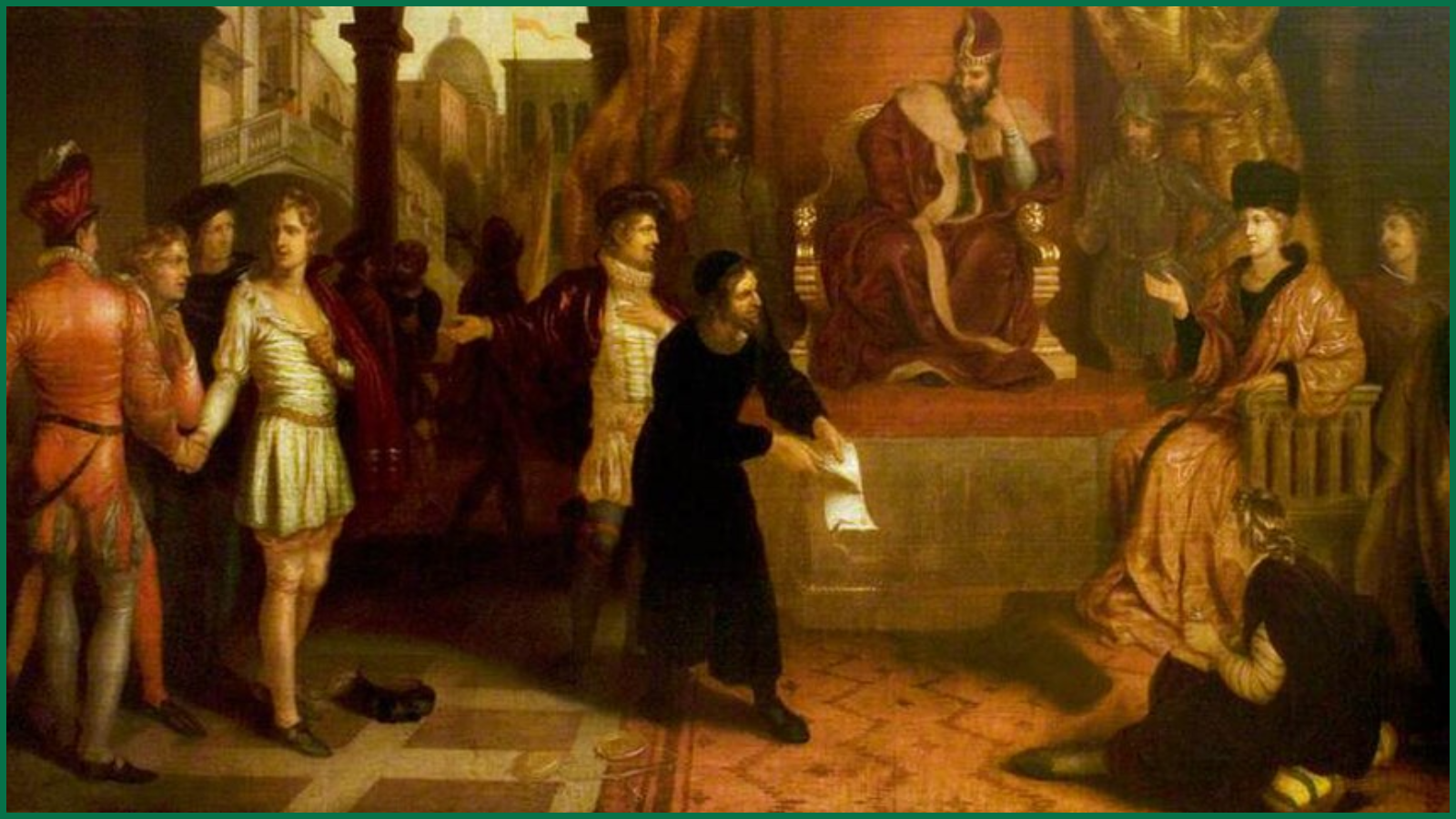
    First there is the titular merchant of Venice, Antonio, who has his capital invested in ships importing goods from afar. His friend Bassanio is handsome but cash-poor. He requires a loan from Antonio in order to travel to Belmont and court Portia, the wealthy heiress of the manor. With Antonio’s money at sea, he turns to the Jewish usurer, Shylock, for a loan that he can give to Bassanio. Here we learn that Antonio has often publicly abused and insulted Shylock on account of his Jewish identity. For this, Shylock is willing to forgo interest on the loan but demands a pound of flesh from Antonio should he default. At the same time, Shylock’s daughter Jessica is preparing to abandon her Jewish faith and the legal restrictions that go with it. She steals her father’s ducats and jewelry, elopes with Lorenzo and the pair abscond to Belmont as part of Bassanio’s entourage. 

    In Belmont, Portia’s deceased father has set up a sort of lottery of caskets that Portia’s potential suitors must win. Despite this, Portia is a woman with a lot of agency in the story which is a pleasant departure from the stifling patriarchal air of a play like Othello. Portia manipulates her suitors to her liking and subtly aids Bassanio to the correct choice of casket so that he wins her hand. She favours Bassanio because she sees him as pliable, lacking fancy hereditary titles or a fortune of his own. We then learn of great misfortune striking Antonio—all three of his ships at sea have met with doom, leaving him vulnerable to his bond with Shylock. 

    When Shylock drags Antonio to the Duke of Venice’s court to acquire his pound of flesh, Portia arrives in disguise to adjudicate the case. Through rhetorical trickery and technical loopholes, she absolutely devastates Shylock, as he is denied his pound of flesh and is stripped of all his wealth. He is also subject to a forced conversion to Christianity, rendering him socially and economically destitute. She saves Antonio but it is implied that Portia has had a hand in manipulating events when she produces a letter stating that all three of Antonio’s ships had arrived safely to port after all.1 We learn that Lorenzo had an eye on Shylock’s money when pursuing Jessica, just as Bassanio had an eye to Portia’s wealth when pursuing her. Antonio exits the play alone and isolated from his newly-wedded friends.

    “On The Jewish Question”

    The character that has attracted the most controversy in The Merchant of Venice is undoubtedly Shylock. A Jewish usurer hungry for the Christian blood of Antonio has provoked much discomfort in post-World War II audiences allergic to overcooked stereotypes around moneylending and blood libels. But Shylock is anything but a one-dimensional caricature. Shakespeare endows him with a humanity and honesty that is unique amongst the characters of the play and this makes sympathy toward his plight difficult to resist:

    He hath disgraced me, and hindered me half a million;
    laughed at my losses, mocked at my gains, scorned my nation,
    thwarted my bargains, cooled my friends, heated mine enemies—
    and what’s his reason? I am a Jew.
    Hath not a Jew eyes? Hath not a Jew hands, organs, dimensions, senses, affections, passions;
    fed with the same food, hurt with the same weapons,
    subject to the same diseases, healed by the same means,
    warmed and cooled by the same winter and summer, as a Christian is?
    If you prick us, do we not bleed? If you tickle us, do we not laugh?
    If you poison us, do we not die? And if you wrong us, shall we not revenge?
    If we are like you in the rest, we will resemble you in that.
    If a Jew wrong a Christian, what is his humility? Revenge. 
    If a Christian wrong a Jew, what should his sufferance be by Christian example? Why, revenge.2

    Although Jews have worn a certain money-grubbing stereotype thanks to the material realities of the Middle Ages, Shakespeare endows Shylock with a transparency of intentions absent in the other characters of the play. He has an integrity that contrasts sharply with Antonio, Bassanio, Jessica, Lorenzo and Portia, who are all prone to degrees of hypocrisy: they marry for money, they engage in theft, they seek loans from those they abuse, they leverage their fortune to manipulate others.3 Shylock points out the hypocrisy of Christian society in general, as attendees of the Duke’s court sit in possession of involuntarily enslaved humans yet cast judgement on his voluntarily signed, mutually agreed upon contract. 

    It has been pointed out that Renaissance England did not have Jewish moneylenders but they did have Italian ones and they were much loathed: “It was not axiomatic to an Elizabethan theatre audience that Italian merchants were more economically virtuous than Jews; Robert Wilson had a good deal of success in the 1580s and 1590s with The Three Ladies of London, a play that pitted a morally upright Jewish merchant against a thoroughly unscrupulous Venetian.”4

    Through the play, Shakespeare reveals that Jews and Christians are at least as equal in ethics as they are in body. In doing so, he renders the foamy saliva and slurs hurled at the Venetian Jews of his play to be completely unjust.

    Marx, separated from the Renaissance by centuries, was writing during a period of heightened anti-Semitism in Germany and across Europe. Although he had a rabbinical heritage, his family was forced to convert to Christianity so that his father could evade a ban on Jews practicing law. Like Shakespeare, Marx recognized this social discrimination to be unjust, with anti-Semitism only masking a collective distaste toward the capitalist economy and predatory finance. 

    Scapegoating as Capitalist Projection

    In Capital, Marx twice likens the capitalist seeking the sweat of labour to Shylock seeking his pound of flesh: “Aye his heart. So says the bond.” Marx also delivers one of his most misunderstood lines in Chapter Four: “The capitalist knows that all commodities, however scurvy they may look, or however badly they may smell, are in faith and in truth money, inwardly circumcised Jews, and what is more, a wonderful means whereby out of money to make more money.” 

    Marx’s reference to “inwardly circumcised Jews” is a direct citation of Romans 2:29 in the New Testament: a Christian, a follower of Jesus, is circumcised by an inward, spiritual cut to the heart instead of the genitals.5 Similarly, commodity production and trade seeks an inner value that will express itself in surplus.6

    Surplus value is what Antonio needs his ships to deliver and it is what every capitalist needs to reproduce their class. Marx makes this analogy in order to emphasize the universal profit motive of capitalist commodity production. Marx and Shakespeare converge on the idea that profit-seeking is not some noxious Jewish attribute—it’s capitalism.

    By setting his play in Venice, the commercial capital of Renaissance Europe, Shakespeare had foreshadowed the total conquest of commerce over global society. The result is a world where, in Marx’s words: “Money is the pimp between need and object, between life and man’s means of life…Money appears as an inverting power in relation to the individual and to those social and other bonds which claim to be essences in themselves. It transforms loyalty into treason, love into hate, hate into love, virtue into vice, vice into virtue, servant into master, master into servant, nonsense into reason, and reason into nonsense.”7

    As we observe in our own world, so it is in The Merchant of Venice. Marriages, familial bonds, friendships and even hatreds are all mediated by the need of money. With money as our pimp, the reduction of individuals into venal objects can always be justified. Morality is inextricably bound to how we collectively produce and reproduce our lives. It is not the characters of The Merchant of Venice who are amoral—it is the economic system that produces them.

    Thanks for reading!


    1. Robin Russin, “The Triumph of the Golden Fleece: Women, Money, Religion and Power in Shakespeare’s The Merchant of Venice,” Shofar Vol. 31, No. 3: 124. ↩︎

    2. See Act 3, Scene 1. ↩︎

    3. For Antonio is full of hubris when he offers a pound of flesh to secure a loan against even Shylock’s advice; Bassanio and Lorenzo seek women to stabilize their financial standing and Portia uses her wealth to misinform Antonio about the fate of his ships, even going so far as to orchestrate a dramatic courtroom standoff where she casually destroys Shylock after a passionate speech about the value of mercy. ↩︎

    4. It is also worth noting that Shylock consistently forgoes profit in order to maintain the prospect of exacting revenge on Antonio for his abuse. Shylock is therefore much less “money hungry” than others in the play—including his daughter Jessica as well as Bassanio and Lorenzo. ↩︎

    5. From the New King James version of the Bible: “He is a Jew who is one inwardly; and circumcision is that of the heart, in the Spirit, not in the letter; whose praise is not from men but from God.” ↩︎

    6. Expressed in the formula: M-C…C’-M’ (money to commodity, commodity + surplus value to money + surplus value). The principal sum of money is thus transformed into a greater quantity. ↩︎

    7. Karl Marx, “The Economic and Philosophic Manuscripts of 1844” in Essential Writings of Karl Marx (Red and Black Publishers, 2010): 137, 140. ↩︎