
Cats and dogs are today’s most popular and cherished pets. Their ubiquitous presence in our built environment makes them something that can be easily taken for granted. There are entire industries and supply chains dedicated to nourishing our furry friends—but this is the outcome of a capitalist economy that has captured the ancient interspecies relationships between humans and their pets. It was not always this way.
A core tenet of historical materialism is that most of our cultural expressions have evolved to service a social system of production that fulfills our biological needs. This matter of historical fact is quite apparent when considering the history of animal domestication. Wolves were the first animals to have conjoined their evolution with human societies, becoming dogs in the process. This occurred deep in nomadic prehistory; too deep for any precise date and place. However it is inferred that mutual benefits arose for those early wolves and people who cohabited camps together. Dogs are excellent wildlife trackers just as humans are excellent hunters.
Humans and wolves together could harvest more wildlife and ensure a higher degree of safety in the dark woods than either species could achieve on their own. The prehistoric tribes forming symbiotic relationships with dogs gained a material productive advantage over canine-less peer groups. This is what incentivized the spread of domestic wolves and greatly assisted Paleolithic people as they traversed new continents and navigated ecosystems that were rapidly changing with the climate.
The correlation between climate change and the emergence of permanent human settlements is well documented. Kōjin Karatani has explored the possibility that agriculture developed centuries after permanent fishing settlements were established in response to the megafauna extinctions at the end of the Ice Age.1
This idea tracks in the case of Egypt, where climate-induced desertification had destroyed the hunter-gatherer way of life about 7,000 years ago. The archaeological record shows that agriculture later developed along the northern Mediterranean shore at the Nile Delta. This area also happens to be one of the best fishing grounds in the entire Mediterranean region. With the later emergence of farming techniques, an agricultural system spread south down the Nile, covering both Lower and Upper ancient Egypt.
Of Paws and Pharaohs
Inseparable from this story is the domestic cat. Just as dogs splintered from a subset of wolves many thousands of years ago, so did domestic cats splinter from the African wildcat at the dawn of human civilization. It is understood that early grain stores attracted great quantities of rodents, which attracted wildcats in turn. There is evidence of various cats cohabiting human settlements independently at different times across a wide range of places between Asia and Europe. But it was in ancient Egypt where the wildcat was transformed into a domestic animal that was then dispersed around the world, becoming the pets we know today.
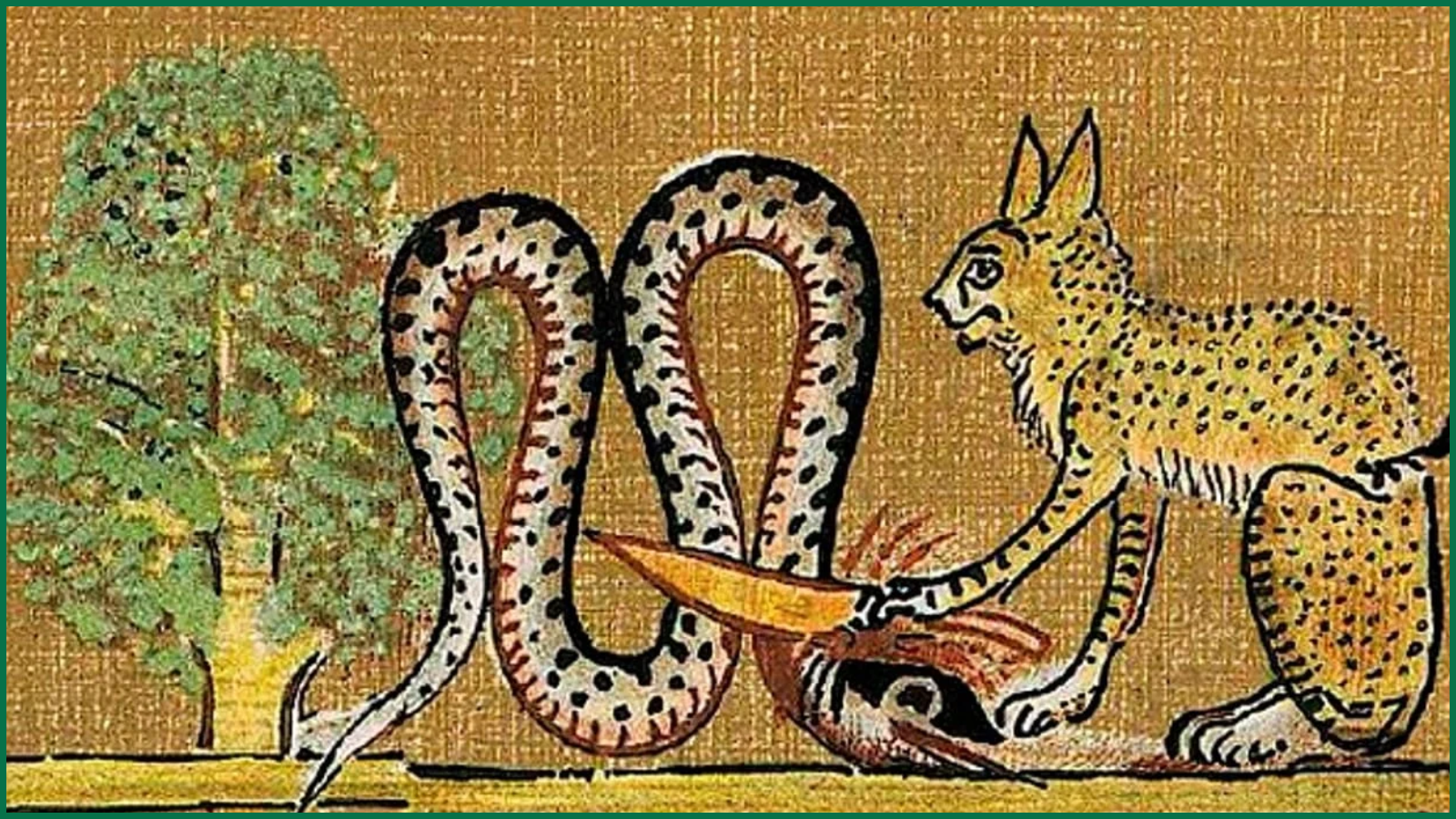
Whereas dogs enabled hunter-gatherers to explore new hunting grounds and increase yield, cats enabled ancient farmers to do the equivalent. Vermin-infested grain stores could turn a hard-earned harvest into poison but the mere presence of cats is often enough to keep rodents at bay. The material incentive was not only there for Egyptian farmers to tolerate cats, but to actively encourage their permanent presence and reproduction. Another serious danger to ancient Egyptian life was the preponderance of venomous snakes along the shores of the Nile river. Cats are, of course, excellent snake-hunters and ancient tomb paintings have often illustrated this skill.
With an entourage of felines, ancient farmers could spread their agrarian economy down the length of the Nile, all the way to Nubia. As it was with so many cultures of antiquity, the harvest was at the centre of religious worship; life and death was always in the balance.
There is a preponderance of Sun-gods, rain-gods, fire-gods, fertility-gods and cereal-gods all over the world at this time. Given the importance of cats to safeguarding the Egyptian way of life, it is no surprise to find cat-gods roaming their pantheon of deities. Bastet offered bounty and health; Sekhmet menaced with fiery destruction; Mafdet provided protection from venomous bites. Cats were thus treated as sacred animals in ancient Egypt—vessels carrying divine elements that both create and destroy.
A Marxian Take
This ancient Egyptian conception of cats may appear as a strange religious affectation to modern audiences but it is important to remember that, in the scorpion-riddled environs of the Nile valley, the presence of cats could really make the difference between life and death, between feast and famine. It is upon this material reality that the edifice of religious belief and conscious thought was raised. The cult of Bastet and sacred status of cats in ancient Egypt cannot be understood without the historical materialism outlined by Karl Marx and Friedrich Engels.2
Cats only began to disperse in earnest along ancient imperial trade routes a little over 2,000 years ago. As Egypt became tied into the broader Mediterranean economy by way of Greek and Roman invasions, domestic cats sprout over the archaeological record, reaching Britain by 100 BCE and China by 730 CE.

This is in sharp contrast to dogs, which became widespread before the end of the Paleolithic era, before the emergence civilization. Dogs have therefore evolved alongside human society; they’ve been bred and trained to perform a wide variety of useful tasks—from herding sheep to hunting fowl to turning meat spits over cooking fires.
Cats, on the other hand, perform their own useful tasks as a matter of solitary wild instinct. For this reason, natural feline behaviour and anatomy was not historically manipulated through selective breeding. Genetically, domestic cats are remarkably similar to their wild African counterparts. Their instincts were maintained because they were extremely useful and complementary to our agrarian economies and fledgling urban spaces.
Cats have therefore gained a unique place on the roll call of human–animal relationships. Unlike dogs, livestock or working “beasts of burden,” regular domestic cats are not completely recognizable products of human selection and labour. They can instinctually survive as feral animals, have a genetic structure interwoven with wildcats and largely communicate on their terms rather than our own.
Straddling the demarcation line between nature and labour, cats possess a Lacanian kernel of the Real that resists conscious symbolization. The mysteriousness surrounding common feline behaviours—the chattering, purring, hiding, kneading, stealthy stalking and bunting—are attributable to the light touch of human beings on the transformation of their nature.
In Capital, Marx wrote:
Labour is, first of all, a process between man and nature, a process by which man, through his own actions, mediates, regulates and controls the metabolism between himself and nature. He sets in motion the natural forces which belong to his own body, his arms, legs, head and hands, in order to appropriate the materials of nature in a form adapted to his own needs. Through this movement he acts upon external nature and changes it, and in this way he simultaneously changes his own nature. He develops the potentialities slumbering within nature and subjects the play of its forces to his own sovereign power.3
Cats have assisted our civilizational appropriation of nature in their remarkable capacity as pest predators. If the core characteristics of their nature was not preserved, cats would have lost utility to our species long ago. But this resistance to domestication became a double edged sword as cats spread widely outside of Egypt and Eurasia entered into the feudal era. Whether it was western Europe or Japan, cats could be met with suspicion and hostility as the hard kernel of their wild instinct was interpreted as something sinister.
Feline Ways and Means
The only reason that cat behaviour appears mysterious to people is because of the preservation of their instincts; we humans have transformed ourselves too much to be able to readily decipher the activity and communication of a less altered species. By the feudal era, in contrast to more domesticated animals, the cats among us could be interpreted as belonging to something not of us.
In antiquity, fear of the unknown was embraced and the subordinate position of human beings to the forces of nature was an accepted part of life. Cats definitively thrived in this cultural environment. But in feudal times, empires crumbled. Warlordism and decentralized agriculture took over while centralized monotheistic religions began to claim institutional power.

The known and unknown forces of nature became reinterpreted as forces of good and evil, a struggle between angels and demons, the power of God versus the tricks of Satan. In this milieu, cats were sometimes seen as demonic agents or the familiars of witches. The Flemish city of Ypres infamously used to throw cats from the belfry tower of Cloth Hall and the association of black cats with the dark spirits of Halloween is a cultural vestige of this era.
It would be an overstatement to say that cats were ever universally persecuted; since the advent of agriculture and seafaring, they’ve just been too useful. But as our mode of production has shifted, so too did our perception of cats. While cats themselves have not changed much since prehistory, our relationship to them was adjusted as we moved from ancient slave economies, to feudal times and into present-day capitalism.
Under capitalism, cats have become our cherished companions in an alienated world of atomized individuals. In a stressful social context of dense and high-tech urban spaces, we admire cats for their fidelity to natural characteristics that we have long shed. Although consumer capitalism has given rise to abominable specialty breeds, the lives of many ordinary cats has never been more comfortable. A $100 billion commodity market caters to their predatory instincts, their playful manners, their carnivorous taste buds and their discretionary affection for furniture.
It has been said that humans did not domesticate cats—cats domesticated humans. Although this is meant tongue-in-cheek, there may be some truth here. The mode of production is the mediating force between humanity and nature, the process that conditions our material existence and conscious thoughts.4 Yet house cats have resisted the demands of historical epochs, unlike dogs, cattle, horses—and people. While modern technology has checked the once-urgent need for feline services, the demands on human labour to accommodate the peculiar nature of cats in a fast-changing world is limitless.
Thanks for reading!

Kōjin Karatani, The Structure of World History: From Modes of Production to Modes of Exchange (Duke University Press, 2014): 35–49. ↩︎
See the fifth through seventh paragraphs of Karl Marx’s “Preface” to A Contribution to the Critique of Political Economy; also “History: Fundamental Conditions” in The German Ideology by Marx and Engels. ↩︎
Karl Marx, Capital, Volume One (Penguin, 1992): 283. ↩︎
See: John Bellamy Foster, “The Return of the Dialectics of Nature: The Struggle for Freedom as Necessity,” Monthly Review, Vol. 74, No. 7: 1–20. ↩︎