
Tag: Nietzsche

  • Marx and Shakespeare: Writing Nationalism with Henry V

    Marx and Shakespeare: Writing Nationalism with Henry V

    Now entertain conjecture of a time
    When creeping murmur and the poring dark
    Fills the wide vessel of the universe.

    —Chorus, Act 4.

    It is a staple of nationalistic fervour where the leader of a country personally vanquishes its enemies, as if embodying the nation itself. Friedrich Nietzsche admired the daring coup d’état of Napoleon’s nephew in France, “which made his own sovereign will ‘seem like the will of the entire nation.’”1 And where historical examples cannot be found to mythologize, they can also be invented.

    The United States does this frequently with their presidents in film. Fictional American heads of state have flown fighter jets against alien invaders, overtaken terrorist hijackers of Air Force One with cunning and deployed martial arts against invading North Koreans.

    Whether a king or president, a head of state adds a layer of profundity to an action hero that defies obvious absurdities to the storyline. They possess “two bodies”—the body of their person and the body politic of the nation that they represent. Shakespeare himself was very conscientious about the king’s two bodies, which he directly explored in plays like Richard II, Hamlet and Henry V.

    It is important to note that the concept of a singular nation-state was only emergent in Shakespeare’s time and he was an influential participant in the formation of English identity through his many history plays. Shakespeare’s histories are understood to be among the most popular in his lifetime, although today these plays are amongst the least produced and least known of his oeuvre.  The reason for this is mainly that the historical figures involved are not very well known to today’s modern audiences as compared to Renaissance England.

    The Henriad

    Most of Shakespeare’s histories are embodied by the eight-play Henriad series that depicts a chain of English kings ruling between 1377 and 1485—about a century or two before the time of writing. They tell the long story of the turbulent period between the deposing of the divinely-ordained King Richard II which ultimately resulted in the devastating Wars of the Roses. The series concludes with the ascension of the House of Tudor to the throne.

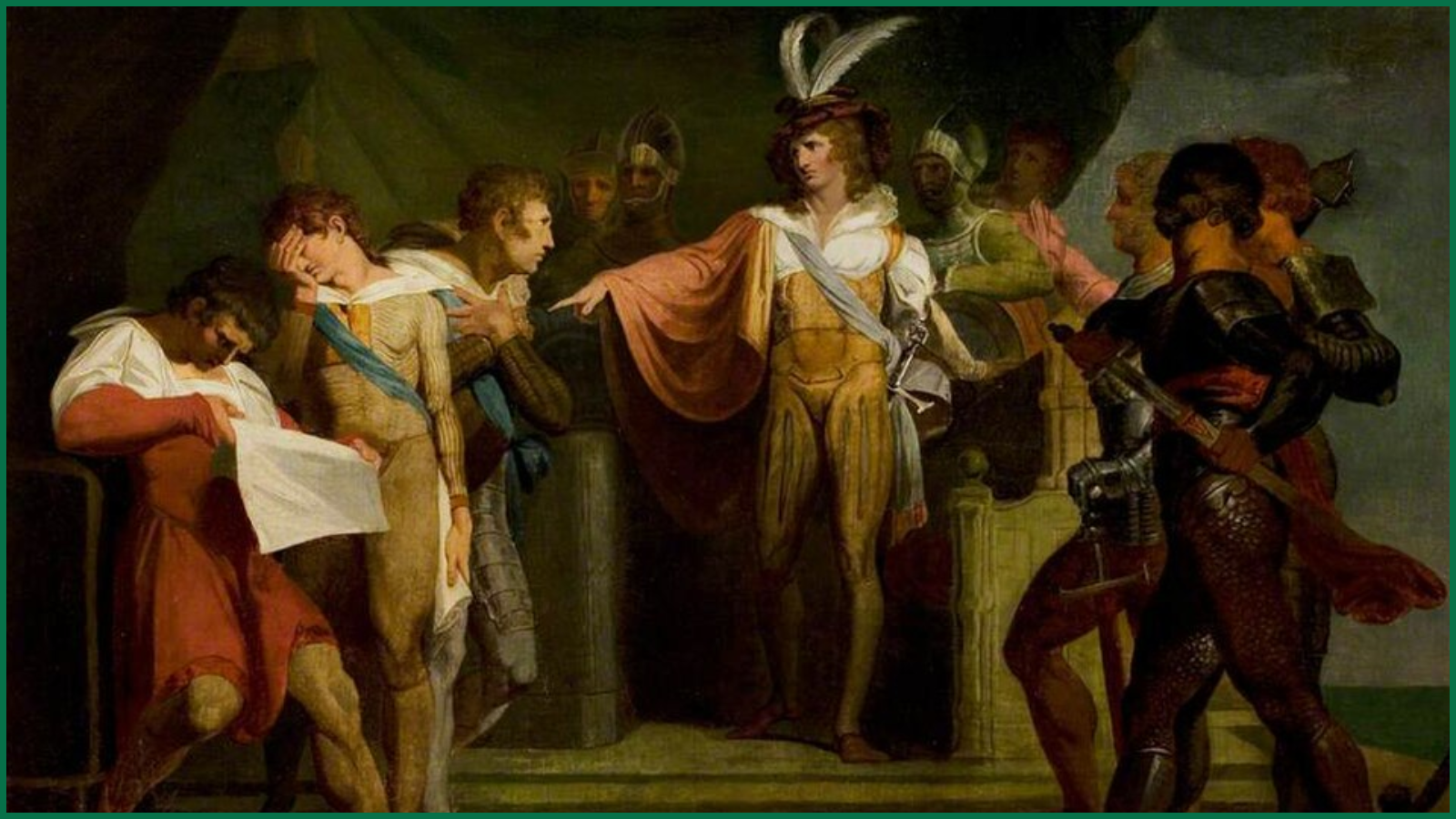
    Henry V serves as a kind of mid-series climax to the Henriad; the peak of English power before the fall into civil war. The story opens with a discussion surrounding the English claim to the French throne. When the Dauphin sends an insulting “gift” of tennis balls to the young King Henry V, the decision to pursue the claim is sealed. Henry assembles his army and leads them into the ferocious siege of Harfleur across the English Channel. Despite difficulties, Henry is almost able to will victory into being with his speech:

    Once more unto the breach, dear friends, once more;
    Or close the wall up with our English dead.
    In peace there’s nothing so becomes a man
    As modest stillness and humility,
    But when the blast of war blows in our ears,
    Then imitate the action of the tiger.
    Stiffen the sinews, summon up the blood,
    Disguise fair nature with hard-favour’d rage.2

    Upon taking Harfleur, the next is the Battle of Agincourt. This battle occupies a privileged space in English national lore to this day—something akin to the Battle of Thermopylae, fictionalized in the movie 300. This is because the English were badly outnumbered on the battlefield, five to one.3 Acknowledging that his army lacks size, Henry delivers one of Shakespeare’s most famous speeches:

    But we in it shall be remembered,
    We few, we happy few, we band of brothers.
    For he today that sheds his blood with me
    Shall be my brother; be he ne’er so vile,
    This day shall gentle his condition.
    And gentlemen, in England now abed
    Shall think themselves accursed they were not here,
    Any hold their manhoods cheap whiles any speaks
    That fought with us upon Saint Crispin’s day.4

    Language and Nation

    The French receive a bloodletting on the battlefield and Henry executes prisoners that he does not believe his small army can guard. Henry is shown to be tactical and shrewd, as he is rousing and patriotic. A warrior, the play concludes with his awkward courting of the French princess Katherine, thus accomplishing his aim of ascending the French throne.

    Henry V demonstrates the horrors of war—and its proud glory. It shows a heroic king—and a morally blemished man. And through these contradictions, it shows something even more important which is the forging of a state, a United Kingdom. This is achieved with Henry’s forming of a coalition army—including Welsh, Scots and Irish—under one king and one language. Shakespeare takes care to emphasize that it will be English adopted into his marriage with Katherine and the French throne, asserting a reversal of fortunes for a French language that was considered superior and sophisticated, one that had dominated England for centuries prior. 

    Prior to the Renaissance and early modernity, languages and dialects tended to be disparate—varying wildly between villages and noble courts. The standardization of national languages arose with the centralization of palace authority and became the mark of a unified nation-state. In Spain, this process began as early as the 1200s; in France, the 1500s. Italian was only standardized in the 1800s with national unification.

    English did not undergo an official standardization but the works of Shakespeare and the printing of the King James Bible are seen as landmark events. It is interesting that Shakespeare, the greatest individual contributor to a standard English language, consciously lifted it to such heights in Henry V. He was not only showing the arrival of a language, but the arrival of a modern nation.

    Nationalism is a powerful social construction that binds people to causes that they may not otherwise support. Shakespeare demonstrates this eloquently in his play. Any moment his men cast rational doubt on the cause they are fighting for or the sacrifice they are prepared to make, Henry arrives with a dazzling display of rhetoric stoking nationalistic pride and dispelling all doubts.

    The Marxian Superstructure

    Marx recognized the role of fabled leaders and national mythology to the creation of a nation-state, which is the necessary cradle for the capitalist market. In his Eighteenth Brumaire of Louis Bonaparte he wrote

    But unheroic though bourgeois society is, it nevertheless needed heroism, sacrifice, terror, civil war, and national wars to bring it into being. And in the austere classical traditions of the Roman Republic the bourgeois gladiators found the ideals and the art forms, the self-deceptions, that they needed to conceal from themselves the bourgeois-limited content of their struggles and to keep their passion on the high plane of great historic tragedy…Thus the awakening of the dead served the purpose of glorifying the new struggles.

    And so it was for Henry V. At the time of writing, England was locked in a formative national struggle against Spain for naval supremacy and access to New World plunder. Shakespeare wrote for a highly diverse audience, including London’s nascent and well-paying bourgeoisie class of lawyers, traders and merchants. With reference to Marx, Henry V is best understood as a heroic play written for a bourgeois audience roused by war, although far from fighting it.

    It is almost a purpose-built story, uniting in the imagination the kingdom’s collection of English, Welsh, Scottish and Irish, together against a common enemy. As a product of early modernity it prodded a national language—a national consciousness—into being. It offers an early glimpse of the national vessel that would eventually subjugate all four corners of the Earth, and lay down a modern capitalist empire on which the sun never set.

    Thanks for reading!


    1. Frank Cameron and Don Dombowsky, eds. Political Writings of Friedrich Nietzsche (Palgrave Macmillan, 2008): 24. Karl Marx, of course, took a dim view of Louis Bonaparte III. ↩︎

    2. From Act 3, Scene 1. ↩︎

    3. Contemporary historians posit a much narrower differential between armies, with the French advantage being 4:3 or 2:1. ↩︎

    4. From Act 4, Scene 3. Saint Crispin’s day celebrates two shoemakers martyred in Roman times, and was marked in the English calendar until shoemaking became mechanized in the 18th century. ↩︎
  • Hitler’s Philosopher

    Hitler’s Philosopher

    Under conditions of peace the warlike man attacks himself.

    —Friedrich Nietzsche, Beyond Good and Evil.

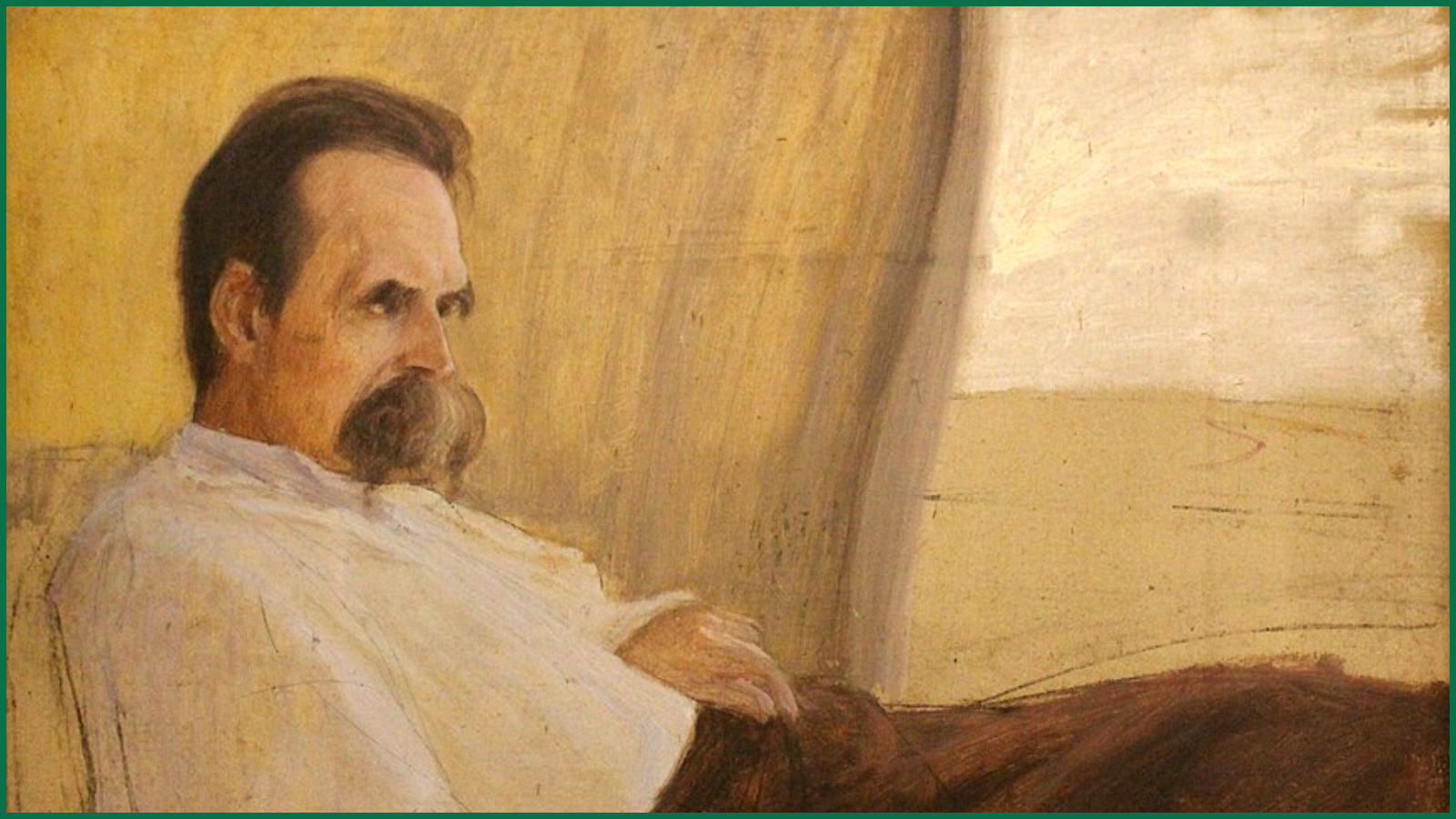
    In Untimely Meditations Nietzsche alerted readers that most written works were little more than “the smoke and vapour of the brain.”1 For a book to avoid the flames, it must contain a fire within itself. It is easy to dismiss Nietzsche’s body of work as slippery, with an undue level of contradictions that negate its possibility as a system of thought. But this is characteristic of a reactionary right that prefers romanticization to reason.2

    The Enlightenment era championed progressive leaps in scientific method, rule of law, technological invention, standard national institutions and conceptual human rights. Karl Marx is the apogee of Enlightenment philosophy because he discovered the objective material and social conditions enabling the progression of human history. Nietzsche, on the other hand, is the pinnacle of the reactionary Counter-Enlightenment opposition. The Counter-Enlightenment generally held that core human characteristics like ascetics, nature, religion and emotion were washed away by 18th and 19th century waves of industry and empiricism. Nietzsche believed that only a rigid social hierarchy—a radical aristocracy—replete with slavery and the relegation of women to childrearing could provide fertile ground for his ideal man, the Übermensch.

    For most of us today, there are elements tracing to both Enlightenment and Counter-Enlightenment thinking that are appealing. Conservatives borrow from the industriousness that modernity unleashed, while upholding the importance of pre-modern religious ideals and social hierarchy. Socialists might admire Romantic commitments to beauty and culture, while they hang onto empirical measures of history and positive human rights. Liberals hold institutions and negative rights in high esteem, while appreciating the role of emotion in public discourse. Nietzsche, with his passionate treatment of culture, hierarchy and human vitality, therefore offers a grab-bag of ideas that almost anyone can pull one or two shiny parts from while ignoring the rest.3

    A Nietzschean Left?

    Jonas Čeika managed to do this in his book How to Philosophize With a Hammer and Sickle, though he is not the first socialist to do so.4 Other left-wing figures such as Gilles Deleuze and Emma Goldman have gone down similar roads with Nietzsche, even though there is not any profound reason for doing so. It is easy to extol Nietzsche’s romantic anti-capitalism and lofty Übermensch ideal because these would seem at home under communism where, in Leon Trotsky’s words, “the average human type will rise to the heights of an Aristotle, a Goethe or a Marx.”5

    Speaking of the latter, Marx has long-since reconciled the gap between between pre-modern, Counter-Enlightenment virtues and the objective nature of the modern capitalist mode of production. Marx himself was not an anti-capitalist like Nietzsche; he was a post-capitalist who believed that the boundaries crossed by capitalist technologies and social relations were the keys to unlocking a harmonious socialist future. The attempted construction of a Nietzschean left is therefore either discordant or illogical in the light of dialectical materialism, which affords Nietzsche little more than a corner of society’s superstructure

    The Overman

    Nietzsche’s detours through an idealized caste system, slavery and perpetual “life-affirming” warfare are not merely the means to the Übermensch end; they are part of the end itself.6 This is because Übermensch—or “overman” in English—would have nobody to sail over if the harried masses weren’t ripe for subjugation and influence. This is expected from a Marxian perspective, which emphasizes the role of human relationships in determining the experience of individuals and the overall structure of society. In order to exist, a master must have a slave, just as an employer must have an employee and an overman must have an underman.

    The domination of commoners by elites is the plough by which Nietzsche’s imagined master morality is cultivated. Although he understood both capitalism and Christianity to be deracinating to culture and morality, these sentiments are not progressive—they are radically regressive, rooted in admiration for the heroic conquerors of antiquity that enslaved entire populations. Whereas mainstream conservatism is informed by feudal Christian traditions and values, Nietzsche drifts much further to the right wing of the spectrum with his admiration for the pagan slave empires of antiquity.

    The Fascist Impulse

    It has been said that Benito Mussolini abandoned socialism in the disillusioning aftermath of the First World War, just after exposure to Nietzsche’s work. It is therefore unsurprising that Italian Fascism is just as slippery and reactionary as Nietzsche’s polemics—and Friedrich’s fingerprints are all over Mussolini’s governing ideology.

    Like Nietzsche, Mussolini glorified antiquity and adopted the Roman fasces as his party’s symbol. Inspired by the concept of “master morality,” he sought to create a Third RomeLa Terza Roma—which would subordinate weaker nations like Greece and Ethiopia by natural right. The city of Rome was to be transformed into a mecca of imposing monuments, piazzas and open-air theatres celebrating the revival of the ancient Roman masters. Far from Marxian classlessness, Mussolini’s corporatist policies created a rigid caste system whereby one’s social standing and rank as a landowner, industrialist, military officer, farmer or worker was practically designated at birth. Women were erased from the public sphere as the rearing of soldiers became their sole duty to the state.

    Given Nietzsche’s undeniable influence on Italian Fascism, it is no wonder that Adolf Hitler gifted Il Duce “an elaborately bound and privately printed volume of the complete works of Friedrich Wilhelm Nietzsche” for his 60th birthday. While the written works of left wing writers like Bertolt Brecht, Helen Keller, Jack London, Marx and Friedrich Engels, met the flames in Nazi Germany, Nietzsche was worshipped. Of particular interest to Nazi theorists was On the Genealogy of Morality, which asserts an iconoclastic view on the origin of civilization:

    Some pack of blond beasts of prey, a race of conquerors and masters, which, organized for war and with the power to organize, without forethought, sets its terrifying paws on a subordinate population which may perhaps be vast in numbers but is still without any form, is still wandering aimlessly.7

    The reference to “blond beasts of prey” is more than a passing allusion. Nietzsche elaborates on the Aryan identity of this conquering race—this “master race”—of aristocratic antiquity which was finally destroyed by a Jewish “revolt of the slaves” and “blood-poisoning.”8 According to Nietzsche, the slave morality operates by inverting what is strong, beautiful and learned into something fearful, ugly and ignorant. By transvaluing ancient Roman and Greek master morality, Judaic priests tamed the empire and then destroyed it. The portraits of three Jews—Jesus, Mary and Joseph—adorning millions of European walls stand as the legacy of this triumphant Jewish slave revolt.9

    It is popularly claimed that the Nazis hijacked Nietzsche’s teachings and misappropriated them for their own sinister purposes. There is some merit to this claim but only in part. For example, despite his screed lionizing the Aryan conquerors of antiquity and bemoaning their Jewish subjects, Nietzsche was plainly not an anti-Semite. He believed that history had turned the Jewish people into “the strongest, toughest and purest race now living in Europe” and held them to be essential ingredients to breeding his imagined postmodern aristocracy.10 Additionally, he did not view the Aryan master race from quite the same racial footing that the Nazis did. For Nietzsche, it was a cultural designation, an exercise of master morality exemplified by Nordic Vikings but also the Brahmin caste of India, Greco-Roman slaveholders and medieval Arabic and Japanese nobility. 

    Nietzsche endorsed Napoleon Bonaparte as a historical example of an Übermensch, capable of terror and genius, who unified Europe along strict hierarchical lines, military discipline and exemplary cultural values. Hitler saw himself as Napoleon’s successor because he unified Europe by force, raised slave populations from the defeated nations, preserved the Prussian aristocracy and promoted a Wagnerian high culture brimming with Nordic valkyries screaming into battle. For the Nazis, the commitment to a transvaluation of Judeo-Christian values went beyond good and evil.

    Master Morality and the Holocaust

    Nietzsche wrote: “For strong people disaster does not come from the strongest, but from the weakest.” Whereas the strong possess unapologetically life-affirming values, the weakest exalt life-denying values and the veneration of their pitiable existence spreads like contagion. The Holocaust, with all its attendant atrocities against Jews, Romani, socialists, sexual minorities and the disabled, was merely a slave revolt in reverse. What the Holocaust represented was a master’s revolt against the slaves from antiquity, the shiftless vagabonds, the egalitarians, the weak and infirm, the homosexuals that perverted good breeding. If the Holocaust is today remembered as “the terror of terrors,” this poses no dilemma as far as Nietzsche is concerned: “The more valuable type [of man] has appeared often enough in the past…Very often he has been precisely the most feared; hitherto he has been almost the terror of terrors.”11

    While Mussolini hewed to a vision that was more classically Nietzschean than Hitler, to claim a misappropriation of Nietzsche’s work by the Nazis is simply dishonest. Nazi ideology was grounded in a defensible interpretation of Nietzsche’s thought, updated to include the latest “discoveries” in eugenics and “racial science.” The gravest misappropriation committed by the Nazis was the inclusion of “socialism” in their party’s National Socialism title. This was a sleight of hand used to convey the Nazi disdain for decadent liberal capitalism while preserving electoral viability in a period when German support for market forces was at an all-time low. A more accurate party title, such as “The New European Aristocrats,” just wasn’t going to resonate with the average German voter.  

    It is a fact that Nietzsche’s passionate attacks on modernity continue to attract significant attention despite the irrational, dark and mystical depths it treads. He strikes at the emotional chords of those frustrated by modern capitalist society. Marx, on the other hand, had a scientific approach to philosophy and helped to develop a praxis for human emancipation. Attempting to reconcile these two schools of thought is akin to attempting reconciliation between oil and water. There is a reason why Marx flatly rejected emotional reactionary politics: it is a dead-end in every sense of the term.

    The historian J. Arch Getty wrote, “Lenin deserves a lot of credit for the notion that the meek can inherit the earth, that there can be a political movement based on social justice and equality.” In the final analysis, are these emancipatory values not superior to Hitler’s embodiment of the Nietzschean “terror of terrors”?

    Thanks for reading!

    Footnotes:

    1. Friedrich Nietzsche, “Schopenhauer as Educator” in Untimely Meditations. ↩︎

    2. See John Richardson’s, Nietzsche’s System (Oxford University Press, 2002) for more on reading Nietzsche’s polemics as a system of thought. ↩︎

    3. Conservative commentators like Jordan Peterson are also notorious for doing this. ↩︎

    4. The most interesting aspects of Jonas Čeika’s How to Philosophize With a Hammer and Sickle (Repeater, 2021) are his inquiries into a hypothetical libertarian socialism. ↩︎

    5. Leon Trotsky quoted in Čeika’s, How to Philosophize With a Hammer and Sickle, 200. ↩︎

    6. See Nietzsche, Twilight of the Idols: “For war trains men to be free.” ↩︎

    7. Frank Cameron and Don Dombowsky, eds., Political Writings of Friedrich Nietzsche (Palgrave Macmillan, 2008): 227. ↩︎

    8. See Nietzsche, The Genealogy of Morals for excerpts. ↩︎

    9. Ibid. ↩︎

    10. Nietzsche, Beyond Good and Evil, 182. ↩︎

    11. Nietzsche, The Antichrist (Alfred A. Knopf, 1918). ↩︎
  • The Fetish of James Bond

    The Fetish of James Bond

    Just when so much of our politics had spilled over into plain sight, James Bond came along right on time. Dramatic imperial courts, palace intrigue and backrooms redolent of cigarette smoke belong to a bygone era. But espionage has never been so important as when the first Bond novel debuted in 1953 and it is this kernel of reality that gives the spy thriller a cover of plausibility. Common sense dictates that espionage must be tedious, precarious and thankless work. But since it operates out of view, fiction can occupy our imagination and dazzle us with bottomless martinis, adrenaline-pumping capers, lustrous sports cars and foxy women playing not-so-hard-to-get.

    The lineup of Bond movies starring Daniel Craig were released over a 15 year period between 2006 and 2021. This was a stretch when terrorism, digital surveillance, the rise of China and deadly viruses all took turns at the forefront of our collective attention. And these things are represented in the Bond films. In Casino Royale, there is terrorist financier Le Chiffre, who makes stock bets based on anticipated attacks. In Skyfall, there is Raoul Silva, an ex-MI6 agent who was detained by China and tortured over his espionage activities in Hong Kong. In Spectre, the “Nine Eyes” program—inspired by the actually existing Five Eyes intelligence alliance—becomes the target of a vast criminal enterprise. And No Time to Die revolves around a synthetic viral bioweapon made with nanotechnology. 

    The Geopolitics of James Bond

    The pressing geopolitical issues of the day tend toward the background in Bond stories, including each Craig film. The flagpoles of global politics are no place for the criminal geniuses, the sharpshooters or duplicitous women who inhabit the world of James Bond. Bond himself can commandeer a bulldozer or cargo plane, shoot down helicopters with a pistol, swift-kick through drywall and implode stone buildings before cocktail hour. It’s difficult to imagine a man of his talents tasked with something so pedestrian as fetching China’s naval papers in the event of war over Taiwan. Besides, that issue would be of more concern to the Americans with all their Asian military bases

    When the CIA does show up they are often more of a nuisance than anything else. While CIA agent Felix Leiter is deferential to Bond, agent Logan Ash is an outright villain who betrays Bond and kills Felix. In Quantum of Solace the CIA side with the villain, Dominic Greene. With a promise of oil, they are easily duped into backing Greene’s plan to overthrow Bolivia’s democratic government. This part of the film is very believable, by the way, given the American government’s pernicious record of violent government overthrows around the world. Bond’s ministerial superior sides with Greene as well, suggesting that a villain with oil would be a  preferable trading partner to “another Marxist giving national resources to the people.” 

    Of course, Bond does not end up in direct contact with the bloody and sordid politics of oil. His pursuit of Greene was personal, related to his ex-lover, Vesper Lynd. Greene’s character avoids real-world geopolitical complexity because oil was a ruse all along—it was actually water that he intended to hoard away from the Bolivian people. So Bond leaves him to to die of thirst in the desert, exacting his personal revenge in the process.

    Bond as Übermensch

    Daniel Craig’s Bond cannot tread at the level governmental affairs because he is not merely a man. He is an Overman of the Nietzschean variety; the highest human being with “the greatest multiplicity of drives, and in the greatest strength that can be endured.”1 His ability to operate any weapon, vehicle or device is astonishing. But his resoluteness under torture and savoir-faire in every interaction demonstrate an Overman who has mastered his drives, able to restrain or unleash them at will. 

    For a perfect construction like Bond, the most difficult part must be finding adversaries resistant to the onslaught he brings. The Craig films have Bond tangling with a shadowy organization known as Spectre, each film revealing another level to the organization that was previously unseen. To paraphrase Fredric Jameson’s description of conspiracy theories, Spectre is a criminal organization “so vast that it cannot be encompassed by the natural and historically developed categories of perception with which human beings normally orient themselves.”2

    It must be no surprise when Bond runs into his own shadow once reaching the top boss of Spectre, as it is revealed that Ernst Stavro Blofeld is his foster brother from when both were children. Blofeld grew so jealous of his father’s relationship with Bond that he decided to kill his dad, fake his own death and found a criminal organization out of spite for James. In other words, it is only James Bond who is capable of creating an adversary to go against himself. Even in the labyrinthine underbelly of global commerce, corrupt dictators and criminal intrigue, there is no organic match for the indomitable 007.

    The Fetish

    Given the circuitousness of Bond’s storyline, it is a good question what the meaning of this British cultural icon actually is, as the face of one of cinema’s longest running film series. Writing for The Guardian, Dan Sabbagh bluntly states, “James Bond’s mission stays the same: letting Britain think it’s still a superpower.” Consider the context in which James Bond was thought up by his creator, Ian Fleming. Britain faced a massive debt at the conclusion of World War II, it had lost the bulk its empire and MI6 had just suffered a brace of defections to the Soviet Union. The United States would be taking up the Western imperial mantle and James Bond becomes the fetish to the British disavowal of this new reality.

    Applying Slavoj Žižek’s conception of fetishistic disavowal to James Bond, the British public “knew very well” that their country would slide into irrelevance “but nevertheless cannot bring [themselves] to really believe it will.”3 The Americans, the Soviets, the Chinese—let them jockey for global supremacy. In James Bond, there is an agent whose abilities are actually too overwhelming for the humdrum of high stakes geopoliticking; it’s beneath him. 

    Daniel Craig’s character filled the interstices beneath the world stages, which is exactly the same space carved out for Bond by his 20th century creators. Given the truth of Britain’s diminished standing in the world, there is a heightened pleasure derived from the fetish object of Bond, and a disproportionate cultural significance attached to him. With the headwinds facing Britain at the moment, the next Bond film can’t come soon enough.

    Thanks for reading!

    Footnotes:

    1. Friedrich Nietzsche quoted in John Richardson, Nietzsche’s System (Oxford University Press, 1996), 69. ↩︎

    2. Fredric Jameson quoted in Robert Tally Jr., Fredric Jameson: The Project of Dialectical Criticism (Pluto Press, 2014), 111. ↩︎

    3. Slavoj Žižek, Living in the End Times (Verso, 2010), x-xi. ↩︎