
Tag: Politics

  • Hitler’s Philosopher

    Hitler’s Philosopher

    Under conditions of peace the warlike man attacks himself.

    —Friedrich Nietzsche, Beyond Good and Evil.

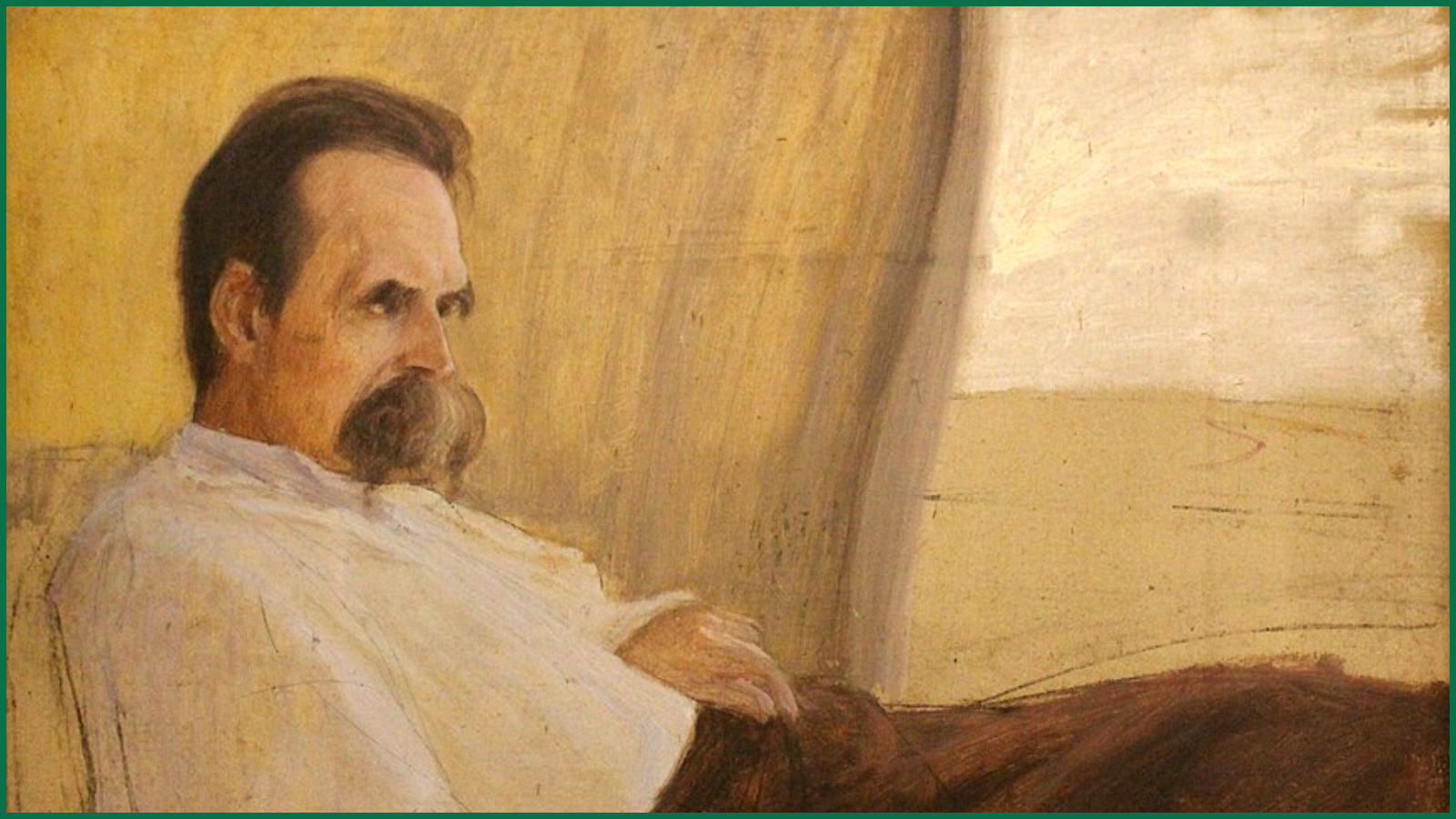
    In Untimely Meditations Nietzsche alerted readers that most written works were little more than “the smoke and vapour of the brain.”1 For a book to avoid the flames, it must contain a fire within itself. It is easy to dismiss Nietzsche’s body of work as slippery, with an undue level of contradictions that negate its possibility as a system of thought. But this is characteristic of a reactionary right that prefers romanticization to reason.2

    The Enlightenment era championed progressive leaps in scientific method, rule of law, technological invention, standard national institutions and conceptual human rights. Karl Marx is the apogee of Enlightenment philosophy because he discovered the objective material and social conditions enabling the progression of human history. Nietzsche, on the other hand, is the pinnacle of the reactionary Counter-Enlightenment opposition. The Counter-Enlightenment generally held that core human characteristics like ascetics, nature, religion and emotion were washed away by 18th and 19th century waves of industry and empiricism. Nietzsche believed that only a rigid social hierarchy—a radical aristocracy—replete with slavery and the relegation of women to childrearing could provide fertile ground for his ideal man, the Übermensch.

    For most of us today, there are elements tracing to both Enlightenment and Counter-Enlightenment thinking that are appealing. Conservatives borrow from the industriousness that modernity unleashed, while upholding the importance of pre-modern religious ideals and social hierarchy. Socialists might admire Romantic commitments to beauty and culture, while they hang onto empirical measures of history and positive human rights. Liberals hold institutions and negative rights in high esteem, while appreciating the role of emotion in public discourse. Nietzsche, with his passionate treatment of culture, hierarchy and human vitality, therefore offers a grab-bag of ideas that almost anyone can pull one or two shiny parts from while ignoring the rest.3

    A Nietzschean Left?

    Jonas Čeika managed to do this in his book How to Philosophize With a Hammer and Sickle, though he is not the first socialist to do so.4 Other left-wing figures such as Gilles Deleuze and Emma Goldman have gone down similar roads with Nietzsche, even though there is not any profound reason for doing so. It is easy to extol Nietzsche’s romantic anti-capitalism and lofty Übermensch ideal because these would seem at home under communism where, in Leon Trotsky’s words, “the average human type will rise to the heights of an Aristotle, a Goethe or a Marx.”5

    Speaking of the latter, Marx has long-since reconciled the gap between between pre-modern, Counter-Enlightenment virtues and the objective nature of the modern capitalist mode of production. Marx himself was not an anti-capitalist like Nietzsche; he was a post-capitalist who believed that the boundaries crossed by capitalist technologies and social relations were the keys to unlocking a harmonious socialist future. The attempted construction of a Nietzschean left is therefore either discordant or illogical in the light of dialectical materialism, which affords Nietzsche little more than a corner of society’s superstructure

    The Overman

    Nietzsche’s detours through an idealized caste system, slavery and perpetual “life-affirming” warfare are not merely the means to the Übermensch end; they are part of the end itself.6 This is because Übermensch—or “overman” in English—would have nobody to sail over if the harried masses weren’t ripe for subjugation and influence. This is expected from a Marxian perspective, which emphasizes the role of human relationships in determining the experience of individuals and the overall structure of society. In order to exist, a master must have a slave, just as an employer must have an employee and an overman must have an underman.

    The domination of commoners by elites is the plough by which Nietzsche’s imagined master morality is cultivated. Although he understood both capitalism and Christianity to be deracinating to culture and morality, these sentiments are not progressive—they are radically regressive, rooted in admiration for the heroic conquerors of antiquity that enslaved entire populations. Whereas mainstream conservatism is informed by feudal Christian traditions and values, Nietzsche drifts much further to the right wing of the spectrum with his admiration for the pagan slave empires of antiquity.

    The Fascist Impulse

    It has been said that Benito Mussolini abandoned socialism in the disillusioning aftermath of the First World War, just after exposure to Nietzsche’s work. It is therefore unsurprising that Italian Fascism is just as slippery and reactionary as Nietzsche’s polemics—and Friedrich’s fingerprints are all over Mussolini’s governing ideology.

    Like Nietzsche, Mussolini glorified antiquity and adopted the Roman fasces as his party’s symbol. Inspired by the concept of “master morality,” he sought to create a Third RomeLa Terza Roma—which would subordinate weaker nations like Greece and Ethiopia by natural right. The city of Rome was to be transformed into a mecca of imposing monuments, piazzas and open-air theatres celebrating the revival of the ancient Roman masters. Far from Marxian classlessness, Mussolini’s corporatist policies created a rigid caste system whereby one’s social standing and rank as a landowner, industrialist, military officer, farmer or worker was practically designated at birth. Women were erased from the public sphere as the rearing of soldiers became their sole duty to the state.

    Given Nietzsche’s undeniable influence on Italian Fascism, it is no wonder that Adolf Hitler gifted Il Duce “an elaborately bound and privately printed volume of the complete works of Friedrich Wilhelm Nietzsche” for his 60th birthday. While the written works of left wing writers like Bertolt Brecht, Helen Keller, Jack London, Marx and Friedrich Engels, met the flames in Nazi Germany, Nietzsche was worshipped. Of particular interest to Nazi theorists was On the Genealogy of Morality, which asserts an iconoclastic view on the origin of civilization:

    Some pack of blond beasts of prey, a race of conquerors and masters, which, organized for war and with the power to organize, without forethought, sets its terrifying paws on a subordinate population which may perhaps be vast in numbers but is still without any form, is still wandering aimlessly.7

    The reference to “blond beasts of prey” is more than a passing allusion. Nietzsche elaborates on the Aryan identity of this conquering race—this “master race”—of aristocratic antiquity which was finally destroyed by a Jewish “revolt of the slaves” and “blood-poisoning.”8 According to Nietzsche, the slave morality operates by inverting what is strong, beautiful and learned into something fearful, ugly and ignorant. By transvaluing ancient Roman and Greek master morality, Judaic priests tamed the empire and then destroyed it. The portraits of three Jews—Jesus, Mary and Joseph—adorning millions of European walls stand as the legacy of this triumphant Jewish slave revolt.9

    It is popularly claimed that the Nazis hijacked Nietzsche’s teachings and misappropriated them for their own sinister purposes. There is some merit to this claim but only in part. For example, despite his screed lionizing the Aryan conquerors of antiquity and bemoaning their Jewish subjects, Nietzsche was plainly not an anti-Semite. He believed that history had turned the Jewish people into “the strongest, toughest and purest race now living in Europe” and held them to be essential ingredients to breeding his imagined postmodern aristocracy.10 Additionally, he did not view the Aryan master race from quite the same racial footing that the Nazis did. For Nietzsche, it was a cultural designation, an exercise of master morality exemplified by Nordic Vikings but also the Brahmin caste of India, Greco-Roman slaveholders and medieval Arabic and Japanese nobility. 

    Nietzsche endorsed Napoleon Bonaparte as a historical example of an Übermensch, capable of terror and genius, who unified Europe along strict hierarchical lines, military discipline and exemplary cultural values. Hitler saw himself as Napoleon’s successor because he unified Europe by force, raised slave populations from the defeated nations, preserved the Prussian aristocracy and promoted a Wagnerian high culture brimming with Nordic valkyries screaming into battle. For the Nazis, the commitment to a transvaluation of Judeo-Christian values went beyond good and evil.

    Master Morality and the Holocaust

    Nietzsche wrote: “For strong people disaster does not come from the strongest, but from the weakest.” Whereas the strong possess unapologetically life-affirming values, the weakest exalt life-denying values and the veneration of their pitiable existence spreads like contagion. The Holocaust, with all its attendant atrocities against Jews, Romani, socialists, sexual minorities and the disabled, was merely a slave revolt in reverse. What the Holocaust represented was a master’s revolt against the slaves from antiquity, the shiftless vagabonds, the egalitarians, the weak and infirm, the homosexuals that perverted good breeding. If the Holocaust is today remembered as “the terror of terrors,” this poses no dilemma as far as Nietzsche is concerned: “The more valuable type [of man] has appeared often enough in the past…Very often he has been precisely the most feared; hitherto he has been almost the terror of terrors.”11

    While Mussolini hewed to a vision that was more classically Nietzschean than Hitler, to claim a misappropriation of Nietzsche’s work by the Nazis is simply dishonest. Nazi ideology was grounded in a defensible interpretation of Nietzsche’s thought, updated to include the latest “discoveries” in eugenics and “racial science.” The gravest misappropriation committed by the Nazis was the inclusion of “socialism” in their party’s National Socialism title. This was a sleight of hand used to convey the Nazi disdain for decadent liberal capitalism while preserving electoral viability in a period when German support for market forces was at an all-time low. A more accurate party title, such as “The New European Aristocrats,” just wasn’t going to resonate with the average German voter.  

    It is a fact the Nietzsche’s passionate attacks on modernity continue to attract significant attention despite the irrational, dark and mystical depths it treads. He strikes at the emotional chords of those frustrated by modern capitalist society. Marx, on the other hand, had a scientific approach to philosophy and helped to develop a praxis for human emancipation. Attempting to reconcile these two schools of thought is akin to attempting reconciliation between oil and water. There is a reason why Marx flatly rejected emotional reactionary politics: it is a dead-end in every sense of the term.

    The historian J. Arch Getty wrote, “Lenin deserves a lot of credit for the notion that the meek can inherit the earth, that there can be a political movement based on social justice and equality.” In the final analysis, are these emancipatory values not superior to Hitler’s embodiment of the Nietzschean “terror of terrors”?

    Thanks for reading!

    Footnotes:

    1. Friedrich Nietzsche, “Schopenhauer as Educator” in Untimely Meditations. ↩︎

    2. See John Richardson’s, Nietzsche’s System (Oxford University Press, 2002) for more on reading Nietzsche’s polemics as a system of thought. ↩︎

    3. Conservative commentators like Jordan Peterson are also notorious for doing this. ↩︎

    4. The most interesting aspects of Jonas Čeika’s How to Philosophize With a Hammer and Sickle (Repeater, 2021) are his inquiries into a hypothetical libertarian socialism. ↩︎

    5. Leon Trotsky quoted in Čeika’s, How to Philosophize With a Hammer and Sickle, 200. ↩︎

    6. See Nietzsche, Twilight of the Idols: “For war trains men to be free.” ↩︎

    7. Frank Cameron and Don Dombowsky, eds., Political Writings of Friedrich Nietzsche (Palgrave Macmillan, 2008): 227. ↩︎

    8. See Nietzsche, The Genealogy of Morals for excerpts. ↩︎

    9. Ibid. ↩︎

    10. Nietzsche, Beyond Good and Evil, 182. ↩︎

    11. Nietzsche, The Antichrist (Alfred A. Knopf, 1918). ↩︎
  • Liberal Democracy is a Sham

    Liberal Democracy is a Sham

    The concept of civilizational decline has been a staple of the far-right at least since the rise of fascism in Europe a century ago. While the right has always fixed its consternation with fast moving cultural changes and the erosion of “traditional values,” they are ideologically incapable of linking their grievances to the capitalist economic system that constantly revolutionizes our way of life.1 But the first quarter of the 21st century has had the experience of successive wars and economic crises and political realignments against the backdrop of a rising China. The anti-capitalist left has therefore embraced the decline narrative, given the extraordinary challenges of environmental deterioration and affordability amidst a rising concentration of wealth and power into the hands of an elite western oligarchy. Throw in the demoralizing Epstein revelations and a rupture to the political order by a berserk President Trump and even western liberals are acknowledging decline.

    If there is one shibboleth of the West that deserves scrutiny at this moment in history, it is liberal democracy. Liberal democracy has been the veneer over western capitalism; a moral ornament obscuring the ransacking of colonies around the world and used to coordinate a unified western response to competition from emergent powers. This has not always been a bad thing—the alliance between liberal capitalist states and the Soviet Union was fruitful in tearing down Nazi Germany, for example.

    In the period post-World War II, western liberal countries could lay claim to progressive achievements on the home front—such as civil rights, accessible education and affordable housing—even while supporting many heinous regimes abroad. Free speech and multiparty elections appeared as great strengths under a regime of centralized news media that gave citizens a common information platform, while high union membership in domestic manufacturing ensured a reasonable distribution of profits.

    Today that regime has changed. Private sector unions have fallen off a cliff and the digital age has turned media consumption into a “Choose Your Own Adventure” story. In a dialectical reversal, yesterday’s free speech and partisan competition have become forces that propel their own demise: conspiratorial misinformation, foreign subversion, online mobs of neo-Nazis, unchecked corporate power, the ascent of dictatorial right-wing populists into office. While smartphone apps and AI models rush out like a waterfall, public infrastructure is achingly slow to build. In Canada it can take 41 years to cut the ribbon on a simple light rail transport—to say nothing of badly needed doctors, schools, energy generation and bridges. The refusal to scrutinize liberal democracy out of some fear that its only alternative is dictatorship must be admonished because capitalism has already put us on an openly authoritarian trajectory with accelerating speed. If the democratic veneer that the West has placed over its society is no longer compatible with the communications technology and global economic structure in existence today, then it is high time to say so.

    Washington’s Warning

    In his farewell address, the first president of the United States foresaw exactly why liberal democracy would cease to function. George Washington argued that partisanship would fragment the common interest into competing factions. A citizenry that identified with a political party rather than the country would lose its principles; they would fail to identify policies affecting the common interest and concern themselves only with gaining power at the next instance. Political parties turn society against itself and create countries within countries: “Thus the policy and will of one country are subjected to the policy and will of another.” In the partisan political environment, Washington said, jealousies prevail and a “spirit of revenge” takes over, clearing the way for “cunning, ambitious, and unprincipled men” to take over on the back of “foreign influence and corruption.”

    Trump rally
    “I’d rather be a Russian than a Democrat.” George Washington warned that partisan animosity would destroy national unity and invite the foreign subversion of national interests.

    The body politic is now terminally ill with the viruses that Washington identified centuries ago. Liberal societies divided by political allegiance has turned the digital space into a playground for foreign actors. While weaker countries like Georgia and the Philippines are sites of proxy wars between East and West influence, the president of the United States openly accepts foreign bribes and Canadian separatists collaborate with agitators from the U.S. government. Elections have turned into sports matches where the politicians are the players, the voters are the fans and corporate CEOs own the teams.

    The Brexit referendum was dominated by Britain’s wealthiest individuals and the OECD has already acknowledged that capital interests have saturated public discourse through industry-funded think tanks, lobbying and direct corporate political advertising. Representative government is powerless to reverse these trends because it is baked into the system; whoever holds power has necessarily benefitted from the existing framework or they wouldn’t be in office. Major reforms therefore hold little incentive but face massive pushback from an elite minority eager to retain its influence. 

    Contemporary liberal governance aligns with Washington’s description of “a frightful despotism” that negates the common interest in favour of permanent minority rule. In Canada, pollution reduction measures have been rolled back while oil companies have received billions in new subsidies—despite a two-thirds majority favouring clean energy and climate protection. A full three-quarters of Canadians give failing grades to their government in assisting with the cost of living crisis. The Canadian government does not possess the tools to meaningfully direct economic outcomes and the majority of people are plunged daily into the hazards of the market. Meanwhile, Canada’s central bank receives no input from labour or consumer stakeholders and the CEO-drenched Business Council of Canada has emerged as the prime minister’s top advisor.

    When majority opinion is fragmented between multiple elected parties, it is only economic elites who maintain consistent influence through successive governments. In the United States, this is especially true; studies analyzing popular opinion and political legislation have concluded that average Americans “have practically zero influence on government policy.”

    On policy, Democrats, Independents and Republicans agree with each other far more often than not. Large majorities in the United States favour public health insurance, ending the embargo of Cuba, ending mass incarceration, avoiding confrontation with Iran and Venezuela, reducing military expenditures, cutting support for Israel and adopting a pro-Main Street economic approach. Yet this is ignored by administration after administration resulting in rock-bottom public trust in government. As little as 17% of Americans trust their government “to do what is right most of the time.”

    A United States that was subordinated to the popular will of Americans would immediately be a gentler, more sustainable global power with an economy that doesn’t cannabilize its own people for profits. But a government anchored by popular opinion would hurt margins across multiple industries—which is a red line for the capitalist regime. Partisan competition therefore exists to exploit wedge issues and keep the democratic majority as far from power as possible.

    Toward a People’s Democracy

    In The State and Revolution, Lenin described liberal democracy as “the best possible political shell for capitalism” because it allows corporate oligarchs to establish their power “so securely, so firmly, that no change of persons, institutions or parties in the bourgeois democratic republic can shake it.”2 The western dictatorship of capital donned respectable attire for the purposes of winning hearts and minds during the Cold War. But since the dissolution of the Soviet Union it has shed its clothes once again.

    Although the People’s Republic of China is derided in the mainstream as an authoritarian country, their decision-making process gathers more input from their citizens than most western countries do. Through online platforms, opinion polling, surveys, telephone hotlines and direct elections of local officials, the people of China give their local governments long lists of actionable items and provide guidance to the strategic Five Year Plans that have modernized their country at warp speed. This does not mean many aspects of the Chinese political system would be palatable to western society but it does expose the arbitrary criteria by which one country is deemed “democratic” while another is smeared as “authoritarian.” After all, if the “democratic” label can apply to a country that grants its citizens zero input in legislation and locks up more of its own people than any other in history, what good is the label? 

    The object of liberal democracy represents a major barrier to class consciousness, even among the left. A misplaced faith in this unworkable system has led to disastrous outcomes for the economic security of western workers; for the debt loads of governments; for slums of the Global South; for the biosphere. This is not a world designed by the democratic majority. To earn the label of democracy, the West must rethink the utility of career politicians making decisions on behalf of the population. Corporate influence must be ruthlessly suppressed and a public sector economy servile to the material wants and needs of the democratic majority must be constructed. With the commanding heights of the economy under public control, fertile ground for cooperative enterprises can finally be laid. 

    If a one party state is a bridge too far, we should consider alternative power structures that could exalt the great mass of working people over special interest groups. For example, power could be vested to non-partisan people’s assemblies chosen by lot. Such assemblies would supervise the bureaucracy and hire expert panels that implement the laws and economic plans determined by direct referenda. It is this, direct democracy, that reconciles the people with their government instead of alienating them from it.

    Contrary to the musings of thinkers like John Stuart Mill, the “tyranny of the majority” is not a historical reality. Every tyranny in history has rested on minority power and the forfeiture of rights to elites. Capital interests have co-opted the democratic title and deformed the concept beyond recognition. But liberal government must be viewed as an enemy in the struggle against elite power. As Marx and Engels said, “the first step in the revolution by the working class is to raise the proletariat to the position of ruling class, to win the battle of democracy.”3 As things now stand, that “battle of democracy” has yet to begin.

    Thanks for reading!

    Footnotes:

    1. Recalling Karl Marx and Friedrich Engels in The Communist Manifesto (Arcturus Publishing, 2017): 37. “Constant revolutionizing of production, uninterrupted disturbance of all social conditions, everlasting uncertainty and agitation distinguish the bourgeois epoch from all earlier ones.” ↩︎

    2. Vladimir Lenin, “The State and Revolution” in Essential Works of Lenin: “What Is To Be Done? And Other Writings (CreateSpace, 2012): 382-3. ↩︎

    3. Marx and Engels, Communist Manifesto, 85. ↩︎
  • Ask the Editor: Predicting 2026

    Ask the Editor: Predicting 2026

    To the editor,


    What do you expect in the year ahead?

    Happy New Year,

    Teela.

    [Sent from Bluesky]

    Happy New Year!

    Predictions may be a fool’s errand but there is always some low-hanging fruit. Democrats will sweep midterm elections, Canada’s prime minister likely obtains his coveted majority government and plastic pollution continues to worsen. Marxists understand the relatively low stakes of these surface-level tendencies. The world we are living in is one where power has long been consolidated by an elite corporate class; yawning economic inequalities and corrupted liberal democracies are only symptoms of this fact. I do not foresee any challenge to ruling class power in the near term, which means that the direction of 2026 has already been set.  

    For all its Trump-related pandemonium, 2025 did not really move the needle away from trajectories previously established. Inflation continued to eat away at pocketbooks around the world. Russia and Israel aggressively redrew the maps of their respective neighbourhoods. China held on to its massive gains in global exports and new technologies. The Western world, including Canada and the European Union, have once again proven politically adrift without the tide of American leadership. The artificial intelligence economy—buoying the world’s stock markets by hype—has turned flat without reaching any clear tipping point. Venezuela has invited condemnable aggression from Washington and this is the fate of any Latin American country daring to exercise sovereignty over their national resources.

    With the big stories of 2025, you’ll notice there was not a lot that was new; events have all unfolded around past momentum. Even an objective change, like US tariff polilcy, has only accelerated the existing trend of Western decline relative to a rising East. Populist movements demonstrate a world clamouring for catharsis but 2026 won’t be the year to deliver it. That is because the economic forces at play tell a story of near-term easing rather than escalation. Inflation is slowing down. AI investors have begun to exercise caution amidst talk of a bubble. The prospect of a Russia–Ukraine ceasefire signal the willingness of both to prioritize economic repair over military objectives. And the erraticism of the Trump White House has only spurred China to stay its course while the West begrudgingly flounders. The fate of Venezuela’s Maduro government may be an open question but, whatever happens, it will be a movie we have seen before.

    The tense stability which looms over the globe this January does not portend any major improvement. Financial strain, environmental deterioration, warfare, oligarchic power, political impulsivity and social unrest will all continue to simmer under the heat of the recent past. The ancient Greek philosopher Anaxagoras said that to “separate off” elements from one another takes a revolution.1 Likewise, the West will need to “separate off” its current ruling class in order to realize a change to its set trajectory. History shows us that revolutions do not occur unless class conflict reaches a raging boil. Although we will be waiting past the new year for that, let’s raise a glass to 2026 and try our best to enjoy the simmer.

    In sols,

        Your editor.

    Send your questions to the Reclamationeditor@thereclamation.co

    Footnotes:


    1. Early Greek Philosophy, trans. Jonathan Barnes (Penguin, 2002): 196. Anaxagoras here was referencing the nature of matter in the universe. ↩︎
  • Ask the Editor: “What is Postmodernism?”

    Ask the Editor: “What is Postmodernism?”

    Dear editor,


    Here’s something I’ve heard applied to Donald Trump, woke liberal activists and everyone Jordan Peterson doesn’t like: postmodern. It’s also a label placed onto some of my favourite films, buildings and artwork, like Eternal Sunshine of the Spotless Mind, the Petronas Towers in Kuala Lumpur and Andy Warhol prints.


    What is postmodernism? Is it good or bad?

    Cheers,

    Sora.

    Dear Sora,


    In his 1991 book Postmodernism, or, the Cultural Logic of Late Capitalism, Fredric Jameson argued presciently that the radical structural changes to the economy underway in the 1980s created a western culture disillusioned by progress, marking a break with modernity in the process.1 33 years later, the disillusionment has deepened and postmodernism rules the public sphere


    After the medieval period was destroyed by the riches of exploited labour and resources from the Americas, modernity followed in its wake. Modernity is characterized by Enlightenment philosophy, secularization and science, liberal democracy, romantic and realist artwork and International Style architecture. It is debatable whether we have truly exited modernity but postmodernism can at least describe its latest evolution. 


    The most consequential casualty of the postmodern turn is the belief in progress. This has given space for right wing populists around the world to lash out at the previous order and ruling institutions. Lacking any philosophical grounding, there has been a tidal wave of contradictory political expressions coming in from the right: nostalgia for past glory while undermining the institutions that facilitated it; trickle down tax policies and trade protectionism; conspiracy theories and “alternative facts;” religious affirmations and hedonistic menageries of drugs and sex. Anything goes, and this is the hallmark of postmodernism. Because there is no grand narrative of history or final destination for humanity, nothing has to make sense beyond the present moment. Postmodernism did not produce identity politics; on the contrary, identity politics relied on the modernist narrative of a society gradually abolishing social prejudices. The triumphalism of postmodern politics has destroyed the “woke” idea, and liberals abandon it as rats flee a sinking ship.


    Many of the postmodern elements seen lately in politics have existed for years in the realm of culture. The parade of cinematic reboots and remakes, nonlinear story structures, imitation of past styles without context and a fusion of high and low art are a few postmodern characteristics that Jameson identified. Postmodernist culture like film, music, artwork or architecture, relies on extensive reference to the past because of an inability to apprehend the future.


    Postmodernism isn’t good or bad. It is simply the cultural analog to our current economic structure and material life. Finding resonance with postmodern culture is expected as we, too, are products of late capitalism.  Just as we see postmodernism dominate the society of a nihilistic West, futurism dominates the society of an optimistic China. Only when the West has consciously apprehended its economic levers will it be able to determine its future and set foot to a new era yet again.

    In sols,

        Your editor.

    Send your questions to the Reclamationeditor@thereclamation.co

    Footnotes:


    1. Fredric Jameson, Postmodernism, or, the Cultural Logic of Late Capitalism (Duke University Press, 1991). ↩︎
  • Ask the Editor: “Why Was Charlie Kirk So Popular?”

    Ask the Editor: “Why Was Charlie Kirk So Popular?”

    Dear editor,


    The coverage has been wall-to-wall ever since the recent assassination of Charlie Kirk. I understand it is a tragedy to lose a young family man to homicide. Politics is very divided now. Despite this, people are getting fired for criticizing Kirk’s politics. With everything happening in the world, I did not see this escalating so much. I had only heard of Charlie Kirk and Turning Points USA in passing before this happened but now I realize that he was big in the Trump world. Why was he so popular to begin with?

    Thanks,

    Davey STL.

    Dear Davey,

    In western representative democracies, politics has literally become a bloodsport. Despite this, the range of issues being debated are actually very narrow. There is always a centrist liberal party and a right wing conservative party and both of them want to maximize returns for wealthy donors above all. There is some discussion about foreign policy, tweaks to government distribution and emotional social issues. That’s about it. In Canada, we have a corporate stooge for prime minister. He campaigned as some kind of progressive nation-builder but he has been anything but in government. 

    Right wing donors in the United States, under the guise of “libertarianism,” are particularly focused on unshackling themselves from environmental protections and labour laws while gaining tax loopholes and subsidies. These ideas aren’t very saleable in the perfunctory elections that take place every couple of years and that’s where activists like Charlie Kirk come in.

    Kirk found a couple of wealthy patrons for his Turning Point organization when he was about 18 years old: Bill Montgomery and Foster Friess. They plugged him into the obscenely vast and well-funded right wing donor network that elevated him to star-status on the right. He built his brand identity by debating liberal college students for a wider audience. In one produced for Jubilee Media, there were five topics discussed: abortion, gender studies, trans-women, diversity, equity and inclusion (DEI) hires and affirmative action. Nothing about corporate power, environmental protection, financial monopolies or the military-industrial complex—the issues that will actually impact the future well-being of society. And that’s the point. Noam Chomsky: 

    The smart way to keep people passive and obedient is to strictly limit the spectrum of acceptable opinion, but allow very lively debate within that spectrum – even encourage the more critical and dissident views. That gives people the sense that there’s free thinking going on, while all the time the presuppositions of the system are being reinforced by the limits put on the range of the debate.1

    When Marx and Engels wrote “the ideas of the ruling class are in every epoch the ruling ideas”—they weren’t talking about the “ideas” paraded about by Joe Rogan, CNN or Charlie Kirk. They were talking about those that can’t be questioned.

    The ruling class lost a talented propagandist, a powerful distractor. Kirk should not have been murdered. It is a tragic loss for his family and his assassination will play right into the hands of his own talking points. After all, if he can be killed over the things he said, those things must now seem really important. 

    In sols,

        Your editor.

    Send your questions to the Reclamationeditor@thereclamation.co

    Footnotes:


    1. Noam Chomsky, The Common Good (Odonian Press, 1998): 43. ↩︎