
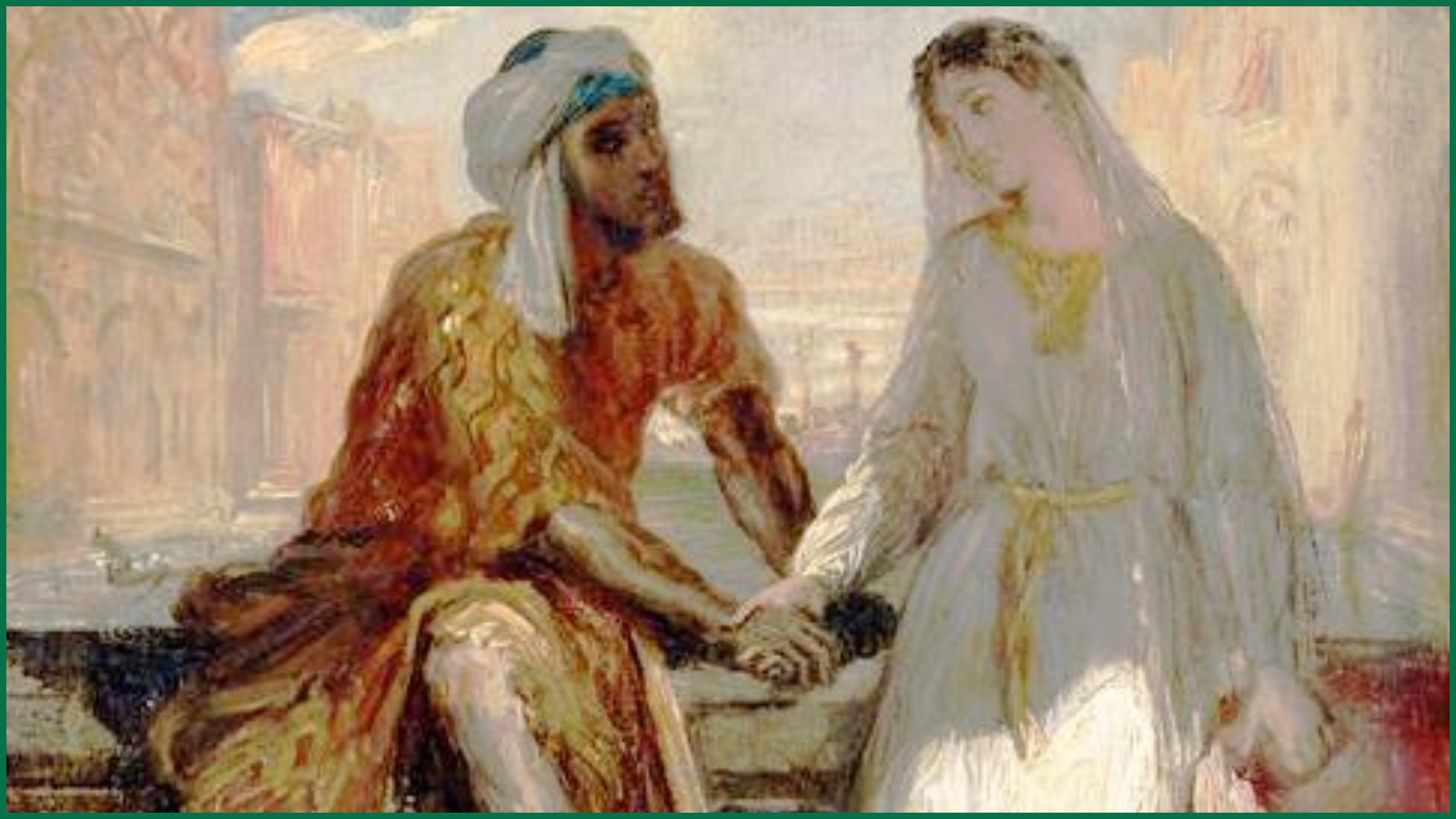
If virtue no delighted beauty lack,
Your son-in-law is far more fair than black.—Duke of Venice, Act 1, Scene 3.
The Tragedy of Othello, the Moor of Venice is a Shakespeare play that carries an echo of the European imagination that lasted beyond Karl Marx’s lifetime. “Moor” was a term used by Europeans to refer to the Muslim North Africans who had conquered and ruled the Iberian Peninsula between 711 and 1492. The Muslim population of Al-Andalus—modern day Spain and Portugal—were quite heterogeneous and did not use the Moor identifier themselves. Even after the Christian reconquest of the Iberian Peninsula, “Moor” was a common European designate applied to continental Africa and the Middle East.
The term was derived from the ancient Roman province of Mauretania—modern day Morocco and Algeria— and it eventually came to denote virtually anyone of a darker complexion. Marx, a German and ethnic Ashkenazi, was nicknamed “the Moor” by friends and family owing to his swarthy skin tone, hair and eyes.
The Moor label—applied to Marx but also by Shakespeare to his Othello title character—is emblematic of European perceptions of race as they evolved through centuries. Since the era of ancient Rome, people of North African, Middle Eastern and sub-Saharan African origin worked and lived in continental Europe. Yet “the ancients did not fall into the error of biological racism; black skin colour was not a sign of inferiority.”1
The ancient world was hardly free of prejudice; individuals were judged harshly according to their occupation, cultural identity or status as citizens. But the concept of race did not exist and physical differences between groups were thought only to be the effects of climate on the human body. This view of race and ethnicity largely held through Europe’s medieval era and into Elizabethan England: “The theory of the humours, the basis of Elizabethan psychology, maintained that men were of different complexions, statures, and countenances of mind and body according to the climate of their birth.”2
Lacking a social construction of race, ancient Rome based their in-group identity on citizenship. And medieval Europe and Renaissance England did much the same thing, only with Christianity as the defining in-group characteristic. This began to change in many parts of Europe during Shakespeare’s lifetime with the advent of the trans-Atlantic slave trade. Othello therefore occupies a blurry space somewhere at the dividing line between the western religious sorting of peoples and the systematic racial categorization that would later come.
A World of Sighs
At the open, we learn that Othello has married Desdemona, the daughter of a Venetian senator. Othello descends from a vague “Moorish” nobility but lives as “a Christianized black in Venice” who has risen to the rank of an esteemed general in the Venetian military.3 Iago serves as Othello’s trusted ensign but he has an axe to grind: Othello has passed him over for the position of lieutenant in favour of Cassio. This enrages Iago but he carefully keeps his feelings hidden. With discretion, Iago alerts Desdemona’s father to her betrothal and appeals to him with charged language in order to rouse opposition: “You’ll have your daughter covered with a Barbary horse…I tell you your daughter and the Moor are making the beast with two backs.”4
Desdemona’s father, betrayed by his daughter marrying without his permission, appeals to the Venetian senate to overturn the ceremony. However, the senators are not persuaded. Desdemona had married with full consent and besides, they require the “valiant Moor” to defend Cyprus from an invading Turkish fleet. Iago then embarks upon a set of hateful schemes designed to ruin Cassio’s reputation, snatch money from Roderigo and destroy Othello’s otherwise happy marriage to Desdemona.
Iago holds the crown amongst Shakespeare’s villains because of the sociopathic manner in which he weaponizes the trust that other characters place in him. Eventually snared by his own web of lies, Iago’s malevolent nature is laid bare in the last act before a bed loaded with the lifeless bodies of Desdemona, Othello and even Emilia, Iago’s wife.
There is exceptional wickedness displayed here, as Iago ruthlessly manipulates Desdemona, Emilia, Cassio and Roderigo in order to convince Othello that his wife was unfaithful to him. But interest in Othello lingers due to the uniqueness of Shakespeare’s choice of protagonist. Shakespeare did not invent the character of Othello whole-cloth; he was devised from a “Moorish” character in a short story by the Italian poet Cinthio. Shakespeare’s version leaves open the possibility that Othello is an Arab or Berber noble of some type, but there are also a number of references to Othello’s appearance that suggest a black complexion.5 This was a bold choice for Elizabethan audiences as only an estimated 300-500 Black people are thought to have resided in England over that period of time.
Bootless Grief
Shakespeare takes measures to ensure that the foreign Othello is perceived favourably by his audience. He possesses a Christian identity, his nobility and rank bless him with a majesty of speech and his bravery in battle has earned him the respect of the Venetian ruling class.6 Even spiteful Iago acknowledges Othello’s virtues that would make him a good husband to Desdemona:
The Moor, howbeit that I endure him not,
Is of a constant, loving, noble nature,
And I dare think he’ll prove to Desdemona
A most dear husband.7
When Othello capitulates to jealousy and slays Desdemona, the labour that Shakespeare undertook establishing his merits persuade the audience to interpret Othello’s horrendous act as contrary to his nature. It is Iago’s scheming that appropriates the blame for this crime and Othello’s motivations are not presented by Shakespeare as “different from any white husband.”8 The extremely patriarchal relations of Renaissance Europe are fully displayed in Othello, without question. But despite the use of vulgar language on the part of antagonistic characters, Othello is assuredly not a racist play.
While Shakespeare lived in a time just prior to the establishment of the concept of race, by Marx’s age this terrible social construction had reached a zenith. It is difficult to imagine that a story like Othello could be devised during the Victorian era without being subsumed by the social relations of race. In Capital, Marx asserted that racism and the capitalist mode of production shared a common origin during the age of colonial exploitation:
The discovery of gold and silver in America, the extirpation, enslavement and entombment in mines of the aboriginal population, the beginning of the conquest and looting of the East Indies, the turning of Africa into a warren for the commercial hunting of black-skins, signalized the rosy dawn of the era of capitalist production.9
While Elizabethan society viewed Christianity as a positive civilizing force, by the Victorian era Marx found a Christian society that was completely subordinate to capital accumulation and its accordant crimes:
The barbarities and desperate outrages of the so-called Christian race, throughout every region of the world, and upon every people they have been able to subdue, are not to be paralleled by those of any other race, however fierce, however untaught, and however reckless of mercy and of shame, in any age of the Earth.10
Destructing the Construction
We can therefore assert that race and racism is a byproduct of economic relations born from the spiral of capital accumulation which early on necessitated colonial subjugation, forced labour and abject slavery. The impoverishing impacts of these economic forces have had profound effects upon global society into the present day, where we remain haunted by these spectres of history. If race is a social construction burnished by the capitalist paradigm then its demolition can only commence with the creation a new economic order.
It was the Nigerian-British poet Ben Okri who said it best: “If Othello did not begin as a play about race, then history has made it one.” Indeed, Othello’s own race is as shapeless as the concept was during Shakespeare’s lifetime. But the aspiration today cannot be a return to feudalism or mercantilism or the harsh economies of antiquity.
Concerning race-based slavery, Marx wrote: “Labour cannot emancipate itself in the white skin where in the black it is branded.” Ending the systematic subjugation of labour along racial lines is one step of a larger emancipatory project. A society that does not sort individuals by race is one thing; a society that does not sort individuals by class is quite another.
Martin Luther King Jr.’s dream of universal liberty will be seen through the eyes of a classless people that recognize the interconnectedness of the universe, of humanity, of all things living. Once the predatory fetters of competition are shed, cooperation will prevail by the motto: “The free development of each is the condition for the free development of all.”11
Thanks for reading!

Frank Snowden, Blacks in Antiquity: Ethiopians in the Greco-Roman Experience (Harvard University Press, 1970): 169. ↩︎
Philip Butcher, “Othello’s Racial Identity” in Shakespeare Quarterly Vol. 3, No. 3: 246. ↩︎
Peter Erickson, “Representations of Blacks and Blackness in the Renaissance” in Criticism Vol. 35, No. 4: 505. ↩︎
Excerpts from Act 1, Scene 1. ↩︎
Philip Butcher goes as far as saying that Othello is “undeniably black” in “Othello’s Racial Identity,” 247. ↩︎
Russ McDonald writes, “Early-seventeenth century Europeans thought of Moors, Turks and Africans as pagan, but Othello is a Christian, a baptized convert whose Christianity is an important marker of his assimilation into Venice and the values of “civilization.” Russ McDonald, ed. Othello (Penguin, 2016): xxxvi. ↩︎
From Act 2, Scene 3. ↩︎
Ruth Vanita quoted in Rebecca Olson, “‘Too Gentle’: Jealousy and Class in Othello” in Journal for Early Modern Cultural Studies Vol. 15, No. 1: 6. ↩︎
Karl Marx, Capital Vol. One (Ancient Wisdom Publishing, 2019): 533. ↩︎
Ibid, 534. Quoting W. Howitt. ↩︎
Karl Marx and Friedrich Engels, The Communist Manifesto. ↩︎
