
Tag: Shakespeare

  • Marx and Shakespeare: Hamlet’s Alienation

    Marx and Shakespeare: Hamlet’s Alienation

    But orderly to end where I begun,
    Our wills and fates do so contrary run
    That our devices still are overthrown
    Our thoughts are ours, their ends none of our own.

    Player King, Act 3, Scene 2.

    Hamlet is William Shakespeare’s most studied play, owing to its layered themes and rich rhetorical devices. It is a literary work drawn on by John Milton for Paradise Lost, it helped Sigmund Freud to develop his theory of Oedipus complex and inspired and two compositions from Pyotr Tchaikovsky. Karl Marx’s deep appreciation of Shakespeare is well known, and Hamlet is a work that he directly references in his Eighteenth Brumaire of Louis Bonaparte.1

    The Play’s the Thing

    Hamlet almost exclusively takes place at Elsinore Castle in Denmark, which is a real place and one of the Renaissance era’s most prominent. Shakespeare was a product of the Renaissance era, and this setting is crucial to contextualizing many of Shakespeare’s plays because it sits on the demarcation line between the Middle Ages and modernity, between superstition and reason, between feudalism and liberalism, between religion and science, between the aristocracy and commerce. The tensions of this era are very important to understanding Hamlet’s inner conflict, just as it is important to understanding the romance between Romeo and Juliet or the racial attitudes embedded in Othello.

    In The German Ideology, Marx and Engels wrote:

    Thus it is quite obvious from the start that there exists a materialistic connection of men with one another, which is determined by their needs and their mode of production, and which is as old as men themselves. this connection is ever taking on new forms, and thus presents a “history” independently of the existence of any political or religious nonsense which would hold men together on its own.2

    In most of Renaissance Europe, the aristocracy maintained a monopoly on political power, derived from ownership over lands worked by a large peasantry. The rise of an urban merchant class figures heavily in some of Shakespeare’s plays, but in Hamlet we are concerned only with the palace intrigue at the top of the Danish royal hierarchy. There is a multiplicity of love triangles, petty schemes from palace courtiers, eavesdroppers and personal grievances that must constitute trivial drama in comparison to the hardship of life for many of the era. In the grand movement of history, palace intrigue is little more than the “political nonsense” that Marx identified.

    The Apparition Comes

    At the outset, the story establishes that Prince Hamlet’s father has died and his Queen mother had hastily remarried with his uncle Claudius who then consolidated the Danish nobility behind his rule. This turn of events has Hamlet already deeply unsettled and melancholy, exacerbated by a visit from his father’s ghost who wanders the Earth while in spiritual Purgatory. The ghost reveals to Hamlet that he was victim of a “murder most foul, strange and unnatural” by the poison of his brother Claudius.3

    Apparitions, witches, potions and magic were accepted forces of nature in Shakespeare’s time and come regularly into his plays as plot devices guiding a character’s arc. Whereas today uncertainty over someone’s cause of death could be resolved by a medical autopsy or forensic crime scene investigation, Hamlet could only shelter under his suspicions until he was contacted from beyond the grave. 

    But the ghost’s revelation confronts Hamlet with demands on his position. In the aristocratic world of hereditary privilege—so far from modern law and commerce—kinship largely determined one’s station in life. Notions attached to honour and nobility depended heavily on defence of kin, and there was no legal authority that Hamlet could appeal to; indeed, his corrupted family was the legal authority.

    Hamlet understands what is expected from the son of a slain father but revenge is complicated by the aristocratic hierarchy of which he is merely a component part. With a murdered father, a mother joined in marriage with the killer and childhood friends in the service of his usurping uncle, Hamlet finds himself completely alienated from the social relations that grant him his identity as a prince. 

    The ensuing conflict of the play is an internal struggle to overcome this experienced alienation, immortalized by Hamlet’s famous speech: 

    To be, or not to be, that is the question:

    Whether ’tis nobler in the mind to suffer

    The slings and arrows of outrageous fortune,

    Or to take arms against a sea of troubles

    And by opposing end them. To die—to sleep,

    No more; and by a sleep to say we end

    The heart-ache and the thousand natural shocks

    That flesh is heir to: ’tis a consummation

    Devoutly to be wish’d. To die, to sleep;

    To sleep, perchance to dream—ay, there’s the rub:

    For in that sleep of death what dreams may come,

    When we have shuffled off this mortal coil,

    Must give us pause—there’s the respect

    That makes calamity of so long life.

    For who would bear the whips and scorns of time,

    Th’oppressor’s wrong, the proud man’s contumely,

    The pangs of dispriz’d love, the law’s delay,

    When he himself might his quietus make

    With a bare bodkin?

    This speech could be rephrased “to live or not to live?” If Hamlet chooses to live as his father’s son by seeking revenge against King Claudius he will certainly perish in the process. On the other hand, he cannot bear an existence as an obedient prince under these circumstances. To live his proper life is a death sentence but to avoid death he must surrender life.

    The Readiness is All

    There is a duality that opens up here between Hamlet’s blood instincts and his social status as a prince. Marx described alienation as characteristic to humanity’s estrangement from productive activity and the reduction of social relations to class standing, when “man feels that he is acting freely only in his animal functions—eating, drinking, and procreating—while in his human functions, he is nothing more than an animal.”4

    As he is estranged from his family and friends by the revelation of his uncle’s homicide and arrogation of the throne, Hamlet ponders his alienated state: 
    “What is a man
    If his chief good and market of his time
    Be but to sleep and feed? A beast, no more.” 

    It is Ophelia that bears the brunt of Hamlet’s dislocation, his rage against the animalistic propensity toward violence and sex. While they had been engaged in a genuine courtship prior to the events of the play, she becomes “the focus of his disgust with the whole sexual process.”5

    Seeing the characteristics of his being stripped of all virtue, Hamlet dismisses any love he once had for Ophelia as brutish lust and he condemns her to a lifetime of abstinence: “If thou dost marry, I’ll give thee this plague for thy dowry: be thou as chaste as ice, as pure as snow, thou shalt not escape calumny. Get thee to a nunnery. Go, farewell.”

    For Marx, alienation will ultimately be resolved when we take conscious control of our circumstances, when we reconcile our productive activity with both our individual selves and species-being. Hamlet’s internal conflict is resolved when he encounters the army of the crown prince of Norway, Fortinbras, on the march through Danish territory. Hamlet’s father had killed Fortinbras’ father in a duel decades earlier and the Norwegian prince had finally arrived to seek his just revenge.

    Hamlet then grasps the unity of opposing forces; to be an obedient prince is the same as to be his father’s son; to be in love is to be lustful; to live is the same as to die; to be is not to be.6 Before throwing himself, his mother and his uncle to their doom, he says: “There is special providence in the fall of a sparrow. If it be now, ’tis not to come; if it be not to come, it will be now; if it be not now, yet it will come. The readiness is all. Let be.”

    Thanks for reading!


    1. For more on Marx’s personal interest in Shakespeare, see Erich Fromm, “Marx’s Concept of Socialism” in Marx’s Concept of Man (Frederick Ungar Publishing, 1961). ↩︎

    2. Karl Marx and Friedrich Engels, The German Ideology (Martino Publishing, 2011): 18-19. ↩︎

    3. The “most foul” and “unnatural” aspects of the murder lie in it being committed by Claudius against his own flesh and blood. ↩︎

    4. Karl Marx, “The Economic and Philosophic Manuscripts of 1844” in Essential Writings of Karl Marx (Red and Black Publishers, 2010): 91. ↩︎

    5. Harold Jenkins, ed., Hamlet (Arden Shakespeare, 1982):151. ↩︎

    6. This is an observation in advace of the famous thought experiment, Schrödinger’s cat. ↩︎
  • Marx and Shakespeare: The World of Romeo and Juliet

    Marx and Shakespeare: The World of Romeo and Juliet

    The psychoanalyst Erich Fromm once described Karl Marx as the archetypal humanist, an embodiment of Enlightenment thought, “the man who every year read all the works of Aeschylus and Shakespeare, who brought to life in himself the greatest works of human thought.”1 Indeed, his daughter Eleanor Marx once said about her upbringing: “As to Shakespeare he was the Bible of our house, seldom out of our hands or mouths. By the time I was six I knew scene upon scene of Shakespeare by heart.”

    Both Alike in Genius

    Karl Marx himself had been introduced to Shakespeare at a young age by his father-in-law and cited the Bard no less than 176 times throughout his published work. This may seem curious, given that Shakespeare himself was no revolutionary or proto-socialist. He was ahead of his time in respect to his artistry but he nonetheless straddled the fence line of the 16th and 17th centuries as a product of the English Renaissance. Capitalism was only nascent here—in its “primitive accumulation” phase, as Marx described it.

    There were many social transformations underway by the time of Shakespeare and these changes followed in the wake of the discovery of the Americas and successive waves of the Black Death. Labour shortages combined with riches pillaged from far-away continents to elevate a commercial class into the chief coordinators of the economic base. The Renaissance was the cultural reflection of this new economy, appearing in an otherwise feudal superstructure. 

    The rich tapestry of Shakespearean dramas no doubt gave living colour to Marx’s theories of human history. Marx summarized his conception of social transformation as follows: 

    In studying such transformations it is always necessary to distinguish between the material transformation of the economic conditions of production, which can be determined with the precision of natural science, and the legal, political, religious, artistic or philosophic—in short, ideological forms in which men become conscious of this conflict and fight it out. Just as one does not judge an individual by what he thinks about himself, so one cannot judge such a period of transformation by its consciousness, but, on the contrary, this consciousness must be explained from the contradictions of material life, from the conflict existing between the social forces of production and the relations of production. No social order is ever destroyed before all the productive forces for which it is sufficient have been developed, and new superior relations of production never replace older ones before the material conditions for their existence have matured within the framework of the old society.2

    Marx was able to discover the base and superstructure of human society given his location in history, where the Industrial Revolution met Enlightenment philosophy. Likewise, Shakespeare was able to capture a wide spectrum of European society in the dramatic form given his placement at the historical intersection between mercantile proto-capitalism and Renaissance culture. While Marx could observe the society of his present, Shakespeare gave him a valuable glimpse into the past. Adjusting for creative license, the plays of Shakespeare allowed Marx to back-test his theory of history and dialectical method.

    In Fair Verona

    Explicit historical references and socio-economic details are left vague in Shakespeare’s Romeo and Juliet, a play which was sourced from an earlier Italian novella and English poem. Verona was a prominent city-state during the Italian Renaissance, ruled by the House of Della Scala before internal divisions led it to be folded into the Venetian Republic during the 1400s.

    In the play, it is Prince Escalus who stands in for Della Scala, and rules a Verona that is sharply divided by the feuding Montague and Capulet families. Even Escalus’ own House is not immune to this division, as his cousin Mercutio favours the Montagues while Count Paris is partial to the Capulets. The feud between the Montagues and Capulets is emblematic of the actual strife between elite factions and warring states of northern Italy between 1200 and 1500.

    The rediscovery of trade routes during the Crusades led to the commercial revolution that underpinned a Renaissance cultural transformation, enriched the merchant class and spurred the maritime activity that culminated in the European colonization of the Americas. Verona is a logical setting for Romeo and Juliet, given that northern Italy was ground-zero for the burgeoning mercantile economy.

    The Veronese setting suggests that the Montagues and Capulets belong to this newer wealthy merchant class and Shakespeare refrained from assigning them specific hereditary titles in his dramatis personae. References to members of either family as “lord” or “lady” are best understood as courtesy titles common to the Renaissance period, acknowledging a family’s high social standing despite lacking feudal lands or noble lineage. 

    The only characters in Romeo and Juliet with hereditary titles reign from the House of Escalus—the ruling house of Verona. The Prince is thus able to threaten the Montagues and Capulets with execution over their escalating violence, as the latter families enjoy wealth but are deprived of political power. This detail recalls Marx’s observation that revolutions in the political superstructure occur only after the economic transformation is complete.

    At the time of the Renaissance, feudal hierarchies were the political reality as the turn toward capitalism was only just gathering steam. The contradictions between the prevailing feudal order and rising capitalist one are therefore integral to the plot of Romeo and Juliet. Without this wealthy urban elite living under feudal auspices, the Montagues and Capulets would not have existed nor have entered a blood feud. The “ancient grudge” between the two households surely stemmed from economic competition over trade which was bloody and fierce in Renaissance Italy.3 

    Civil Blood and Civil Hands

    Competition between merchant families may have been especially violent in this era because they lacked hereditary nobility and relied solely on financial accumulation to claim status. Market competition can turn any investment or transaction sour—ruining in an instant a great merchant house that had taken decades to build its standing.

    Blood feuds and vendettas between families were a staple of justice in the feudal era owing to the lack of centralized secular authority. However, the uptake of the blood feud tradition by wealthy urban families was greatly disruptive to the commerce and social order of emergent Renaissance cities. This is why we see Prince Escalus attempt to suppress the feud between the Montagues and Capulets in Verona whereas a similar feud between rural families would not have drawn such condemnation at this period in time. 

    This brings us to another salient point of Marx’s thought; namely, the absence of any “universal ideal” of justice that exists outside of social relations. Justice is enmeshed within the web of social relations that form under a given mode of production.4 This view explains the historical acceptance and rejection of slavery, evolving marital relations and family law, the administration of justice between generations, the practice of usury, and the regulation of property from the Paleolithic period up to the present day—to name a few examples. In Renaissance Europe, social relations were very much in flux as the importance of commerce spurred urbanization and the merchant class climbed nearer in rank to the landed aristocracy, not in terms of political power, but in terms of wealth. 

    An interesting outcome of this social fluctuation was the rise of “disorderly conduct” in Renaissance Verona, characterized by gambling, street fights, ribaldrous music and festive dance parties. These debaucherous activities drew members of all classes into subversive contact with one another, as they were undertaken without regard for social rank or hereditary privilege. Chief among these disorderly gatherings was the unsanctioned masque party.5 At a masquerade with identities concealed, a knight could break bread with a porter, a noble could pour wine for a cobbler or a Montague could fall in love with a Capulet.6

    The masque party hosted by Capulet is the pivotal scene of the story: the moment when Romeo notices the young Juliet from across the ballroom is also when Tybalt becomes aware of Romeo’s presence and seeks to violently remove him from the party. Capulet interrupts Tybalt and prevents him from disturbing Romeo, demonstrating the patriarch Capulet’s commitment to the spirit of the masquerade—a suspension of social hierarchy and normative relations. 

    A Death-Marked Love

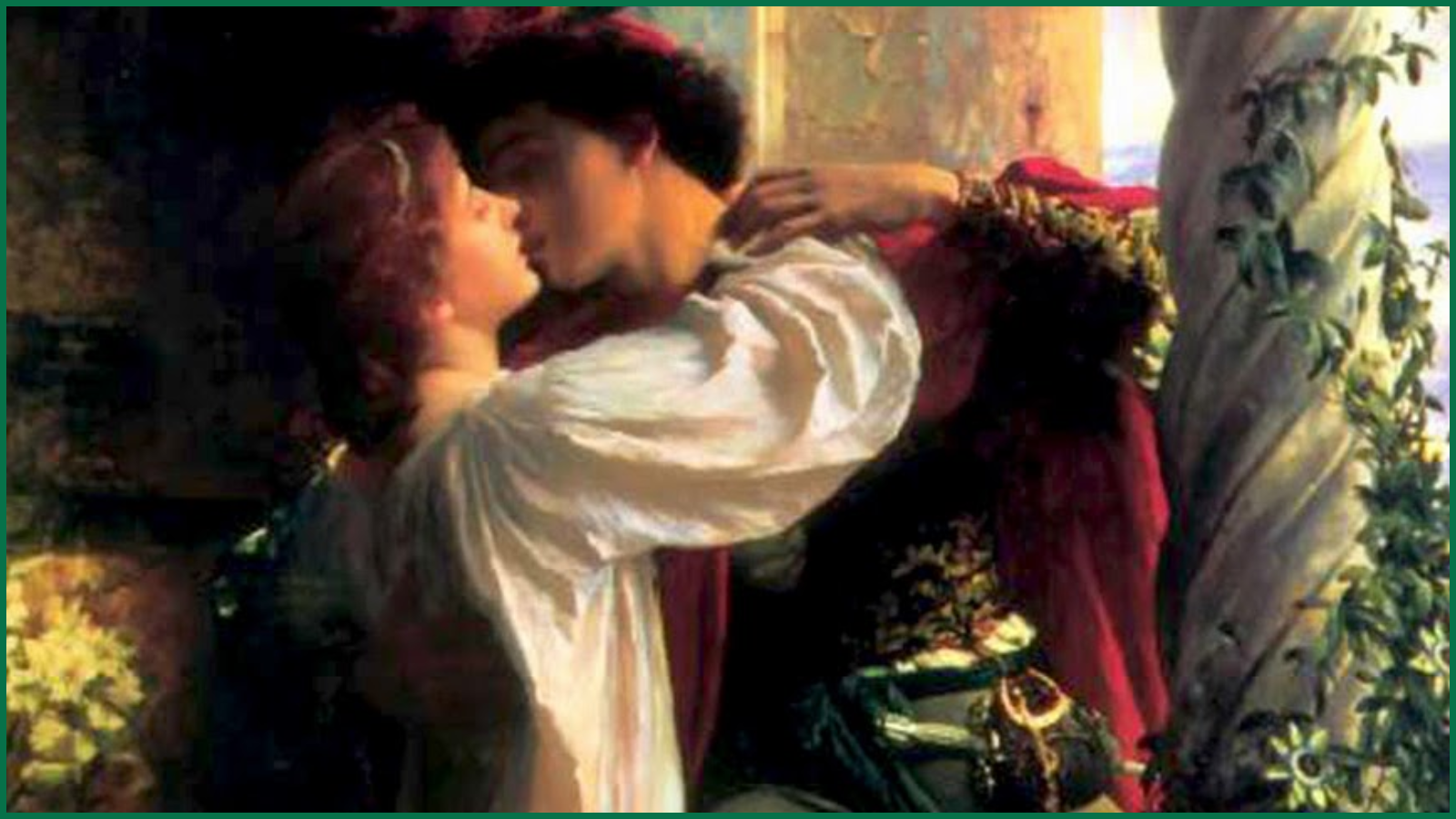
    Born of a subversive gathering, the romance between Romeo and Juliet is embedded with a seditious quality that threatens long-standing customs. Whereas the Count Paris pursues Juliet through a traditional courtship, negotiated between himself and Capulet, Romeo and Juliet consent to marry each other from a place of fiery passion for one another and without the approval of their parents. Love marriages would not become become a norm in the West until the 17th and 18th centuries but they were emergent as the Renaissance began sweeping through western Europe.

    The relationship between Romeo and Juliet represents early modernity. On the other hand, the relationship between Paris and Juliet represents the declining feudal order—just like his hereditary title of Count. The language Juliet uses with Count Paris is formal and terse; he mistakes gaining Capulet’s consent with gaining Juliet’s affection.7 For this mistake he pays with his life when Romeo kills him during a confrontation at the Capulet tomb—a place he had no business lingering.8

    The blood feud is the other declining feudal custom that clashes violently against the romance between Romeo and Juliet. In the play it is like a fire and it consumes the lives of Tybalt and Mercutio as when lend it fuel. Mercutio’s Queen Mab speech foreshadows the agony of modern aspirations against the ferocity of feudalism’s twilight: valiant soldiers toasting wine before they are soaked by the blood of slit throats; civic lawyers and honourable clergymen corrupted by the pursuit of money; the tender kiss between those in love becomes a scourge of venereal disease and swollen pregnant bellies. 

    There is a deep cynicism attached to the story of Romeo and Juliet, reflecting a Renaissance era draped over the coffins filled by victims of bubonic plague; when wealth was asserted by means of warfare in Europe and unspeakable colonial violence abroad. The blood feud between the Montagues and Capulets could never end peacefully. The modern aspiration represented by the marriage between Romeo and Juliet was ultimately shattered by the “ancient grudge” between their two families. But they destroy the old order when they refuse to acquiesce to it. In their joint-suicide, they bury not only themselves but also the blood feud that came between them. Modernity prevailed in Romeo and Juliet just like modernity prevailed in history—at a tremendous cost priced in blood. 

    Thanks for reading!


    1. Erich Fromm, “Marx’s Concept of Socialism” in Marx’s Concept of Man (Frederick Ungar Publishing, 1961). ↩︎

    2. Karl Marx, “Preface” to A Contribution to the Critique of Political Economy. ↩︎

    3. See Thomas F. Arnold, “Violence and Warfare in the Renaissance World” in A Companion to the Worlds of the Renaissance (Blackwell Publishing, 2007): 460–474,  for more on this subject.  ↩︎

    4. David Harvey, A Companion to Marx’s Capital Volume 2 (Verso, 2013): 189. ↩︎

    5. Zoe Farrell, “Connections and Community in Sixteenth-Century Verona” in Journal of Social History, Vol. 59, No. 4: 10-13. ↩︎

    6. In Freudian terms, they become each other’s object-cathexis, a conscious and unconscious register of libidinal energy. The “love at first sight” concept was accepted in Shakespeare’s day, as Cupid’s spell could be cast with mere eye contact. ↩︎

    7. See Act 4, Scene 1 of Romeo and Juliet for a good example of this. ↩︎

    8. This confrontation has been edited out of prominent screen adaptations of the play for the purpose of making Romeo appear more sympathetic. Both Baz Luhrman and Frank Zeffirelli removed it. ↩︎