
Nought’s had, all’s spent,
Where our desire is got without content.
‘Tis safer to be that which we destroy
Than by destruction dwell in doubtful joy.—Lady Macbeth, Act 3, Scene 2.
Macbeth ranks among the most popular of Shakespeare’s plays alongside Hamlet, A Midsummer Night’s Dream and Romeo and Juliet. It is commonly taught in primary English classes and is a frequent visitor to the stage and screen, with recent films featuring Michael Fassbender and Denzel Washington in the titular role.
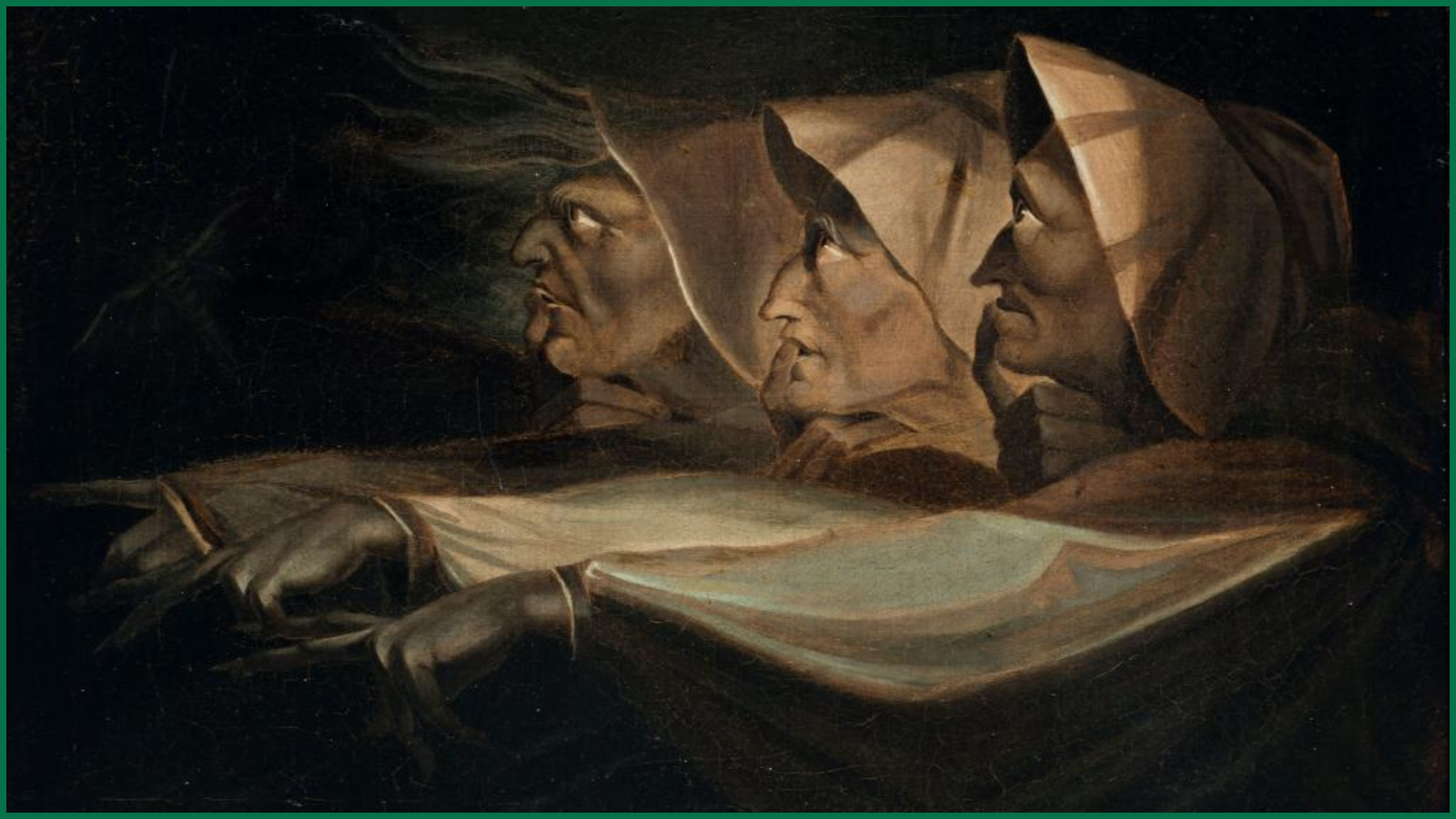
The play famously tells the story of Macbeth, Thane of Glamis, beginning with his heroic victory against Scottish rebels who have allied with Norway to depose the Scottish King Duncan. An encounter with three witches—or the Weird Sisters—sets Macbeth onto fulfilling a prophecy that he should become king.1 He accomplishes this, but in the most violent of ways: by conspiring with his wife to murder the king in his sleep overnight at Inverness Castle and frame the royal bodyguards for the crime.
Their plan succeeds but it inflicts enormous psychic damage on the Macbeths. Aware of their criminal accession to the Scottish throne, they resort to increasingly paranoid and depraved actions to cover up their original crime and secure their power, with Macbeth arranging the murder of his friend and fellow thane, Banquo, as well as the innocent family of Macduff. Ultimately, Macduff and Duncan’s son, Malcolm, join forces to overthrow the maniacal Macbeth and restore order to the crown.
Bad Magic
A number of Shakespeare’s stories centre around competition for a throne or regicide or the power struggles that bring strife to a kingdom. Macbeth is no different in this regard. Unique to this play are the use of witches to foment the initial conflicts that put the plot in motion. The Weird Sisters present themselves in the very first scene, where they declare an intention to meet with Macbeth, parting with the line: “Fair is foul and foul is fair / Hover through the fog and filthy air.”
The precise motivations of the witches are never made explicit. As an aside, they are only referred to as “witches” in the stage directions; in spoken verse they are known as the “weyward” or “weird” sisters. They are described as having beards and “withered attire” and are best conceptualized as androgynous demonic beings set on spreading moral chaos—quite different from the caricature of broomstick-riding women wearing pointy black hats.
In the second scene of the play, just after the Weird Sisters present themselves to the audience, we learn that Macbeth has distinguished himself in battle on the side of his king, by executing the rebel Macdonwald in a brutal fashion: cutting him open from his navel to his jaw before chopping off his head and displaying it on a parapet.2 We can deduce that the savage manner of this slaying is what drew the witches’ attention to Macbeth and summoned them to the Scottish highlands—a place where “fair is foul and foul is fair.”
Accentuating this point is Macbeth’s first spoken verse in the play. Marching back from battle, he says to Banquo: “So foul and fair a day I have not seen.” The Weird Sisters possess a disordered ethics; one that revels in mortal chaos, thunderstorms and dead livestock. In Macbeth, the witches recognize a kindred spirit and fellow traveller, even though he is oblivious to this himself.
When the sisters appear to Macbeth and Banquo along their march, Macbeth finds himself riveted by their prostration before him as both Thane of Cawdor and King of Scotland. Meeting King Duncan shortly thereafter, he is granted the Thane of Cawdor title in addition to his existing Thane of Glamis, solidifying the witches as prophetic beings in the mind of Macbeth.
The witches also tempt Banquo’s curiosity by suggesting that his descendants will themselves be kings of Scotland. He is unmoved by this, which demonstrates a couple of facts: one, Banquo is not morally deficient as Macbeth is and, two, the witches have no real controlling power beyond suggestion. After Macbeth is made Thane of Cawdor, Banquo cautions him:
But ‘tis strange;
The instruments of darkness tell us truths,
Win us with honest trifles, to betray’s
In deepest consequence.3
Banquo’s warning affirms the widely held belief in early modern England that demonic power is not often represented by direct, physical intervention in the world but, rather, it is something that acts upon the conscience.4 Although Macbeth and his wife believed they were touched by some supranatural divination, the Weird Sisters really just activated the pair’s own ambition by stoking temptation and suspicion. At no point did they give instructions to the Macbeths to kill anybody. As they dangled the possibility of Macbeth taking the throne or pointed out threats to his power, murder—even child murder—was the reflexive response.
The Demonic King
Lady Macbeth is eventually consumed by unconscious guilt as she is unable to conciliate her spiritual damnation. But by Act 3 Macbeth openly acknowledges having given his immortal soul over to Satan, the “common enemy of man.”5 Resigned to spiritual destitution, Macbeth becomes even more dangerous and depraved. For him, securing the throne became a sort of moral sunk cost fallacy: if he already lost his soul by committing regicide, why should he avoid violence if it secures his Earthly gains?
Even for Shakespeare, Macbeth is a bleak and brooding story that likely would not have been written if it was not for the prior ascension of James I to the English throne. James believed that he had been targeted by witchcraft when he encountered storms while sailing to Denmark in order to meet his future bride. The incident inspired him to write a treatise called Daemonologie, concerning all matters of dark magic, sorcery and demonic forces at work corrupting humanity.6
James had an acute interest in the subject, but demonic beings were an accepted presence of early modern English life at the time. The historian Kathryn Morris writes:
Renaissance discourse included the idea of civil authority as a likely target of the demonic conspiracy. Jean Bodin claimed that political authorities (the sovereign, as well as the magistrates) should expect witches’ aggression. This clearly followed from the sovereign’s status as God’s vice-regent: the sovereign had a special obligation in the fight against the Devil, and so was especially likely to be the subject of attacks.7
Morris goes on to explain that “legitimate, godly authority will be the target of the demonic usurper,” while “the sovereign’s authority was tied up in the ability to counter this pressing threat and to preserve epistemic stability.”8 King Duncan, his hands full with rebellious subjects, failed to recognize the demonic forces gathering in his midst. By rewarding the vicious slaying of Macdonwald, Duncan inadvertently kicked off a sequence of events that saw Macbeth transmogrify into the demonic usurper and proceed to wreak havoc on the kingdom.
A Changing Face of Evil
The sociologist Max Weber described modern society as one that is “disenchanted.” We no longer see the human realm as a battlefield between angels and demons, good and evil, magic and miracles, God and Satan. Macbeth can only be understood on the terms of the previously-existing traditional, enchanted society.
For Karl Marx, it was the advancing forces of production that spurred the application of scientific rigour to all manners of the economy, and then, the society. The Industrial Revolution has purged traditional superstitions from the cultural landscape by developing a high-tech economic base with a secular, science-oriented superstructure hanging overhead.
That said, in one instance Marx and Engels actually invoke the imagery of dark magic to describe the modern economy:
Modern bourgeois society, with its relations of production, of exchange and of property, a society that has conjured up such gigantic means of production and of exchange, is like the sorcerer who is no longer able to control the powers of the nether world whom he has called up by his spells…It is enough to mention the commercial crises that by their periodical return put the existence of the entire bourgeois society on its trial, each time more threateningly. Society suddenly finds itself put back into a state of momentary barbarism; it appears as if a famine, a universal war of devastation, had cut off the supply of every means of subsistence.9
Marx and Engels’ choice of analogy was not accidental. The wars, hunger and environmental catastrophes familiar to us today by way of unchecked capital accumulation and recurring economic crises are the very things that were blamed on demonic forces during history’s previous epoch. Just as it was the God-given job of civil authorities to manage the cosmic balance of “good versus evil” during the feudal period, so it is the secular job of our leaders today to ward off economic crisis and bring forward prosperity.
Money, like magic, has the occult power to lift collective fortunes, improve individual status, exercise power over others, pervert our conscious thoughts and cast calamities onto entire nations. Instead of witchcraft, we see today that crude monetary interest can drive people toward any sort of theft, deception and murder. Macbeth is a meditation on the impersonal forces that governed the early modern world. And Marxism is a meditation on the impersonal forces governing us today.
Thanks for reading!

In the first publication of Macbeth, the witches are referred to as “weyward” in the Early Modern English. Because the root of “weird” is the Old English “wyrd,” meaning “power to control fate,” the witches came to be referred to as the “Weird Sisters” in subsequent publications of the play. Interestingly, they are never referred to as “witches” in the spoken dialogue, only in the stage directions. ↩︎
As told by the Captain: “For brave Macbeth, disdaining Fortune…Which ne’er shook hands nor bade farewell to him / Till he unseamed him from the nave to th’ chaps / And fixed his head upon our battlements.” ↩︎
From Act 1, Scene 3. Stephen Orgel, ed., The Pelican Shakespeare: Macbeth (Penguin, 2000): 12. ↩︎
Gregory Dodds, “Review of The Devil and Demonism in Early Modern England,” Renaissance Quarterly, Vol. 60, No. 1: 274-275. ↩︎
As spoken by Macbeth in Act 3, Scene 1. Orgel, Macbeth, 42. ↩︎
James RX, Daemonologie, In Forme of a Dialogie, (Printer to the Kings Majestie, 1597). Project Gutenberg: https://www.gutenberg.org/cache/epub/25929/pg25929-images.html ↩︎
Kathryn Morris, “Past, Present, and the Politics of Witch Hunts,” Renaissance and Restoration, Vol. 47, No. 4: 162. Reference to political philosopher Jean Bodin’s 1580 treatise entitled, On the Demon-Mania of Witches. ↩︎
Ibid, 155, 163. ↩︎
Karl Marx and Friedrich Engels, The Communist Manifesto (Arcturus, 2017): 43-44. ↩︎