
The concept of “laissez-faire” capitalism has been around for nearly 300 years. It was first devised by French Physiocrats who believed that the only legitimate functions of the state were preserving physical security, civil liberty and property. Karl Marx gives both the capitalist state and laissez-faire economics a thorough description in Capital, demonstrating the role of state intervention in capital accumulation, the subordination of the state to ruling class interest and the destabilizing effects that unregulated markets have on mediating class interests.
From the Marxian point of view, laissez-faire capitalism is neither politically feasible nor is it socially desirable—a pattern largely validated by history. To the present, we see a tightening grip of oligarchic capital over the state and societal backlash to international trading agreements, institutional lending, the demise of private sector unions and Western deindustrialization spurred by the free movement of capital. The fetishization of “free market economics” was not always inevitable.
Yet anyone engaged in political discourse today will inevitably come across capitalist supporters espousing exactly these laissez-faire, minarchist type dogmas. The contemporary incarnation of this vulgar libertarianism traces to the Cold War era and the school of Austrian economics. Fascism and Nazism had erupted as outgrowths of distressed capitalist systems in Europe, prompting many anti-fascists to take a socialist turn. Seeking to rehabilitate capitalism’s image, liberal economists like Friedrich Hayek and Ludwig von Mises re-framed the “capitalism vs. socialism” debate as one of “free markets vs. government planning,” instead of class conflict between workers and elites.
At the time, this Austrian framing served as a sharp contrast to the centrally planned Soviet economy, the capitalist war economies of fascist belligerents and Keynesian policies in the West. By refusing to engage with the Marxist critique of class power, an idealistic conception of unfettered capitalism could drip freely from the pens of Hayek and von Mises—one where any problem inherent to capitalism could be be solved by being more capitalist-y. This idea was later taken up by Ayn Rand and given a romantic treatment at the heart of her hugely influential Objectivist philosophy.
A Free Market Utopia
Although she is often dismissed as an unserious polemic in the academy, it is plain to see why Rand is a great favourite of the ruling class that owns the economy. In The Virtue of Selfishness she lays out her economic brand as “a full, pure, uncontrolled, unregulated laissez-faire capitalism—with a separation of state and economics, in the same way and for the same reasons as the separation of state and church. A pure system of capitalism has never existed, not even in America; various degrees of government control had been undercutting and distorting it from the start.”1
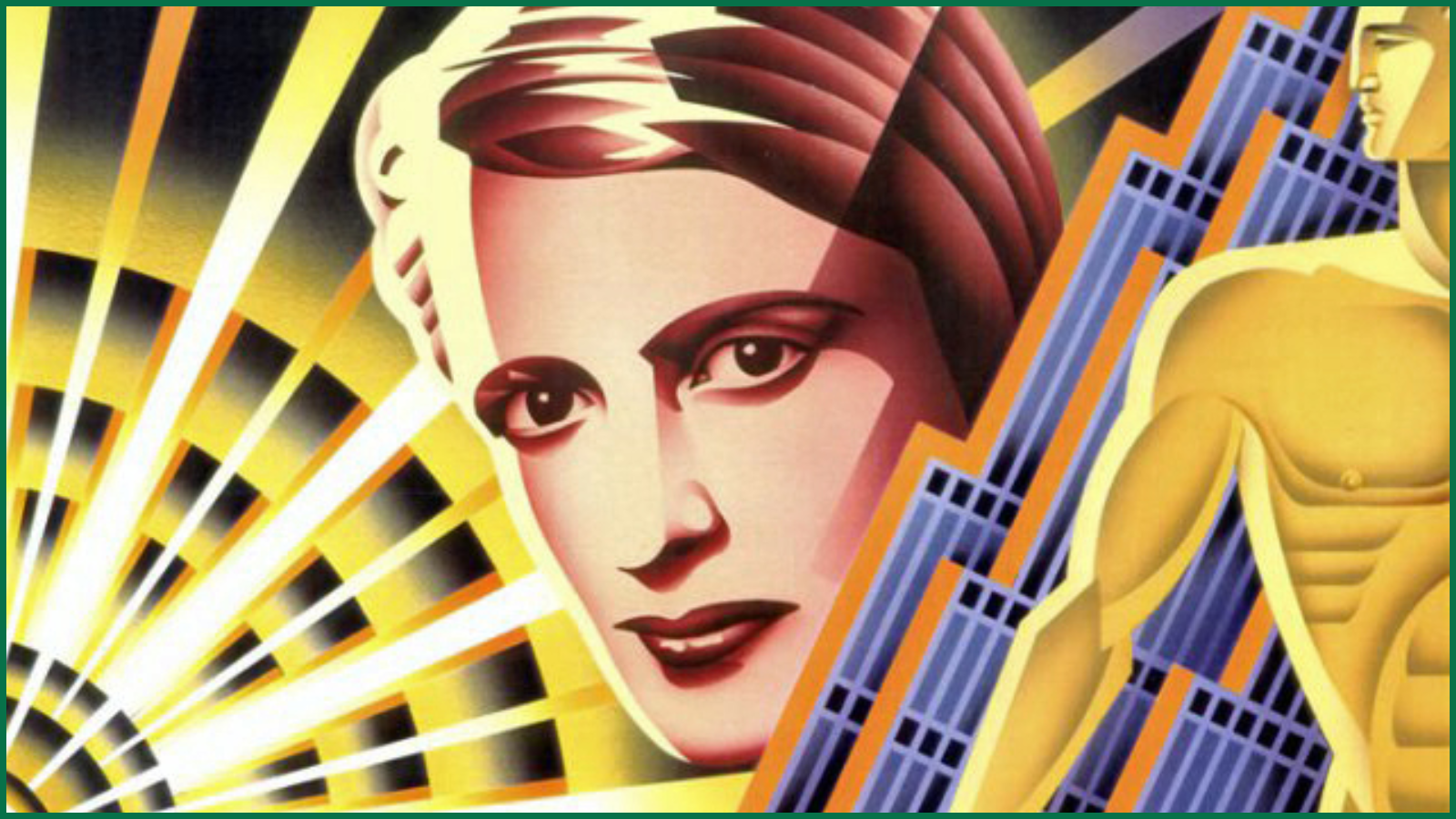
This formulation was illustrated in novels The Fountainhead and Atlas Shrugged, where her rugged protagonists—replete with chiseled jaws, angular frames and aggressively Aryan names—are oppressed by bureaucrats and crony capitalists with beady eyes and balding heads. Whereas Marx had shown that state formation is primarily shaped by an ownership class keen on extending its economic power, Rand casts the state as a product of the shiftless masses, the expression of a Nietzschean herd only capable of irrational self-harm and jealous thoughts.
Rand’s worlds are curiously devoid of capitalism’s seamiest actors; sex traffickers, dodgy landlords, financial speculators and predatory lenders aren’t found in her work. There are creative entrepreneurial savants and they agonize against the ubiquitous grain of government leeches, thieving associates and parasitic family members. For example, Hank Rearden and Dagny Taggart are despised out of envy over their exceptional talent and competence, which other characters think is unfair and worthy of destroying.
Rearden is subject to staged riots and government blackmail—even his wife attempts to emotionally destroy him and his brother stages a double-cross to infiltrate his prodigious enterprise and sabotage it from within. Taggart, on the other hand, must contend with her own brother constantly undermining her sage decision-making while also seeking to exploit it.
There are also principled objectors who consciously withdraw from economic participation. Genius architect Howard Roark opts for hard labour at the granite quarry instead of compromising his artistic integrity with conformist hacks. Hugh Akston, a renowned philosopher in Atlas Shrugged, chooses to flip burgers rather than see his rational teachings go unappreciated. And brilliant inventor John Galt lays track for a railroad rather than lend his true talents to a deadbeat society.
It’s interesting that Rand, the queen of laissez-faire, devised so many heroes that hold their creative ingenuity above crude market interests—although their integrity seems to pay off in other ways. For example, they are able to manifest rippling muscles without exercise and exert sexual dominance over their lower-order rivals with ease.
Rand stated in her newsletter, “I am not primarily an advocate of capitalism, but of egoism; and I am not primarily an advocate of egoism, but of reason.” Working backwards, it would be irrational for her characters to betray their integrity as that would violate their egoistic virtues which can only be expressed in a laissez-faire society expunged of collectivist ideas. As a result of this reasoning, the climax of Rand’s two novels have her protagonists committing acts of terrorism that force systemic changes to smothering collectivist regimes.
The Ideal Loner
To be fair, these books are a romanticism, and Rand’s characters are deliberately single-gear caricatures. To cite one reviewer who gave Atlas Shrugged a positive appraisal, her protagonists are all “healthy, attractive zealots that put in 80 billable hours a week, drink cocktails and have sex-fests every night.” They incur no moral dilemmas, have had no traumas, no children, no phobias and encounter almost nobody worthy of friendship.
These are idealized versions of people—but, besides Rand, whose ideals do they embody, really? If capitalism is the vehicle of egoism and egoism the vehicle of reason, Rand demonstrates that the only people capable of reasoning a pathway to success are devoid of feeling or want of companionship. The rest of us, subject to the spectrum of human experience and emotion, are doomed to mediocrity, beady eyes and Rogaine in the medicine cabinet.
When we appear as participants in the market, our own complex individuality is stripped down to that of “buyer” or “seller.” Likewise, we can spot a glaring flaw in Ayn Rand’s love-letters to capitalist individualism: it only works when the complexity of human sensuousness and social relations are torn down to the studs. She’s taken the narrow viewpoint of a market participant and has tried to build a comprehensive philosophy around it.
In his climactic speech of Atlas Shrugged, John Galt argues that trade is the object of the mind, and “man’s mind is his basic tool of survival. Life is given to him, survival is not. His body is given to him, its sustenance is not. His mind is given to him, its content is not.” But Rand’s formulation here is too reductionist to be accurate.
Becoming Human
In the process of becoming independent subjects, we can point to language being the bedrock of human consciousness. Language is not traded for but is freely received in a social context. It is a collective product that connects individuals to the cooperative group necessary for survival. According to psychoanalyst Jacques Lacan, language plugs the individual into the symbolic order and enables subjectivity, transmission of knowledge and abstract thought production.
Through language, a social consciousness acts upon the individual and the individual, in turn, acts upon the social consciousness. Marx and Engels write in The German Ideology: “Language is as old as consciousness, language is practical consciousness…for language, like consciousness, only arises from the need, the necessity, of intercourse with other men. Consciousness is therefore from the very beginning a social product.”
If this seems like a stretch, consider the cases of feral children raised without human interaction. It is clear that consciousness does not develop in the void of language and human contact. Survival is not guaranteed either, unless the child is taken up by a pack of animals. Both survival and mental content must be given at an early age if they are to be utilized later on. Rand’s oversimplification of individuality was first established in The Fountainhead when Howard Roark says in court, “but the mind is an attribute of the individual. There is no such thing as a collective brain. There is no such thing as a collective thought.” This is literally true but it denies a key aspect of the constant exchange between ourselves and the environment.
There is a social consciousness that exists within the minds of society’s members and it comprises that collection of thoughts not specific to an individual. National borders, social status, cultural norms, the value of paper money—these are all examples of constructs within the social consciousness that do not live or die with any one person. Marx and Lacan posit a social consciousness that begins with language. Sigmund Freud and Carl Jung came to similar conclusions about the the collective unconscious, represented by the superego and universal archetypes.
In a book review, Ann Marie Plane and Leslie Tuttle explain that dreams possess a “dual quality” of “individual experience and social claim” that roots “dreamers in the greatest and most charged religious, political and social debates of their times.”2 In other words, the most intensely private thoughts of individuals—their dreams—reveal both the economic epoch and social unconscious temporally in existence. Rand’s insistence that “nothing can be learned about man by studying society” simply doesn’t hold water.3
It follows, then, that the principal struggle laid out in The Fountainhead, “the individual against the collective,” can be rejected as a false premise. One becomes an individual by way of the collective, just as the collective exists by way of the individuals that form it. Marx writes in The Grundrisse: “The human being is in the most literal sense a political animal, not merely a gregarious animal, but an animal which can individuate itself only in the midst of society.” In other words, it is working together rather than apart that leads to individual flourishing.
Indeed, one cannot become a writer without readers, a parent without children, a critic without artists, a husband without a spouse, a worker without an employer, a professor without students, a friend without a friend, a buyer without a seller. Rejecting the social dimension of human nature will result in the type of emotional stunting that clearly afflicts the Randian hero. Nathaniel Branden, Ayn Rand’s protege and former lover, picked up on this later in life when he criticized Rand: “You have taught people to repress, repress, repress.”
Toward Socialism
Perhaps a crushingly lonely laissez-faire dystopia is the best possible system for the statuesque workaholics of Rand’s imagination. But for an individualism congruent with human nature, it is a shame that Ayn did not discover Oscar Wilde’s The Soul of Man Under Socialism. Contrary to Rand, Wilde says that “Socialism itself will be of value because it will lead to Individualism” and this will “disturb the monotony of type, slavery of custom, tyranny of habit, and the reduction of man to the level of a machine.”
Socialism rests its case on the real premise that no person can exist without another, that no human potential is reached alone and no prosperity is achieved independently. While the market flattens us into the one-dimensional traders of Rand’s novels, Wilde says that “art is the most intense mode of Individualism that the world has ever known.” Art, creative invention and scientific discovery express the full knowledge of human existence and our passion for the universal truths of nature.
Living for others—something Rand denounces as an altruistic evil—is precisely what capitalism requires to function, as billions of workers and consumers toil on a decaying planet for the benefit of a tiny global elite. Wilde: “The chief advantage that would result from the establishment of Socialism is, undoubtedly, the fact that Socialism would relieve us from that sordid necessity of living for others which, in the present condition of things, presses so hard upon almost everyone.”
Free and voluntary exchange between people is only possible absent a capitalist class structure that subordinates us to impersonal market forces and positions us into a cutthroat competition against machines, fellow workers and corporate owners. Wilde continues, “were the machine the property of all, everyone would benefit by it. At present machinery competes against man. Under proper conditions machinery will serve man.”
The proper conditions that Wilde refers to is a democratic economy of common ownership. Supporting independent creative pursuits under a regime of minimized work days, automated production, the dissolution of “intellectual property” and freely accessible housing, education and health care will never be in the interest of the capitalist ruling class. In capitalism—laissez-faire or otherwise—profit is the object of the economy. Instead, we need individual flourishing to become the object of the economy. That will only be achieved through socialism.
Thanks for reading!
