Tag: Death

  • Marx and Shakespeare: Hamlet’s Alienation

    Marx and Shakespeare: Hamlet’s Alienation

    But orderly to end where I begun,
    Our wills and fates do so contrary run
    That our devices still are overthrown
    Our thoughts are ours, their ends none of our own.

    Player King, Act 3, Scene 2.

    Hamlet is William Shakespeare’s most studied play, owing to its layered themes and rich rhetorical devices. It is a literary work drawn on by John Milton for Paradise Lost, it helped Sigmund Freud to develop his theory of Oedipus complex and inspired and two compositions from Pyotr Tchaikovsky. Karl Marx’s deep appreciation of Shakespeare is well known, and Hamlet is a work that he directly references in his Eighteenth Brumaire of Louis Bonaparte.1

    The Play’s the Thing

    Hamlet almost exclusively takes place at Elsinore Castle in Denmark, which is a real place and one of the Renaissance era’s most prominent. Shakespeare was a product of the Renaissance era, and this setting is crucial to contextualizing many of Shakespeare’s plays because it sits on the demarcation line between the Middle Ages and modernity, between superstition and reason, between feudalism and liberalism, between religion and science, between the aristocracy and commerce. The tensions of this era are very important to understanding Hamlet’s inner conflict, just as it is important to understanding the romance between Romeo and Juliet or the racial attitudes embedded in Othello.

    In The German Ideology, Marx and Engels wrote:

    Thus it is quite obvious from the start that there exists a materialistic connection of men with one another, which is determined by their needs and their mode of production, and which is as old as men themselves. this connection is ever taking on new forms, and thus presents a “history” independently of the existence of any political or religious nonsense which would hold men together on its own.2

    In most of Renaissance Europe, the aristocracy maintained a monopoly on political power, derived from ownership over lands worked by a large peasantry. The rise of an urban merchant class figures heavily in some of Shakespeare’s plays, but in Hamlet we are concerned only with the palace intrigue at the top of the Danish royal hierarchy. There is a multiplicity of love triangles, petty schemes from palace courtiers, eavesdroppers and personal grievances that must constitute trivial drama in comparison to the hardship of life for many of the era. In the grand movement of history, palace intrigue is little more than the “political nonsense” that Marx identified.

    The Apparition Comes

    At the outset, the story establishes that Prince Hamlet’s father has died and his Queen mother had hastily remarried with his uncle Claudius who then consolidated the Danish nobility behind his rule. This turn of events has Hamlet already deeply unsettled and melancholy, exacerbated by a visit from his father’s ghost who wanders the Earth while in spiritual Purgatory. The ghost reveals to Hamlet that he was victim of a “murder most foul, strange and unnatural” by the poison of his brother Claudius.3

    Apparitions, witches, potions and magic were accepted forces of nature in Shakespeare’s time and come regularly into his plays as plot devices guiding a character’s arc. Whereas today uncertainty over someone’s cause of death could be resolved by a medical autopsy or forensic crime scene investigation, Hamlet could only shelter under his suspicions until he was contacted from beyond the grave. 

    But the ghost’s revelation confronts Hamlet with demands on his position. In the aristocratic world of hereditary privilege—so far from modern law and commerce—kinship largely determined one’s station in life. Notions attached to honour and nobility depended heavily on defence of kin, and there was no legal authority that Hamlet could appeal to; indeed, his corrupted family was the legal authority.

    Hamlet understands what is expected from the son of a slain father but revenge is complicated by the aristocratic hierarchy of which he is merely a component part. With a murdered father, a mother joined in marriage with the killer and childhood friends in the service of his usurping uncle, Hamlet finds himself completely alienated from the social relations that grant him his identity as a prince. 

    The ensuing conflict of the play is an internal struggle to overcome this experienced alienation, immortalized by Hamlet’s famous speech: 

    To be, or not to be, that is the question:

    Whether ’tis nobler in the mind to suffer

    The slings and arrows of outrageous fortune,

    Or to take arms against a sea of troubles

    And by opposing end them. To die—to sleep,

    No more; and by a sleep to say we end

    The heart-ache and the thousand natural shocks

    That flesh is heir to: ’tis a consummation

    Devoutly to be wish’d. To die, to sleep;

    To sleep, perchance to dream—ay, there’s the rub:

    For in that sleep of death what dreams may come,

    When we have shuffled off this mortal coil,

    Must give us pause—there’s the respect

    That makes calamity of so long life.

    For who would bear the whips and scorns of time,

    Th’oppressor’s wrong, the proud man’s contumely,

    The pangs of dispriz’d love, the law’s delay,

    When he himself might his quietus make

    With a bare bodkin?

    This speech could be rephrased “to live or not to live?” If Hamlet chooses to live as his father’s son by seeking revenge against King Claudius he will certainly perish in the process. On the other hand, he cannot bear an existence as an obedient prince under these circumstances. To live his proper life is a death sentence but to avoid death he must surrender life.

    The Readiness is All

    There is a duality that opens up here between Hamlet’s blood instincts and his social status as a prince. Marx described alienation as characteristic to humanity’s estrangement from productive activity and the reduction of social relations to class standing, when “man feels that he is acting freely only in his animal functions—eating, drinking, and procreating—while in his human functions, he is nothing more than an animal.”4

    As he is estranged from his family and friends by the revelation of his uncle’s homicide and arrogation of the throne, Hamlet ponders his alienated state: 
    “What is a man
    If his chief good and market of his time
    Be but to sleep and feed? A beast, no more.” 

    It is Ophelia that bears the brunt of Hamlet’s dislocation, his rage against the animalistic propensity toward violence and sex. While they had been engaged in a genuine courtship prior to the events of the play, she becomes “the focus of his disgust with the whole sexual process.”5

    Seeing the characteristics of his being stripped of all virtue, Hamlet dismisses any love he once had for Ophelia as brutish lust and he condemns her to a lifetime of abstinence: “If thou dost marry, I’ll give thee this plague for thy dowry: be thou as chaste as ice, as pure as snow, thou shalt not escape calumny. Get thee to a nunnery. Go, farewell.”

    For Marx, alienation will ultimately be resolved when we take conscious control of our circumstances, when we reconcile our productive activity with both our individual selves and species-being. Hamlet’s internal conflict is resolved when he encounters the army of the crown prince of Norway, Fortinbras, on the march through Danish territory. Hamlet’s father had killed Fortinbras’ father in a duel decades earlier and the Norwegian prince had finally arrived to seek his just revenge.

    Hamlet then grasps the unity of opposing forces; to be an obedient prince is the same as to be his father’s son; to be in love is to be lustful; to live is the same as to die; to be is not to be.6 Before throwing himself, his mother and his uncle to their doom, he says: “There is special providence in the fall of a sparrow. If it be now, ’tis not to come; if it be not to come, it will be now; if it be not now, yet it will come. The readiness is all. Let be.”

    Thanks for reading!


    1. For more on Marx’s personal interest in Shakespeare, see Erich Fromm, “Marx’s Concept of Socialism” in Marx’s Concept of Man (Frederick Ungar Publishing, 1961). ↩︎

    2. Karl Marx and Friedrich Engels, The German Ideology (Martino Publishing, 2011): 18-19. ↩︎

    3. The “most foul” and “unnatural” aspects of the murder lie in it being committed by Claudius against his own flesh and blood. ↩︎

    4. Karl Marx, “The Economic and Philosophic Manuscripts of 1844” in Essential Writings of Karl Marx (Red and Black Publishers, 2010): 91. ↩︎

    5. Harold Jenkins, ed., Hamlet (Arden Shakespeare, 1982):151. ↩︎

    6. This is an observation in advace of the famous thought experiment, Schrödinger’s cat. ↩︎
  • Ask the Editor: “I’m Afraid of Dying”

    Ask the Editor: “I’m Afraid of Dying”

    Dear editor,


    I’ve been surrounded by death recently. At least it feels like that. My mentor from college passed away from metastatic breast cancer a few months ago. She was in her thirties. Then it was a cherished family friend; in her sixties, also cancer. Most recently a co-worker’s heart gave out on the job. That was only two months ago. I have felt doom since then. It is affecting my sleep. What if I don’t wake up in the morning? Any moment my life could be torn away from me. Will I receive a cancer diagnosis? Brain aneurysm? Could my heart explode next time I am on the treadmill? What happens afterward? I’m afraid of dying.

    Thanks,

    Charlotte.

    Dear Charlotte,

    I find the present age a little too scientific about this issue. Regularly attend the doctor, have blood analyzed, wear a helmet on the bike and don’t think about mortality. That’s a long ways off. And it might be. But it might not be. In my own experience, grief is almost “not supposed to be” discussed past the funeral and, for pensive people, this prohibition may exacerbate the death anxiety. In order to live with the uncertainty of existence we must dispel the image of a hungry grim reaper hanging about our shadows with a gleaming sickle.

    Freud saw death as a drive to “restore an earlier state”—the state of inorganic being. And Marx said that “death seems to be a harsh victory of the species over the particular individual and to contradict their unity.” Both are true in that rational Enlightenment sort of sensibility but they have all the comfort of a cold steel bed. 

    Religious beliefs aside, I’ll point out that the ancient philosophers tended to be more confrontational with this subject than those that came later. At the height of Christendom all attention was paid to the afterlife and in modernity all attention is paid to rigid inquiry. For this subject I turn to to the Epicureans who lived by the adage: “Death is nothing to us.” As atomic beings, once we lose our senses, we lose our ability to perceive, worry or fear anything. It is therefore irrational to worry about non-existence as there is nothing that can be feared in that state. What you are experiencing is neither an authentic fear of death nor a fear of loss. We do not lose our lives, we only cease to live them.

    It seems to be the suddenness by which your loved ones and colleague stopped living that has aggravated your grief and catalyzed anxiety. There may be unfulfilled wishes that flummox you. Epicurus said: “He who is in least need of tomorrow will approach it with the greatest pleasure.”1 This is where I believe you should channel your conscious energy. What provides you enjoyment? Try to arrive happy every night to bed. There are likely social pressures and internal judgements that you are facing. Consciously and humbly work through them. Do you have unfulfilled goals and aspirations stoking this “need for tomorrow”? It is important that you locate these because they are the true sources of anxiety. The fear of dying is relieved once you temper the need for tomorrow and render it no more than a pleasant want.

    In sols,

        Your editor.

    Send your questions to the Reclamationeditor@thereclamation.co

    Footnotes:


    1. Brad Inwood and L.P. Gerson, eds., The Epicurus Reader: Selected Writings and Testimonia (Hackett Publishing, 1994), 103. ↩︎
  • Ask the Editor: Grieving the Loss of a Pet

    Ask the Editor: Grieving the Loss of a Pet

    Dear editor,

    I’ve lost a cherished pet. My cat passed away earlier this year and this has felt like one of the most devastating losses I have ever experienced in my life. We spent every waking hour around the house together; he loved me unconditionally and he felt like an extension of my soul. 

    As a materialist, I am conflicted. On principle, I do not believe in the afterlife. But in moments of grief I find comfort in the idea of heaven, the idea that I will meet my loved ones again on the other side. How should I think about this philosophically?

    Regards,

    Beatrix.

    Dear Beatrix,

    I am very sorry for your loss. People and their pets can forge deep bonds because these relationships are free of the complicated dramas and personal judgements that often pockmark our interpersonal relations.  

    It is important to understand that the realm of materialism includes both matter and energy. Matter is easy to comprehend because it is visible and something that we can physically interact with. Energy accounts for motion but it is not something that we can see directly. We do not interact with it so much as we feel it. When Marx likens social relations to a “law of gravity” or makes reference to the “life force,” he is affirming a notion of energy being like the glue which binds material objects together.

    If a star loses a planet in its orbit, it wobbles. Though it has lost the gravitational energy of this planet, its former presence can be observed thousands, even millions of years later. This is because the gravity between two objects will make permanent changes that persist long after the relationship ends.

    Likewise with our cherished pets. We may wobble with grief when they are gone and we will be permanently changed after they do. The realm of energy is mysterious and the existence of an afterlife cannot be confirmed or denied by current understanding. But your heart is beating and let Abraham Lincoln remind you that “the memory” of your loved one, “instead of agony, will yet be a sad sweet feeling in your heart, of a purer and holier sort than you have known before.”1  

    In sols,

    Your editor.

    Send your questions to the Reclamationeditor@thereclamation.co

    Footnotes:


    1. Abraham Lincoln quoted in Edith Hall, Aristotle’s Way: How Ancient Wisdom Can Change Your Life (Penguin Books, 2020), 230. ↩︎
  • The Psycho-Capitalist Dystopia of “Alien”

    The Psycho-Capitalist Dystopia of “Alien”

    There is something elemental to the vastness of outer space with its infinity of stars and planets and eternal unknowns that lend off-planet stories a conspicuously epic quality. After all, this is the realm of gods and titans, Zarathustra and Siddartha, heaven and angels, Star Trek and Star Wars. Even on the small screen there is Battlestar Galactica, motored by existential warfare, the fate of the entire species in the hands of one starship’s crew.

    Ridley Scott’s Alien blows in from the spindrift of ancient cosmology and the modern space opera, an oddity considering the spartan scope of the story. The premises of the original Alien trilogy require little imagination for today’s audience situated in the capitalist society. In the original, there is the blue collar crew of the Nostromo, tugging 20,000,000 tons of mineral ore to Earth. In the sequel, Aliens, the United States Colonial Marine Corps are sent to an extraterrestrial corporate outpost on a relief operation. And Alien 3 takes place on a prison planet. There is nothing glamorous or awe-inspiring around the cosmos in this franchise—it is a place for the utilitarian, for the rugged, for the criminally deranged. Nothing we can’t find on present-day Earth.

    The Masterpiece

    Alien sets an understated tone for the two that follow. There are installments outside the original trilogy that deviate from this mould—and they suffer for it. But the 1979 classic had first built the resonance with a mass audience that was required for the future sequels to be developed. The film opens with views of the Nostromo and the mountainous ore refinery it stages as cargo. The seven member crew awaken from stasis—hypersleep, to cope with the years-long interstellar voyages. The crew believe they are nearing Earth but we soon learn that their ship’s operating system has awakened them on a company order to investigate a mysterious transmission emanating from a moon they are passing by.

    Right away we see that capitalist class relations are integral to this plot; while the crew is reluctant to undertake such a dangerous assignment, they are ultimately compelled to do so under threat of “total forfeiture of shares.” At one point Dallas, the captain, bluntly states that the only “standard procedure is to do what the hell they tell you to do.”

    The imbalance of power is clear. If the crew refused to comply, the Weyland-Yutani corporation might lose an opportunity to profit but the crew would have to surrender their income, all for naught their many years spent aboard the starship. Even more lopsided, the crew is forced to risk their lives to investigate a potentially lucrative discovery while any proprietary claims would be held by Weyland-Yutani. The Marxist view on wage labour comes into focus: “The worker in capitalist society becomes dehumanized, regarded by the capitalists as simply another piece of equipment which is necessary for the production of profit. The workers become less than human…since they are forced to sell their lives in order to ‘make a living.’”1

    The film taps our collective anxiety that the unquenchable profit-motive underpinning our economy has lead us to transgress boundaries that were not meant to be crossed. Nuclear accidents, ocean acidification, weapons of mass destruction, the hole in the ozone layer, microplastics permeating our bloodstreams, viral lab leaks, artificial intelligence run amok—there is no shortage of potential disasters pending in a world of blind capitalist production. Films such as Planet of the Apes, The Terminator, The Day After Tomorrow and 28 Days Later all play on this collective fear.

    In Alien, it takes shape after three crew members disembark from their ship and discover an extraneous vessel crashed into the rocky surface of the moon. Upon entering, they first find a dead extra-terrestrial pilot, and next, a hull “full of leathery objects…like eggs or something.” A spider-like creature erupts from an egg and sizzles through Kane’s visor, attaching itself to his face. 

    In his Poetics, Aristotle finds that “every tragedy falls into two parts—Complication and Unravelling.”2 The complication occurs early, when the Nostromo receives the radio transmission and is forced by Weyland-Yutani to dock on a moon of a gas giant in the Zeta Reticuli star system. The unravelling occurs after the spider-like creature—a facehugger—has fallen from Kane’s head, the crew sitting down to one last meal before returning to stasis. This is a famously gruesome scene where a parasitic organism explodes from Kane’s chest in a geyser of blood. The fate of the ship is essentially sealed at this moment. Weyland-Yutani demands the return of the alien at the expense of the workers’ lives and the rapidly-growing parasitoid picks off the remaining crew one-by-one, able to turn them into eggs and begin its ghastly lifecycle anew.

    The Horror

    Deductions about many plot elements of this film can only be made at the point of unravelling when this parasite, this xenomorph, is unleashed on the crew of the Nostromo. First, it is clear that we are not watching a science fiction so much as a horror. The vacuum of outer space is a sublime backdrop for a horror film because the muteness of the void approximates the silence of death and non-existence. The producers understood this and created the artful tagline: “In space no one can hear you scream.” 

    Another visible element concerns the derelict alien ship containing the eggs. While the ship did not reach its intended destination, the deadly cargo must have had a destructive purpose all along, with the eggs intended to be dropped as bombs on an unassuming indigenous population—xenomorphs being the ultimate bioweapon. This bioweapon doesn’t merely kill its targets; it impregnates them, it is birthed by them and it destroys them in the voracious service of replicating its species. In Hinduism there is Shiva, the paradoxical god of both creation and destruction who simultaneously creates and destroys the universe in a cosmic dance.3 An element of divinity, of fetishization, is put forward which is further alluded to in the prequel film Prometheus

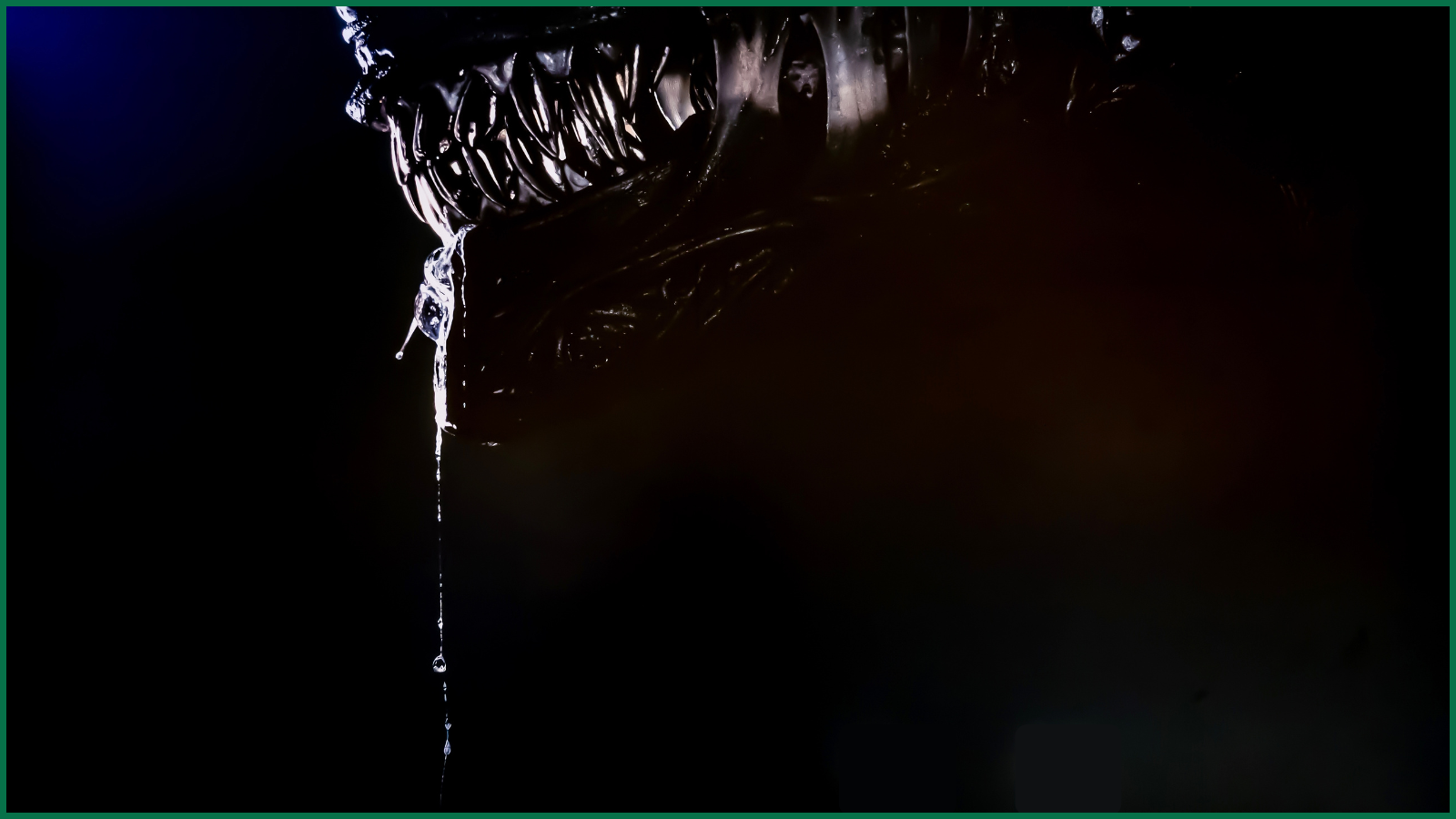
    The xenomorph was expressly designed by Swiss surrealist H.R. Giger with strong sexual overtones: a phallic head and a drooling vagina dentata for jaws. This represents the male fear of castration while the impregnating facehugger leaping from the egg evokes rape. The unity of creation and destruction—of reproduction and death—is given a modern form in Alien although it is not a new concept. Religious allegory aside, Sigmund Freud discovers this unity at the psychoanalytic level and likens the release of sexual orgasm to dying itself: “This accounts for how similar the state following complete sexual gratification is to dying, and for the fact that in lower animals death and the procreative act coincide.”4 For Freud, the death drive innate to living things appears as “aggression and destruction” when it is turned toward the external world.5

    The Mythology

    The xenomorph is the physical embodiment of the death drive, a product of “alien interspecies rape” and the death of its host.6 The aggression and destruction projected outward is total and directly avails its life instincts and reproduction. The android, Ash, in the film describes it as the “perfect organism. Its structural perfection is matched only by its hostility.” It necessarily takes up the most extremely rapacious form of both life and death, its species pullulating ceaselessly over a mountain of blood-stained corpses and shattered rib cages. 

    In feudal Europe it was believed that demonic incubi and succubi would sexually attack people as they slept with repeated interactions resulting in death. In antiquity this attribute is seen in satyrs and various demi-gods, and in the nomadic society it is seen in mystic and impetuous animals in nature. There is a primordial fear of death and sex working here and its cultural expression is determined by the economic mode of production that situates society. This exemplifies what Marx and Engels say in The German Ideology, that it is “material production” that alters the existence of people, including “their thinking and the products of their thinking.” 

    What Giger, Scott and O’Bannon created with Alien is a space-age capitalist interpretation of the demonic, sexually violent archetype. It is no coincidence that workers, grunt soldiers and prisoners bear the weight of deadly encounters with the parasites in the original trilogy and always under the orders of the soulless Weyland-Yutani corporation. Taking the metaphor further, the xenomorphs symbolize the overwhelming totality of capitalism itself: they flourish by devouring their two sources of wealth, nature and human beings.7

    Thanks for reading!

    Footnotes:

    1.  “Editor’s Preface” in Essential Writings of Karl Marx (Red and Black Publishers, 2010), 16. ↩︎

    2. Aristotle, “Selections from Poetics,” in Art and Interpretation: An Anthology of Readings in Aesthetics and the Philosophy of Art (Broadview Press, 1998), 34. ↩︎

    3. John M. Koller, Oriental Philosophies, Second Edition (Charles Scribner’s Sons, 1985), 111-2. ↩︎

    4. Sigmund Freud, Beyond the Pleasure Principle (Broadview Editions, 2011), 113. ↩︎

    5. Sigmund Freud, Civilization and Its Discontents (Broadview Editions, 2016), 91. ↩︎

    6. Screenwriter Dan O’Bannon described Alien as a movie about “alien interspecies rape.” www.buzzfeed.com/alisonwillmore/19-movie-monsters-that-look-like-penises-and-vaginas ↩︎

    7. Karl Marx, Capital, Volume One. Paraphrasing: “Capitalist production, therefore, develops technology, and the combining together of various processes into a social whole, only by sapping the original sources of all wealth — the soil and the labourer.” ↩︎