Under conditions of peace the warlike man attacks himself.
—Friedrich Nietzsche, Beyond Good and Evil.
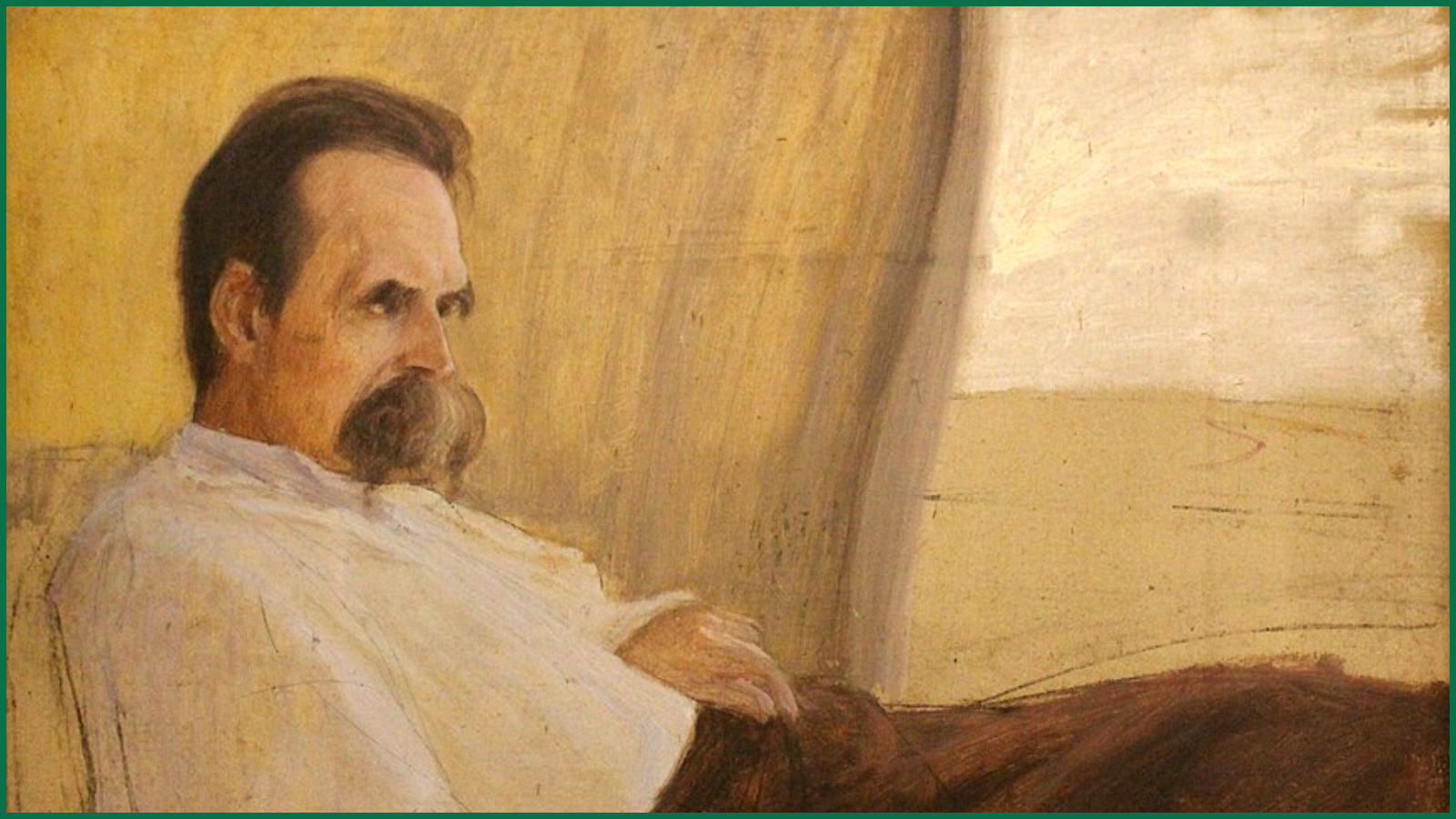
In Untimely Meditations Nietzsche alerted readers that most written works were little more than “the smoke and vapour of the brain.”1 For a book to avoid the flames, it must contain a fire within itself. It is easy to dismiss Nietzsche’s body of work as slippery, with an undue level of contradictions that negate its possibility as a system of thought. But this is characteristic of a reactionary right that prefers romanticization to reason.2
The Enlightenment era championed progressive leaps in scientific method, rule of law, technological invention, standard national institutions and conceptual human rights. Karl Marx is the apogee of Enlightenment philosophy because he discovered the objective material and social conditions enabling the progression of human history. Nietzsche, on the other hand, is the pinnacle of the reactionary Counter-Enlightenment opposition. The Counter-Enlightenment generally held that core human characteristics like ascetics, nature, religion and emotion were washed away by 18th and 19th century waves of industry and empiricism. Nietzsche believed that only a rigid social hierarchy—a radical aristocracy—replete with slavery and the relegation of women to childrearing could provide fertile ground for his ideal man, the Übermensch.
For most of us today, there are elements tracing to both Enlightenment and Counter-Enlightenment thinking that are appealing. Conservatives borrow from the industriousness that modernity unleashed, while upholding the importance of pre-modern religious ideals and social hierarchy. Socialists might admire Romantic commitments to beauty and culture, while they hang onto empirical measures of history and positive human rights. Liberals hold institutions and negative rights in high esteem, while appreciating the role of emotion in public discourse. Nietzsche, with his passionate treatment of culture, hierarchy and human vitality, therefore offers a grab-bag of ideas that almost anyone can pull one or two shiny parts from while ignoring the rest.3
A Nietzschean Left?
Jonas Čeika managed to do this in his book How to Philosophize With a Hammer and Sickle, though he is not the first socialist to do so.4 Other left-wing figures such as Gilles Deleuze and Emma Goldman have gone down similar roads with Nietzsche, even though there is not any profound reason for doing so. It is easy to extol Nietzsche’s romantic anti-capitalism and lofty Übermensch ideal because these would seem at home under communism where, in Leon Trotsky’s words, “the average human type will rise to the heights of an Aristotle, a Goethe or a Marx.”5
Speaking of the latter, Marx has long-since reconciled the gap between between pre-modern, Counter-Enlightenment virtues and the objective nature of the modern capitalist mode of production. Marx himself was not an anti-capitalist like Nietzsche; he was a post-capitalist who believed that the boundaries crossed by capitalist technologies and social relations were the keys to unlocking a harmonious socialist future. The attempted construction of a Nietzschean left is therefore either discordant or illogical in the light of dialectical materialism, which affords Nietzsche little more than a corner of society’s superstructure.
The Overman
Nietzsche’s detours through an idealized caste system, slavery and perpetual “life-affirming” warfare are not merely the means to the Übermensch end; they are part of the end itself.6 This is because Übermensch—or “overman” in English—would have nobody to sail over if the harried masses weren’t ripe for subjugation and influence. This is expected from a Marxian perspective, which emphasizes the role of human relationships in determining the experience of individuals and the overall structure of society. In order to exist, a master must have a slave, just as an employer must have an employee and an overman must have an underman.
The domination of commoners by elites is the plough by which Nietzsche’s imagined master morality is cultivated. Although he understood both capitalism and Christianity to be deracinating to culture and morality, these sentiments are not progressive—they are radically regressive, rooted in admiration for the heroic conquerors of antiquity that enslaved entire populations. Whereas mainstream conservatism is informed by feudal Christian traditions and values, Nietzsche drifts much further to the right wing of the spectrum with his admiration for the pagan slave empires of antiquity.
The Fascist Impulse
It has been said that Benito Mussolini abandoned socialism in the disillusioning aftermath of the First World War, just after exposure to Nietzsche’s work. It is therefore unsurprising that Italian Fascism is just as slippery and reactionary as Nietzsche’s polemics—and Friedrich’s fingerprints are all over Mussolini’s governing ideology.
Like Nietzsche, Mussolini glorified antiquity and adopted the Roman fasces as his party’s symbol. Inspired by the concept of “master morality,” he sought to create a Third Rome—La Terza Roma—which would subordinate weaker nations like Greece and Ethiopia by natural right. The city of Rome was to be transformed into a mecca of imposing monuments, piazzas and open-air theatres celebrating the revival of the ancient Roman masters. Far from Marxian classlessness, Mussolini’s corporatist policies created a rigid caste system whereby one’s social standing and rank as a landowner, industrialist, military officer, farmer or worker was practically designated at birth. Women were erased from the public sphere as the rearing of soldiers became their sole duty to the state.
Given Nietzsche’s undeniable influence on Italian Fascism, it is no wonder that Adolf Hitler gifted Il Duce “an elaborately bound and privately printed volume of the complete works of Friedrich Wilhelm Nietzsche” for his 60th birthday. While the written works of left wing writers like Bertolt Brecht, Helen Keller, Jack London, Marx and Friedrich Engels, met the flames in Nazi Germany, Nietzsche was worshipped. Of particular interest to Nazi theorists was On the Genealogy of Morality, which asserts an iconoclastic view on the origin of civilization:
Some pack of blond beasts of prey, a race of conquerors and masters, which, organized for war and with the power to organize, without forethought, sets its terrifying paws on a subordinate population which may perhaps be vast in numbers but is still without any form, is still wandering aimlessly.7
The reference to “blond beasts of prey” is more than a passing allusion. Nietzsche elaborates on the Aryan identity of this conquering race—this “master race”—of aristocratic antiquity which was finally destroyed by a Jewish “revolt of the slaves” and “blood-poisoning.”8 According to Nietzsche, the slave morality operates by inverting what is strong, beautiful and learned into something fearful, ugly and ignorant. By transvaluing ancient Roman and Greek master morality, Judaic priests tamed the empire and then destroyed it. The portraits of three Jews—Jesus, Mary and Joseph—adorning millions of European walls stand as the legacy of this triumphant Jewish slave revolt.9
It is popularly claimed that the Nazis hijacked Nietzsche’s teachings and misappropriated them for their own sinister purposes. There is some merit to this claim but only in part. For example, despite his screed lionizing the Aryan conquerors of antiquity and bemoaning their Jewish subjects, Nietzsche was plainly not an anti-Semite. He believed that history had turned the Jewish people into “the strongest, toughest and purest race now living in Europe” and held them to be essential ingredients to breeding his imagined postmodern aristocracy.10 Additionally, he did not view the Aryan master race from quite the same racial footing that the Nazis did. For Nietzsche, it was a cultural designation, an exercise of master morality exemplified by Nordic Vikings but also the Brahmin caste of India, Greco-Roman slaveholders and medieval Arabic and Japanese nobility.
Nietzsche endorsed Napoleon Bonaparte as a historical example of an Übermensch, capable of terror and genius, who unified Europe along strict hierarchical lines, military discipline and exemplary cultural values. Hitler saw himself as Napoleon’s successor because he unified Europe by force, raised slave populations from the defeated nations, preserved the Prussian aristocracy and promoted a Wagnerian high culture brimming with Nordic valkyries screaming into battle. For the Nazis, the commitment to a transvaluation of Judeo-Christian values went beyond good and evil.
Master Morality and the Holocaust
Nietzsche wrote: “For strong people disaster does not come from the strongest, but from the weakest.” Whereas the strong possess unapologetically life-affirming values, the weakest exalt life-denying values and the veneration of their pitiable existence spreads like contagion. The Holocaust, with all its attendant atrocities against Jews, Romani, socialists, sexual minorities and the disabled, was merely a slave revolt in reverse. What the Holocaust represented was a master’s revolt against the slaves from antiquity, the shiftless vagabonds, the egalitarians, the weak and infirm, the homosexuals that perverted good breeding. If the Holocaust is today remembered as “the terror of terrors,” this poses no dilemma as far as Nietzsche is concerned: “The more valuable type [of man] has appeared often enough in the past…Very often he has been precisely the most feared; hitherto he has been almost the terror of terrors.”11
While Mussolini hewed to a vision that was more classically Nietzschean than Hitler, to claim a misappropriation of Nietzsche’s work by the Nazis is simply dishonest. Nazi ideology was grounded in a defensible interpretation of Nietzsche’s thought, updated to include the latest “discoveries” in eugenics and “racial science.” The gravest misappropriation committed by the Nazis was the inclusion of “socialism” in their party’s National Socialism title. This was a sleight of hand used to convey the Nazi disdain for decadent liberal capitalism while preserving electoral viability in a period when German support for market forces was at an all-time low. A more accurate party title, such as “The New European Aristocrats,” just wasn’t going to resonate with the average German voter.
It is a fact the Nietzsche’s passionate attacks on modernity continue to attract significant attention despite the irrational, dark and mystical depths it treads. He strikes at the emotional chords of those frustrated by modern capitalist society. Marx, on the other hand, had a scientific approach to philosophy and helped to develop a praxis for human emancipation. Attempting to reconcile these two schools of thought is akin to attempting reconciliation between oil and water. There is a reason why Marx flatly rejected emotional reactionary politics: it is a dead-end in every sense of the term.
The historian J. Arch Getty wrote, “Lenin deserves a lot of credit for the notion that the meek can inherit the earth, that there can be a political movement based on social justice and equality.” In the final analysis, are these emancipatory values not superior to Hitler’s embodiment of the Nietzschean “terror of terrors”?
Thanks for reading!

Footnotes:
Friedrich Nietzsche, “Schopenhauer as Educator” in Untimely Meditations. ↩︎
See John Richardson’s, Nietzsche’s System (Oxford University Press, 2002) for more on reading Nietzsche’s polemics as a system of thought. ↩︎
Conservative commentators like Jordan Peterson are also notorious for doing this. ↩︎
The most interesting aspects of Jonas Čeika’s How to Philosophize With a Hammer and Sickle (Repeater, 2021) are his inquiries into a hypothetical libertarian socialism. ↩︎
Leon Trotsky quoted in Čeika’s, How to Philosophize With a Hammer and Sickle, 200. ↩︎
See Nietzsche, Twilight of the Idols: “For war trains men to be free.” ↩︎
Frank Cameron and Don Dombowsky, eds., Political Writings of Friedrich Nietzsche (Palgrave Macmillan, 2008): 227. ↩︎
See Nietzsche, The Genealogy of Morals for excerpts. ↩︎
Ibid. ↩︎
Nietzsche, Beyond Good and Evil, 182. ↩︎
Nietzsche, The Antichrist (Alfred A. Knopf, 1918). ↩︎