Tag: History

  • Marx and Shakespeare: Writing Nationalism with Henry V

    Marx and Shakespeare: Writing Nationalism with Henry V

    Now entertain conjecture of a time
    When creeping murmur and the poring dark
    Fills the wide vessel of the universe.

    —Chorus, Act 4.

    It is a staple of nationalistic fervour where the leader of a country personally vanquishes its enemies, as if embodying the nation itself. Friedrich Nietzsche admired the daring coup d’état of Napoleon’s nephew in France, “which made his own sovereign will ‘seem like the will of the entire nation.’”1 And where historical examples cannot be found to mythologize, they can also be invented.

    The United States does this frequently with their presidents in film. Fictional American heads of state have flown fighter jets against alien invaders, overtaken terrorist hijackers of Air Force One with cunning and deployed martial arts against invading North Koreans.

    Whether a king or president, a head of state adds a layer of profundity to an action hero that defies obvious absurdities to the storyline. They possess “two bodies”—the body of their person and the body politic of the nation that they represent. Shakespeare himself was very conscientious about the king’s two bodies, which he directly explored in plays like Richard II, Hamlet and Henry V.

    It is important to note that the concept of a singular nation-state was only emergent in Shakespeare’s time and he was an influential participant in the formation of English identity through his many history plays. Shakespeare’s histories are understood to be among the most popular in his lifetime, although today these plays are amongst the least produced and least known of his oeuvre.  The reason for this is mainly that the historical figures involved are not very well known to today’s modern audiences as compared to Renaissance England.

    The Henriad

    Most of Shakespeare’s histories are embodied by the eight-play Henriad series that depicts a chain of English kings ruling between 1377 and 1485—about a century or two before the time of writing. They tell the long story of the turbulent period between the deposing of the divinely-ordained King Richard II which ultimately resulted in the devastating Wars of the Roses. The series concludes with the ascension of the House of Tudor to the throne.

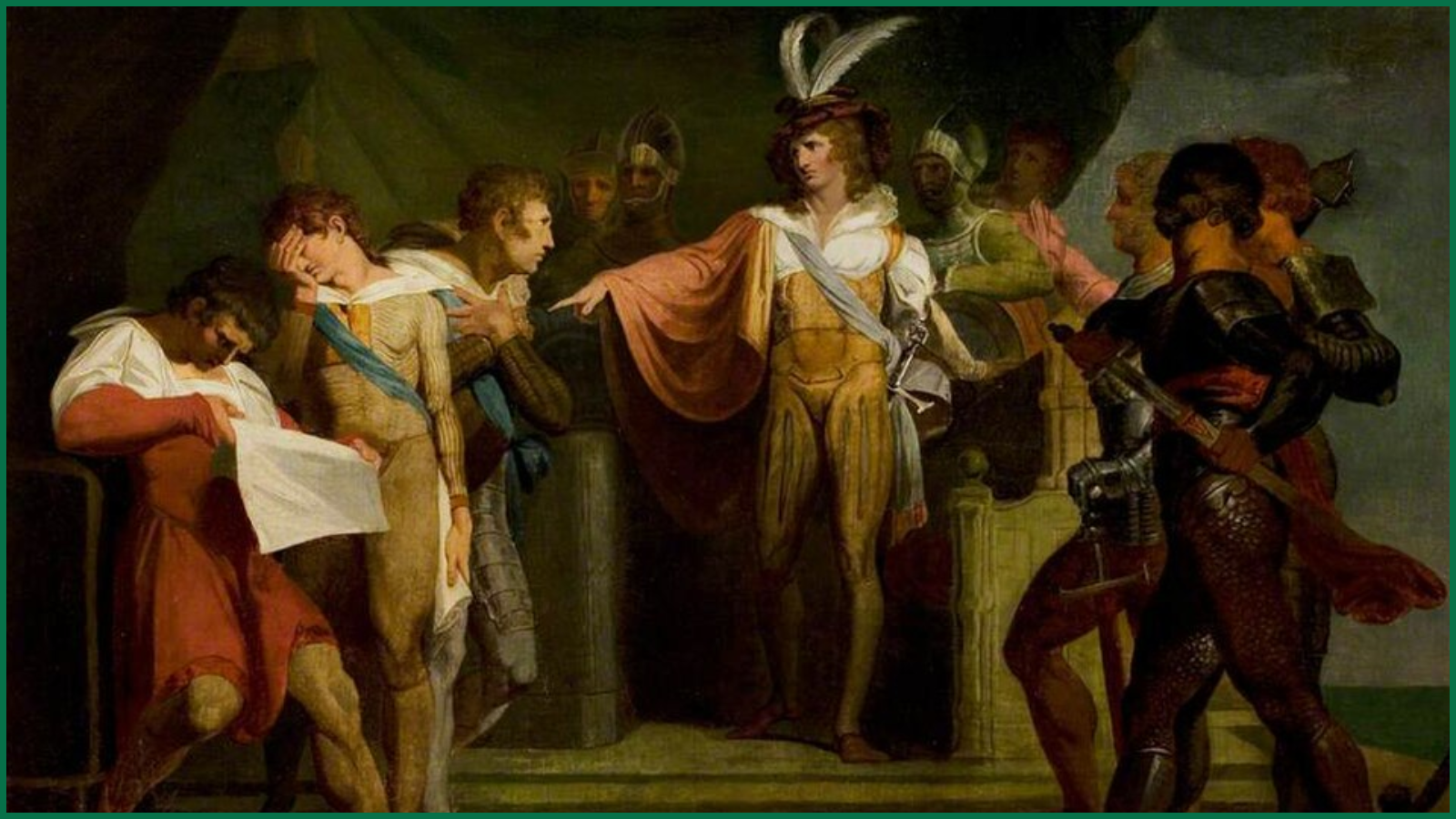
    Henry V serves as a kind of mid-series climax to the Henriad; the peak of English power before the fall into civil war. The story opens with a discussion surrounding the English claim to the French throne. When the Dauphin sends an insulting “gift” of tennis balls to the young King Henry V, the decision to pursue the claim is sealed. Henry assembles his army and leads them into the ferocious siege of Harfleur across the English Channel. Despite difficulties, Henry is almost able to will victory into being with his speech:

    Once more unto the breach, dear friends, once more;
    Or close the wall up with our English dead.
    In peace there’s nothing so becomes a man
    As modest stillness and humility,
    But when the blast of war blows in our ears,
    Then imitate the action of the tiger.
    Stiffen the sinews, summon up the blood,
    Disguise fair nature with hard-favour’d rage.2

    Upon taking Harfleur, the next is the Battle of Agincourt. This battle occupies a privileged space in English national lore to this day—something akin to the Battle of Thermopylae, fictionalized in the movie 300. This is because the English were badly outnumbered on the battlefield, five to one.3 Acknowledging that his army lacks size, Henry delivers one of Shakespeare’s most famous speeches:

    But we in it shall be remembered,
    We few, we happy few, we band of brothers.
    For he today that sheds his blood with me
    Shall be my brother; be he ne’er so vile,
    This day shall gentle his condition.
    And gentlemen, in England now abed
    Shall think themselves accursed they were not here,
    Any hold their manhoods cheap whiles any speaks
    That fought with us upon Saint Crispin’s day.4

    Language and Nation

    The French receive a bloodletting on the battlefield and Henry executes prisoners that he does not believe his small army can guard. Henry is shown to be tactical and shrewd, as he is rousing and patriotic. A warrior, the play concludes with his awkward courting of the French princess Katherine, thus accomplishing his aim of ascending the French throne.

    Henry V demonstrates the horrors of war—and its proud glory. It shows a heroic king—and a morally blemished man. And through these contradictions, it shows something even more important which is the forging of a state, a United Kingdom. This is achieved with Henry’s forming of a coalition army—including Welsh, Scots and Irish—under one king and one language. Shakespeare takes care to emphasize that it will be English adopted into his marriage with Katherine and the French throne, asserting a reversal of fortunes for a French language that was considered superior and sophisticated, one that had dominated England for centuries prior. 

    Prior to the Renaissance and early modernity, languages and dialects tended to be disparate—varying wildly between villages and noble courts. The standardization of national languages arose with the centralization of palace authority and became the mark of a unified nation-state. In Spain, this process began as early as the 1200s; in France, the 1500s. Italian was only standardized in the 1800s with national unification.

    English did not undergo an official standardization but the works of Shakespeare and the printing of the King James Bible are seen as landmark events. It is interesting that Shakespeare, the greatest individual contributor to a standard English language, consciously lifted it to such heights in Henry V. He was not only showing the arrival of a language, but the arrival of a modern nation.

    Nationalism is a powerful social construction that binds people to causes that they may not otherwise support. Shakespeare demonstrates this eloquently in his play. Any moment his men cast rational doubt on the cause they are fighting for or the sacrifice they are prepared to make, Henry arrives with a dazzling display of rhetoric stoking nationalistic pride and dispelling all doubts.

    The Marxian Superstructure

    Marx recognized the role of fabled leaders and national mythology to the creation of a nation-state, which is the necessary cradle for the capitalist market. In his Eighteenth Brumaire of Louis Bonaparte he wrote

    But unheroic though bourgeois society is, it nevertheless needed heroism, sacrifice, terror, civil war, and national wars to bring it into being. And in the austere classical traditions of the Roman Republic the bourgeois gladiators found the ideals and the art forms, the self-deceptions, that they needed to conceal from themselves the bourgeois-limited content of their struggles and to keep their passion on the high plane of great historic tragedy…Thus the awakening of the dead served the purpose of glorifying the new struggles.

    And so it was for Henry V. At the time of writing, England was locked in a formative national struggle against Spain for naval supremacy and access to New World plunder. Shakespeare wrote for a highly diverse audience, including London’s nascent and well-paying bourgeoisie class of lawyers, traders and merchants. With reference to Marx, Henry V is best understood as a heroic play written for a bourgeois audience roused by war, although far from fighting it.

    It is almost a purpose-built story, uniting in the imagination the kingdom’s collection of English, Welsh, Scottish and Irish, together against a common enemy. As a product of early modernity it prodded a national language—a national consciousness—into being. It offers an early glimpse of the national vessel that would eventually subjugate all four corners of the Earth, and lay down a modern capitalist empire on which the sun never set.

    Thanks for reading!


    1. Frank Cameron and Don Dombowsky, eds. Political Writings of Friedrich Nietzsche (Palgrave Macmillan, 2008): 24. Karl Marx, of course, took a dim view of Louis Bonaparte III. ↩︎

    2. From Act 3, Scene 1. ↩︎

    3. Contemporary historians posit a much narrower differential between armies, with the French advantage being 4:3 or 2:1. ↩︎

    4. From Act 4, Scene 3. Saint Crispin’s day celebrates two shoemakers martyred in Roman times, and was marked in the English calendar until shoemaking became mechanized in the 18th century. ↩︎
  • In Brief: The Curse of Interesting Times

    In Brief: The Curse of Interesting Times

    Nearly everyone has heard the ancient Chinese curse meant to hex foes: “May you live in interesting times.” It is notable for its irony; on the surface, “interesting times” sounds alluring and non-threatening. But what constitutes an age of historical interest is never a mundane era of calm. What makes history interesting is the wars, the plagues, the conquests and the chaos that rupture stability and leave scars for future generations. The saying emphasizes that nobody wants to live through these times, even if they enjoy reading about them.

    It is also entirely apocryphal. “May you live in interesting times” is neither ancient nor Chinese nor a curse. Rather, it began circulating in British political circles at the turn of the 20th century before going mainstream in the Anglosphere. The insistence on an ancient Chinese origin is meant to convey a certain banality or cyclicity to the extraordinary modern epoch that succeeded the Middle Ages.

    Since Columbus crashed the shores of Hispaniola in 1492 there has been an accelerated rate of change permeating every rung of global society from the royal palace to the peasant village to the hunting camp. Modernity has wiped clean nearly every mode of existence that had previously stood for millennia. 

    Writing near the time and place where the apocryphal Chinese curse first originated, Karl Marx linked modernity’s dizzying pace to the motion of a capitalist economy fed by surplus value: 

    Constant revolutionizing of production, uninterrupted disturbance of all social conditions, everlasting uncertainty and agitation distinguish the bourgeois epoch from all earlier ones. All fixed, fast-frozen relations, with their train of ancient and venerable prejudices and opinions, are swept away, all new-formed ones become antiquated before they can ossify. All that is solid melts into air, all that is holy is profaned, and man is at last compelled to face with sober senses his real conditions of life, and his relations with his kind.1

    Following Marx’s summation, the curse of interesting times is synonymous with life under the capitalist mode of production. In the present age we have seen our lives revolutionized by smartphones and Ozempic and artificial intelligence and the infinite scroll of social media. Without any new land to discover or national markets to conquer, the economic forces devouring profit have blown open digital universes and pierced the sky with rockets. All this, and there are still those among us who remember a time before the “personal computer” and internet. 

    Marx correctly diagnosed technological revolution and cultural agitation as endemic to capitalism but he undoubtedly underestimated the market’s ability to distract humanity from our sober senses, our real conditions of life, our relationships with others.

    Even with the power to connect billions into direct relations, social media is reduced to a horde of vanity projects. The planetary boundaries for pollution are broken in the heat of smouldering summers. Leading nations have become the geopolitical equivalent of mass shooters. The western economy lives on the edge of a stock market bubble inflating by the day. But should any of this concern you—there’s a pill for that. Interesting times indeed.

    Rosa Luxemburg said: “The most revolutionary thing one can do is always to proclaim loudly what is happening.” Overcoming the curse of interesting times still depends on apprehending its root cause; the suicidal logic of capitalist growth and the corporate suppression of human vitality. The current state of class consciousness is strung-out but the potential to connect, to organize, to educate and to inspire has never been more latent.

    Thanks for reading!


    1. Karl Marx and Friedrich Engels, The Communist Manifesto. ↩︎
  • US Aggression in Latin America: A History

    US Aggression in Latin America: A History

    When the U.S. government purchased Louisiana from France, they secured a land stretching from present-day Montana, through Oklahoma and terminating at the Gulf of Mexico. However a new dispute opened with Spain concerning the southwest boundary of the formerly French territory: Texas. The Americans felt that they had acquired the territory as part of their deal with France but Spain maintained that it was them who had control over that land. The Spanish sale of Florida to Washington was meant to settle the Texas issue and the U.S. government formally relinquished its claims as part of the transaction. But American settlers on the frontier had other ideas.

    Mexico gained independence from Spain in 1821 and was quickly recognized by the United States. Initially the two countries enjoyed friendly diplomatic relations, with the Treaty of Limits affirming Mexican sovereignty over Texas and other western territories, including present-day Arizona and California. Within this cordial political atmosphere, American homesteaders were invited to settle in Texas and help to stabilize a fragile Mexican economy. What they received was an unruly population with little respect for Mexican sovereignty, much less Mexican people or customs.1 Tensions came to a boil when Mexico abolished slavery in 1829. As many American settlers had brought slaves with them, they would have faced a loss of property if the Mexican law was enforced. Instead they took up arms, kicked out Mexican authorities and demanded to be annexed by the United States.

    Early Aggressions

    Mexico warned the U.S. that their border treaty would be nullified if they annexed Texas. The Mexicans undoubtedly misunderstood the expansionist spirit of manifest destiny, having been fooled by prior friendly relations with Washington. The resulting Mexican–American War dropped the full brutality of U.S. superiority down on Mexico like the hammer of Thor: boys were shot for sport; churches were desecrated and Catholics murdered; women and little girls were stripped naked and assaulted in unspeakable ways; entire villages were razed by fire.2 The barbarity only halted when the U.S. military occupation of Mexico City forced the surrender of 55% of Mexican territory.

    The Mexican–American War was not any kind of dark chapter in the history of U.S.–Latin America relations. On the contrary—it set the mould. With the conquest of new territory stretching to the Pacific, American commercial interests began to reach down the coastline and into Central America.

    The western appetite for bananas and other tropical commodities brought US capital into contact with a new swathe of Latino peoples—and it went about as well for them as it did for the Mexicans in years prior. The ravaging of Mexico proved to America, with its powerful industrial economy, that it could act with impunity toward its less-developed neighbours to the south. Their capital and guns afforded them enormous power over a region that lacked both.

    Warfare is defined as an “open and declared armed hostile conflict between nations.” The Banana Wars of the early 20th century carry an unfortunate title because they were not wars—they were repeated molestations of vulnerable populations by an imperial power.

    When Haiti and the Dominican Republic fell into debt, the US deployed artillery, machine guns and naval ships. They stole the national gold reserves, turned government finances over to New York banks and gave American corporations free access to land for sugar plantations run by forced labour. When a nationalist insurgency threatened foreign property in Nicaragua, marines arrived to quash the rebellion. They proceeded to take over government finances and established a military base to suppress future anti-American revolts. When Washington decided to build a canal across the Isthmus of Panama, they backed a secessionist movement that would pull the small, pliable country of Panama from the lands of Greater Colombia. When abhorrent working conditions on American-owned sugar plantations in Cuba sparked civil unrest, thousands of marines arrived to protect the harvest and suppress anti-American agitation.3 When plantation workers in Colombia protested payment in coupons rather than cash and demanded a six day work week, the United Fruit Company massacred the strikers. In Honduras, United Fruit kept workers’ movements at bay by paying off presidential candidates and funding right wing militias. This combination of efforts made the corporation the most powerful entity in the state.

    The Dictatorships

    The advent of the Cold War brought American hegemony over Latin America to new heights. With the US military in confrontation with communist forces in Asia and Europe, covert action and special operations were relied on in the Western Hemisphere. Across Latin America, torture chambers and CIA-trained death squads blossomed alongside a growing number of brutal right wing dictators aided by Washington. Argentina, Bolivia, Brazil, Chile, Cuba, Dominican Republic, El Salvador, Guatemala, Haiti, Nicaragua, Paraguay, Uruguay, and Venezuela all suffered visits from oppressive regimes that consolidated power and murdered their opposition under the cynical guise of “anticommunism.” Even modestly progressive and liberal-democratic movements were snuffed out in many of these countries, as elections were overturned and American corporate interest reigned supreme.

    This was the Latin America that confronted a young Che Guevara as he embarked on his notorious motorcycle journey across the continent. On his trip he witnessed the the cold and hungry conditions of mine workers in Chile and the faces of poverty in Peru, people who “go on living only because it’s a habit they cannot shake.”4

    Guevara correctly understood that the division of Latin America into “unstable and illusory nationalities” made the region ripe for exploitation and US domination.5 He saw this domination first-hand in 1954 when living in Guatemala, where an elected government proposed land reform for its farmers. Soon afterward, it was overthrown by American bombers in order to install a pro-United Fruit Company dictatorship headed by Castillo Armas, a CIA asset who murdered thousands of people. This experience proved the futility of representative democracy in the face of powerful corporate interests.

    Having been marked for execution by the homicidal U.S. puppet in Guatemala, Guevara fled to Mexico where he met Fidel Castro and joined the Cuban revolutionary struggle. Cuba was also ruled by a pro-US dictator at this time and he oversaw routine executions of political opponents and a Cuban economy where American corporations controlled approximately 40% of sugar production, 90% of mining concessions, 100% of cattle ranching, 80% of utilities and had a monopoly on imports. Additionally, the corruption of the Batista regime allowed the American Mafia transform Havana into a drunken cesspool of gambling and prostitution. 

    With striking lucidity President John F. Kennedy admitted

    I believe that there is no country in the world including any and all the countries under colonial domination, where economic colonization, humiliation and exploitation were worse than in Cuba, in part owing to my country’s policies during the Batista regime.

    The success of the Cuban revolution saw the re-appropriation of national property and the destruction of casinos by throngs of empowered Habaneros. The revolution went on to deliver universal housing, healthcare and education, restoring dignity to a despoiled country. However, the antagonism would re-emerge in the form of a suffocating economic blockade and countless coup attempts.

    The Debt Racket

    The end of the Cold War brought more liberal governance to Latin America but they were saddled with debts carried over from the era of military juntas. From this situation came America’s next racket: the “Washington Consensus,” which was little more than a set of neoliberal dictates devised by western financiers for nations held in debt bondage.

    Mass privatization, austerity budgets and easy American access to cheap labour and resources were the hallmarks of crisis financing in the 1980s and 1990s, pulling in countries such as Argentina, Chile, Honduras, Nicaragua, Mexico and Venezuela—resulting in La Década Perdida (the Lost Decade) of stagnant economies and soaring inequality. In other words, the Washington Consensus represented another hegemonic “push from the United States” for “trade agreements favourable to the United States…The free flow of capital that these trade agreements were designed to foster has only benefitted the rich nations and the wealthy classes.”6 Derivative of these neoliberal policy prescriptions is a migration crisis and the 21st century “pink tide” of elected progressive governments throughout Latin America.

    From the Banana Wars era to the present day, we can see that Che Guevara was proven right: liberal democracy in exploited countries is too weak to uplift the great majority and a lack of regional solidarity has made it easy for the United States to run roughshod over Latin America. In terms of real purchasing power, the region has been economically stagnant for 50 years, with examples of worsening poverty and shrinking middle incomes over that time. The pink tide movement was driven back by “soft” coups in Brazil and Bolivia, corporate pressure and repeated attacks from Washington on Latin American progressive heads of state. One pink tide country which resisted coup attempts and foreign subversion was Venezuela under Hugo Chavez

    In a span of 14 years Chavez was able to double school enrolment, make literacy and healthcare universal, raise access to safe drinking water from 82% to 95%, build 700,000 homes, return one million acres of land to indigenous people, reduce malnutrition from 21% to 3%, and cut unemployment and infant mortality in half. His government accomplished this through a program that forcefully eschewed liberalism in favour of participatory democracy at the neighbourhood level, worker-owned enterprises and nationalization of resources and services. For these successes, the United States delivered to Venezuela the same verdict that Cuba received decades ago: economic strangulation, with the harshest measures arriving in 2019.

    What Venezuela and Cuba represent is an expression of defiance in the face of 180 years of unbroken US hegemony in Latin America. For this reason, they are admired by a great many people who “personally suffered under US-sponsored military dictatorships that dominated much of the region” for decades.7 The kidnapping of Chavez’s successor, Nicolás Maduro, is an attempt to force compliance with the pillaging of Latino resources that American corporations feel entitled to. Cheering this move is fatally wrong, even for opponents of socialism: if Venezuela and Cuba are the backlash to United States interventionism, it follows that another intervention could make the situation much worse.  

    What the United States has done to Venezuela will perpetuate the familiar cycle of political violence and economic dependency—the breeding ground for anti-American resentment—serving nobody but the corporate lobby. The best moments in US–Latin America relations occurred when America expanded the realm of sovereignty rather than crushed it: the turnover of the Panama Canal to Panamanian authority and FDR’s short-lived Good Neighbour policy of non-interference in the region. As long as Latin American politics remains a reaction to American doctrine, the Western Hemisphere will not be free.

    Thanks for reading!

    Footnotes:

    1. The irony of this development in Texas compared to present-day complaints over immigration should not be lost on anyone. ↩︎

    2. See: Stephen Carney, The Occupation of Mexico (Government Printing Office, 2016): 20, 37, and Peter Guardino, “Gender, Soldiering, and Citizenship in the Mexican–American War of 1846-1848” in The American Historical Review, Vol. 119, No. 1: 43. ↩︎

    3. Louis A. Perez Jr., Intervention, Revolution, and Politics in Cuba (University of Pittsburgh Press, 2012): 98. ↩︎

    4. Che Guevara, The Motorcycle Diaries: Notes on a Latin American Journey (Ocean Press, 2003): 41.  ↩︎

    5. Ibid, 92. ↩︎

    6. Teresa A. Meade, A History of Modern Latin America: 1800 to the Present (John Wiley & Sons, 2022): 8. ↩︎

    7. Ibid, 10. ↩︎
  • How the Capitalist Stole Christmas

    How the Capitalist Stole Christmas

    For those of us in northern climes, there really is no better time of the season than Christmas. Egg nog and turkey, the heat of a crackling fire, that royal pine scent. It’s the high point of winter where cold weather and snow brightens the atmosphere; reflecting twinkle lights and hanging drapes of candy cane red. 

    On the calendar of the secular West, Christmas is the most important holiday, spurring entire industries and price indexes. For all the bluster of church bells and the “war on Christmas,” you’d be forgiven for thinking this was a doctrinal Christian holiday bastardized by secular affectations. But it isn’t.

    A Saturnalian Christmas

    The date of Christ’s birth was never established by religious scripture. Without a date, celebrations by early Christians would have been impossible. December 25 was chosen by Pope Julius I sometime around 337 AD and it accomplished two things. First, it projected mystic divinity to the life of Jesus. As he was widely regarded to have been crucified on March 25, it followed that the Annunciation must have occurred on the same day; a perfect nine month pregnancy puts baby Jesus snug in a manger on December 25. Second, this date coincided with the existing pagan holiday of Saturnalia, making for a tidy Christian cooptation of an existing Roman landmark. 

    Little is known about early Christmas traditions—if there were any at all to speak of. Birthdays were not nearly as significant to ancient and medieval people as they are now. But from the Middle Ages, it is apparent that Christmas had much more in common with the Roman Saturnalia than it did with Catholic ritual: a multi-day public revelry of drunken stupor and feasting, when slaves could be free and peasants could be lords and all rules of the social hierarchy were flattened. In fact, the traditional 12 days of Christmas was so sinful and disorderly that the very first “war on Christmas” was actually waged by American Puritans who attempted to ban the holiday by levying fines against those who observed it.

    Whether Saturnalia or medieval Christmas, we see in both instances a holiday that was religious in name only. Rather than piety, what they really provided was a temporary release to the tense social hierarchy and class system. This was the occasion when Roman slave masters and medieval landlords would grant privileges and gifts to their subjects, solidifying the economic order with community cohesion. The multitude of free days dedicated to communal partying is practically unthinkable to modern economies, which generally only grant about ten statutory holidays throughout the entire year—let alone 12 for a single event. But for the largely agrarian economies of pre-capitalist Europe, there was not much work to be conducted during the winter months.

    Capitalist Christmas

    Although the Puritan Christmas ban during the 1600s failed, the advent of industrial capitalism granted them their wish. The spread of urban factories, industrial mining, shipbuilding yards and textile mills throughout the 1700s scrambled the established agrarian economy and muted the raucous 12 days of Christmas. People were working 16 hours a day, six days per week. Owing to such dreary working conditions in the Anglosphere, by the 1800s  people “hardly took notice of the holiday at all.”1

    Describing the capitalist thrust toward exchange value and profit realization, the geographer David Harvey wrote: “The monetization of everything appears to be an unstated evolutionary law of capital.”2 The history of Christmas is clearly an example of this capitalist tendency. Whereas the old Christmas posed an obstacle to capitalist accumulation, the new Christmas would facilitate it. The community that made that debaucherous, 12 day Saturnalian binge possible was pulverized by the crushing weight of industrial machines and thirst for survival wages. As Marx said, “where money is not itself the community, it dissolves the community.”3

    Shared holidays are a kernel of communal human nature and social labour that have found cultural expressions for all of known history. What we find with Christmas is a tradition that was melted down by the Industrial Revolution and reforged with a capitalist skin. Christmas trees were the first seasonal item to be put up for sale in towns and cities across North America, as the German custom gained widespread popularity after the arrival of migrants. Christmas tree decorations then followed suit, spurning the seasonal sales of street vendors. Printing presses were the next to cash in on the season with the marketing of mass produced Christmas cards that could be sent via public mail delivery. The social nature of Christmas cannot be denied here; Christmas trees for family enjoyment and public display, cards purchased for friends and family across North America. The gift was the next logical expansion of the Christmas commodity ecosystem.

    From an economic standpoint, the Christmas gift represents the ruthless commodification of social life under the guise of selfless giving to loved ones. Gift giving within a capitalist framework effectively exploits our cooperative nature for the realization of private profits. The costs do not have to be paid up front. Canadians are expected to carry $6.1 billion in post-holiday debt entering 2026. Last year, 36% of Americans took on about $1,100 in debt to finance Christmas and Brits collectively raised £1.1 billion in holiday debt. For many, it is so much easier to go into debt than it is to say “no” to their children.

    Enter Santa

    The most recognizable symbol of Christmas isn’t Jesus—it’s Santa Claus. On the surface, it appears absurd that the birthday boy, the King of kings and Lamb of God, would be overshadowed on his special day by a plump, sleigh-riding elf from the North Pole. It makes sense only when considering the history: Christmas was never a particularly religious ritual and modern Christmas is largely a capitalist construction that drives commodity sales.

    Santa Claus is a composite figure based on 19th century American storytelling and Dutch interpretations of Saint Nicholas, or Sinterklaas. He was not invented by marketeers but his legendary association with gift giving to children made him the perfect marketable Christmas vehicle to drive sales. Attempting to turn Jesus into a piece of marketing would be heretical to the religious and exclusionary to the secular. But Santa; Santa can appear in Coca-Cola advertisements and department store parades. Santa can sprout like mushrooms in December at malls across a continent. The consummate salesman of Christmas, Santa can even get ripped and work the Target store.

    Whereas previous modes of production often brought producers and consumers into personal relationships, what happens in the capitalist marketplace is the relation of prices, brands and objects against one another. The production process itself is concealed as “consumers come to form a relationship with products instead of the people who make them.”4

    Likewise with Santa, whose mythical veneer belies a fetish: by projecting the generosity of Christmas onto an elf, we distance ourselves from the credit cards and labour that perpetuate the myth. Santa is the symbol of overconsumption under a cloak of charity. After all, he is only as generous as we are willing to spend. Yet, when we are acculturated into the Santa myth we recognize that the gifts he procures come from Santa’s workshop rather than a toy store or Amazon delivery. We are alienated from production and bound to superficial mass consumption—and we acknowledge this fact by our refusal to impute these qualities onto Santa, whose elves intimately handcraft gifts from wish lists.

    The intimacy is important because this is what grows through the cracks. Despite the commercial creation of Christmas, the communal feast lives on. It is the social quality of Christmas that gives it a heartbeat—and that cannot be purchased at the department store.

    Thanks for reading!

    Footnotes:

    1. “Christmas in 19th Century America,” History TodayVol. 45, No. 12. ↩︎

    2. David Harvey, A Companion to Marx’s Grundrisse(Verso, 2023): 79. ↩︎

    3. Karl Marx, Grundrisse (Penguin, 1993): 224. ↩︎

    4. Jack Lasky, “Commodity Fetishism,” in Ebsco, 2024. ↩︎
  • Free Markets, Unfree People

    Free Markets, Unfree People

    Most of us dread the deadening of the body and will do anything to avoid it. About the deadening of the soul, however, we don’t care one iota.1
    —Epictetus

    As the earliest human societies emerged conscious from nature egalitarianism was a common characteristic. Economic surpluses were minimal and production of material needs relied on a nakedly social effort. The psychologists David Erdal and Andrew Whiten suggest:  “Egalitarian behaviour patterns evolved because…individuals became so clever at not losing out to dominant individuals that vigilant sharing became possible, and this was the most effective economic strategy in the circumstances in which Homo sapiens evolved.”

    In the prehistoric era of hunter-gathering, or primitive communism, there was no incentive to hoard resources, ideas or technology. In fact, doing so would have carried detrimental consequences to the individual, the group and the wider species. Resources and technology were freely shared between groups and individuals, and this type of cooperation facilitated the dominion of humanity over the globe. The free exchange of ideas and resources during this era fall into the categories of gifts between tribes, reciprocal exchange between kin and petty barter between individuals. 

    After ecological pressures provoked the Neolithic Revolution, humanity had to grapple with sedentary living and the production of an economic surplus above what was needed to reproduce the population. In the presence of surplus, our tendency toward cooperation and egalitarianism became inverted and economic classes formed which laid claim to different points along the production and distribution ladder. In a dialectical reversal of epic proportions, the prehistoric aversion to domination gave way to the slave economy, the most oppressive economic system known to history.

    Ancient Rome was so saturated with unfree labour that little distinction was made between working citizens earning a wage and slave labour owned by a master. Slaves commonly held managerial roles, conducted business and apprenticed in skilled trades. Selling oneself into slavery was an attractive means to escape poverty. In such an economy, it was the narrow band of elite slave owners who absorbed the surpluses of antiquity.

    Dawn of the Market

    Both enslaved and wage labour transitioned into tenant farming during the late decline of the western Roman empire. Feudalism was a sort of synthesis between the enslaved labour of Rome and the social organization of the Germanic tribes. Meanwhile, Christian idealism began to permeate the superstructure of medieval Europe. Since most of the population was tied down to agricultural production on plots of land, merchants took on an important role in the circulation of goods. Markets were held at regular times and places throughout Europe, giving prospective buyers and sellers of wares notice to prepare. Merchant guilds coordinated the movement of imports and commercial profits became a pathway for non-landholding Europeans to capture a piece of the economic surplus of the feudal era.

    Medieval commerce was sublated by the capitalist system as it began to develop after 1492. After peasants were shook loose from ancestral farmland and piled into cities, permanent shops replaced the market squares and merchant banks funded New World pillaging expeditions. We see a point in history where labour, surplus production and capital break free of physical boundaries. This economic transformation created the foundations of science, Enlightenment philosophy, the modern state, monetary system and, of course, the idea of the free market.

    “Free market” is defined by Britannica as “an unregulated system of economic exchange, in which taxes, quality controls, quotas, tariffs, and other forms of centralized economic interventions by government either do not exist or are minimal.” It’s interesting that free market fundamentalism—or laissez-faire economics—arrive on the political scene around the same time as socialism does, during western industrialization.

    As noted in the first paragraph, human beings evolved with an aversion to domination and preference for some modicum of economic and political egalitarianism. The adoption of sedentary living and the creation of economic surpluses within a class hierarchy threw back much of the formal cooperation of hunter-gatherers but it did not eliminate the collective want of freedom. Cooperation and freedom from domination is hardwired into our evolutionary history. This is visible in slave rebellions and peasant uprisings, as well as religions preaching liberation of the spirit. What capitalist modernity offers is a chance to concretely understand society and create the necessary political and economic conditions for liberation.

    Socialism v. Markets?

    For socialists, liberation involves a positive action: the organization of workers to overthrow the state and create a new government that lays hold of the economic levers of power. This would allow society to democratically create the material conditions needed for individual flourishing. Free marketeers are the inverse of this, socialism’s negative correlate: cut the government to a minimum and remove political authority from economic levers. The great promise of the free market is to provide “social order without institutions, claiming not to be one itself.”2 The premise here is that a market of self-interested individuals is the best allocator of goods and services for the whole of society. The market represents true capitalism, and true capitalism only exists where state authority ends.

    Voluntary exchange between individuals would certainly be a feature of any pro-social economy. For this reason free market fundamentalism can sound attractive. But it brings forward serious problems owing to the rock-ribbed power imbalances embedded within the capitalist economy. Every class society has featured an elite class which posits a state to protect property and safeguard economic interests and capitalism is no different. In his history of capitalism, Jürgen Kocka writes:

    State formation and the origins of financial capitalism were closely connected, and the nexus provided a way for prosperous urban citizens in high finance, a small elite, to establish their influence on politics while simultaneously making their entrepreneurial success dependent on powerful rulers and their shifting political fortunes.3

    This is a situation that continues to the present day, with the powerful corporate lobby and central banks that fuse financial capital to the state apparatus.4

    Assuming that the Siamese twins of state and corporate power could be surgically separated, the benefits are not clear. The capitalist market is not like the reciprocal exchange and gift economies of our prehistoric ancestors. It descended to us from authoritarian ramparts, by way of colonial subjugation, race-based slavery and violent ethnic cleansing. No wonder that the capitalist market is a bare-knuckled fight in which each participant must attempt to end the day with more money than they began it with.

    Even for a bourgeois economist like John Maynard Keynes it was apparent that the accumulation of money had bound society to “pseudo-moral principles which have hag-ridden us for two hundred years, by which we have exalted some of the most distasteful human qualities into the position of the highest virtues.”5 Under such conditions, scams are incentivized, price gouging is profitable, environmental stewardship is burdensome, stock swindles are rife and labour appears only as a costly appendage to production.

    Stamping the capitalist market with the title of “free” does not dress the window much either. Engels pointed out the logical fallacy of the “free” aphorism when critiquing a proposal to repackage Germany as a free state: “Taken in its grammatical sense, a free state is one where the state is free in relation to its citizens, hence a state with a despotic government.”

    Once the great mass of people is subordinated to market forces by way of survival, the market is free to act on them in despotic ways. The workplace is a totalitarian encampment where using the bathroom and eating lunch are objects of scrutiny, the threat of termination hanging like the sword of Damocles over the necks of employees.6 Meanwhile, bills accrue. Small businesses collapse under the weight of competition. Houses are seized by debt obligations and families go hungry by price shocks. In the absence of income, the free market pushes desperate participants into drug peddling and sex trafficking. Art and corporate advertising become salacious performances demanding attention from a tired population on the go. Sterile escapism is rampant. Information deteriorates to the standards of minds made lazy and politics is a bloodsport. Every stripper pole, inside trade and contract killing can be rationalized so long as it pries away a profit. When Adam Smith likened the market to an “invisible hand” he failed to mention how often it would punch us in the face.

    Past the Paradigm

    The multitude of social ills kicked up by a despotic market which commands labour and demands consumption is the reason why the free market utopia is a mirage, at best. Even a conservative thinker like John Gray adroitly pointed out that cultural conservatism is not compatible with free market, laissez-faire policies.7 The conservative rebellion against corporate diversity policies and global trade are examples of misalignment between the capitalist market and traditional values.

    If the political theatre is the stage of class conflict, the current tug-of-war between interventionist modern liberals and the protectionist populist right wing demonstrates that there is no room in the troupe for free market fundamentalists. The market has already blazed a trail for mass migration, menacing technologies, medical bankruptcy, sky-high utility prices, the outsourcing of decent jobs and hollowing out of public infrastructure. All that’s left to do is fight amongst the wreckage left in its wake.

    The capitalist paradigm has only cemented over a scant 300 years of human history. Capitalism has visited humanity with a progression out of feudalism but its market is neither efficient or rational, as the swelling expanse of global slum dwellers, overflowing landfills and microplastics in our bloodstream attest.

    What is needed is not the expansion of the capitalist marketplace but its sublation: a pulling forward of our latent cooperative instincts into a universal exchange that rewards economic actors according to the satisfaction of human need rather than profit. In such a post-capitalist market, the gift economy and reciprocal exchange reappear. Rewards accrue to the doctors curing cancer; the innovators shortening the workday; the oceanographers detoxifying our waterways; the engineers constructing comfortable housing and transport for all. For humanity to have a future we must not oppose the current paradigm but go beyond it.

    Thanks for reading!

    Footnotes:

    1. Epictetus, Discourses and Selected Writings (Penguin, 2008): 15. ↩︎

    2. Fredric Jameson, Valences of the Dialectic (Verso, 2010): 293. ↩︎

    3. Jürgen Kocka, Capitalism: A Short History (Princeton University Press, 2016): 43. ↩︎

    4. David Harvey, The Limits to Capital (Verso, 2018): 321. ↩︎

    5. Keynes as quoted in David Harvey, A Companion to Marx’s Grundrisse (Verso, 2023): 83. ↩︎

    6. David Harvey, A Companion to Marx’s Capital (Verso, 2010): 176. ↩︎

    7. John Gray discussed in Jameson, Valences, 463-4. ↩︎
  • Historical Materialism

    Historical Materialism

    This article is part of a series on classical Marxism.

    The chronological sequence of events leading to the present can be looked at in a number of ways. Sometimes it is mystified, a progression guided by the hand of God or a creator. This is generally what is taught in churches. To the more secular-minded, it can appear as a random sequence of events—one unfolding drama after another between the armies of warlords and conquerors, the avarice of kings and emperors, the bedrooms of aristocrats and financiers. This is the “great man theory” of history which supposes that social changes and historic events are mainly impacted by gifted individuals driving the realm of humans forward. Then there are the idealists, asserting the predominance of collective consciousness and content of the mind in determining events. This view holds that the best ideas will advance themselves through free and open communication, with the strongest ones rising to the top and shaping our government, laws, technologies, economic exchange and global institutions.

    The materialist conception of history grounds things differently. As humans are evolved from nature and are reliant on it to meet all of our basic needs, materialism places our history on the basis of our natural being. As most hominids and pre-modern humans existed without religious concepts, advanced cognition or complex language, mapping our history onto these things does not make much sense. While human society today may “feel” very much removed from the whims of nature, this is a fallacy since everything from computers, smartphones, houses, clothes and food are all ultimately derived from some natural extraction. Thus the true fault line between society and the world of nature is “the mediating realm of human labour and production.”1 As individuals must be nourished and fed before they can think or speak, so too must any collective of people be able to meet their biological needs before they are able to ponder philosophy, establish an oral history or develop an artistic culture: “The first historical act is thus the production of the means to satisfy these [biological] needs, the production of material life itself.”2

    Historical materialism is the assertion that the basis of all history starts with how people produce. Because we, as material beings, are required to first produce our physical bodies before we can produce ideas and individuals, the ideas and individuals that come thereafter will be a reflection of how we produce. Everything else—politics, art, culture, religion—derives secondarily from this basis in production. That is not to dismiss the existence of individual talents or the significance of ideas, but life’s first instances must be materially produced before any individual or collective expressions can be made. The latter depends on the former. Thus it is seen that great men, religion, political intrigue and ideas in general are corollary to the economic system and not the other way around. Human societies, as an outgrowth of nature, therefore emerge with a universal base-superstructure shape that Karl Marx summarized as follows:

    In the social production of their existence, men inevitably enter into definite relations, which are independent of their will, namely relations of production appropriate to a given stage in the development of their material forces of production. The totality of these relations of production constitutes the economic structure of society, the real foundation, on which arises a legal and political superstructure and to which correspond definite forms of social consciousness. The mode of production of material life conditions the general process of social, political and intellectual life. It is not the consciousness of men that determines their existence, but their social existence that determines their consciousness.3

    Image: Wikimedia Commons

    Labour and production are an “everlasting Nature-imposed condition of human existence” but the forms that production takes and the societies that it produces are variable and highly dependent on available technology, access to resources, received cultural values, etc.4 The social hierarchy of production plus the resources in use and the technologies deployed constitute the mode of production—the economic base. Politics, culture, social customs and intellectual products are the superstructure resting atop this base, shaping our individual and collective consciousness. If anybody imagines being born at a different time period than their own, what they are imagining is life within a different hierarchy of production and its corresponding customs and norms.

    In history, there has been a progression of four major modes of production that have been well-documented and studied, presented below. A fifth is theorized but has yet to fully emerge.

    1. Primitive communism. This is also known as a tribal or hunter-gatherer society, but it is regarded as a form of communism because they were classless. A classless society does not denote equality or absence of authority or any social hierarchy, however. Classlessness denotes individual autonomy over labour, as nobody has the means to seize the work of others. Surpluses, resources and positions of authority are managed democratically by the group, often by consensus. This mode of production was predominant during the Paleolithic Era when Earth was in an ice age. The economic base consisted of technology such as bows and arrows, early use of fire, rafts, hand axes, and big game resources like rhinoceros’ and woolly mammoths. This mode of production corresponded with a superstructure which found expressions in cave paintings, figurine carvings, flute-like instruments made of bone and animistic religions.
    1. Ancient mode of production. The transition to settlements and agriculture occurred after the ice age had ended and various megafauna species began going extinct. The warmer climate allowed for a transition to domesticated crops and livestock which resulted in much greater food production and increased population densities—even as life expectancy crashed due to higher rates of disease and less nutritious diets. The appearance of large grain surpluses also gave rise to humanity’s first class structures and violence over territory. As warrior-kings and armies developed, enslavement of other peoples became common. This mode of production is largely epitomized by the master–slave class relation seen in Ancient Greece, Rome, Persia and Asia. Humanity’s first cities were created under this mode and it developed technologies like wood ploughs and iron tools, utilizing a variety of resources through aqueducts, roads, mines and quarries. The existence of a slaveholding class resulted in a complex superstructure marked by polytheistic, harvest-based religions, early writing systems, political institutions, philosophy, pottery and astronomy.
    1. Feudal mode of production. Feudalism came into being as the western Roman Empire was gradually undermined by an exhaustion of the slave trade and conflict with Germanic tribes, until it was eventually negated by the tribes altogether. The result was a massive deconstruction of political authority, away from cities and empire and toward rural fiefdoms controlled by warlords-turned-aristocrats and hereditary royal monarchies. This mode of production is defined by the predominant lord–peasant class relation. While ownership of slave labour was diminished, the labour of serfs was captured by agricultural rents paid to the manor. Previously discovered technologies were mostly adapted to village life, including mills, clocktowers and blast furnaces. The superstructure at this time was largely characterized by the rise of monotheistic religion across the known world. In western Europe, this was crystallized in the Catholic Church which offered political legitimacy to rulers in the form of a “divine right to rule” ideology. The Church also dominated the musical, writing, art and social life of this time period.  
    1. Capitalist mode of production. As feudal Europe developed its productive forces and its aristocracy matured, a thirst developed for expanding trade routes. Existing routes had become monopolized by the Ottoman Empire and this is what motivated Christopher Columbus to set sail, eventually landing on the shores of what is now the Dominican Republic. Ensuing was an unprecedented wave of settler colonization, with all of the pillage of gold, silver, produce, furs and fish that came along with it. As whole continents cracked open to agriculture and trade, plantations developed and slavery was revived in a racialized form. This veritable rush of wealth led to immense capital accumulation by European powers, ushering in the capitalist era. Technological development began to rise exponentially with the Industrial Revolution of the 1700s, as steam power, cotton gins and telegraphs appeared. Additional crop varieties from the New World and improved plough technology led to enclosures of farmland, expulsions of peasants and the creation of a mass wage-labour force. The capitalist–wage labour, or employer–employee, class relation is dominant under capitalism, rendering both slavery and serfdom uneconomical due to huge increases in production and the need for mass-consumption. The superstructure under capitalism is marked by the rise of liberal representative democracy, a secular public life, the fracturing of the Christianity with Protestant strains, mass media and the commodification of culture and goods and services. With rapid technological change, capitalism has now placed us firmly into the digital age.
    1. Free association of producers. A theoretical system whereby the labouring classes under capitalism—almost 99% of the population—become the ruling ownership class over the economy and government. Systems of socialist ownership sprouted up during the 20th century in opposition to imperial capitalism, while others have found a footing within the global capitalist structure today. National parks, public education, health care services, co-operatively owned enterprises, public transportation and the post office are all examples. Durable forms of socialism have yet to supersede global capitalism in a meaningful way. The goal of a free association is a classless society which minimizes mandatory work and unleashes the creative potential of all individuals as they dedicate themselves to self-directed pursuits. The primary purpose of this economic base is to produce goods and services according to need rather than payment, with the realm of want and culture dictated by free and voluntary exchange between individuals. Calculated surpluses would be managed via direct democratic means and allocated according to the material interests of the liberated society. The superstructure of such a system is unknown, but would be determined organically from the bottom-up, with decentralized communication technology, such as the Internet, playing a central role.

    Further reading:

    Karl Marx and Friedrich Engels, The German Ideology: Chapter One.

    —————————–


    1. John Bellamy Foster, “The Return of the Dialectics of Nature: The Struggle for Freedom as Necessity,” Monthly Review, Vol. 74, No. 7: 6. ↩︎

    2. Karl Marx and Friedrich Engels, The German Ideology: On Feuerbach. ↩︎

    3. Karl Marx, “Preface” of A Contribution to the Critique of Political Economy. ↩︎

    4. Karl Marx, “Chapter 7: The Labour-Process and the Process of Producing Surplus Value” in Capital: Volume One. ↩︎
  • Capitalism

    Capitalism

    This article is part of a series on classical Marxism.

    There is a claim that capitalism is defined by free trade and markets but this is an obscurity. Capitalism utilizes both markets and economic planning where beneficial, just like every other economic system has done—including hunter-gatherers, ancient Rome and feudal Japan. The definition of capitalism is actually very simple and specific: private ownership of production and wage labour. These characteristics may seem unimpressive from today’s vantage point but their fruition conceals a long and shady history.

    In Capitalist Realism, Mark Fisher points out the prevailing sentiment of 21st century disempowerment: “It is easier to imagine the end of the world than the end of capitalism.”1 As recent movies and television series indicate, there is a fascination with the apocalypse and barren moral landscapes that burn on our consciousness. Now that capitalism is concretized as the social reality in most of the world, the mind’s eye has tunnel vision regarding it. However, this anguish is not a distinct capitalist phenomena. Eschatology is an ancient subject. Generations of medieval peasants saw little change, despite the shifting boundaries of feudal fiefdoms and principalities. The Roman Empire and Ancient Egypt were supposed to last forever. And the Paleolithic era nearly did. For so many who lived and died in the past, it must have also been easier to imagine the end of the world than the end of their own way of life.

    That would not be true of every single generation—after all, there are active periods of revolution where artifacts and norms are torn down within the lifetime of individuals. And if anything distinguishes capitalism from what has preceded it, it must be the fixed quality of hectic upheavals. Karl Marx observed: “Constant revolutionizing of production, uninterrupted disturbance of all soil conditions, everlasting uncertainty and agitation distinguish the [capitalist] epoch from all earlier ones.”2 And again: “Modern industry never views or treats the existing form of a productive process as the definitive one. Its technical basis is therefore revolutionary, whereas all earlier modes of production were essentially conservative.”3 The nature of capitalism is therefore paradoxical—its end is unimaginable but so too is any status quo within it. Revolutionary change—in consumer goods, living costs, warfare, culture, nature and demographics—are always descending upon us under capitalism.

    Primitive communism, ancient slave societies and feudalism all arose gradually. The phase transitions triggered by natural human evolution, a warming Neolithic climate and the supplanting of Rome’s slave economy with feudalism all took place over centuries. Not so with capitalism. If capitalism is a spinning-hot mess of instability, conflict, technological invention and brutal exploitation, it’s because it was born in a frenzy of looting, genocidal violence, biological contagion and piracy. Feudal Europe was a pressure cooker of mounting debts, stifled trade routes, Catholic Inquisitions, bubonic plague and a bridled merchant class. Capitalism did not really emerge in the world—it exploded onto it the moment Columbus made landfall on Caribbean shores. Observing the golden adornments and timid nature of the Arawak people he encountered, Columbus salivated: “With fifty men we could subjugate them all and make them do whatever we want.”

    In a short matter of decades the indigenous societies, mired in less-advanced modes of production like primitive communism and slave economies, were broken to the thunder of Old World disease, technology and thirst for lucre. Gold and silver deposits in the Americas were drained by indigenous labour toiling under the swords of conquistadors, oceans were mercilessly exploited, vast tracts of land were cleared for plantations of sugar, tobacco and cotton, the African slave trade was engaged.4 From the European perspective, wealth seemed to amass from thin air, as all debts were paid far from home in the form of blood and environmental ruination. In a preview of what would later become the stock market, expeditions dedicated to pillaging native kingdoms were funded by investors risking capital for shares on future spoils. It was the ransacking of the Americas, the mass-utilization of African slaves and gunboat diplomacy in Asia that marked capitalism’s primitive accumulation stage. To follow still was the Industrial Revolution and formal colonization of South Asia, the Middle East and continental Africa.

    The concept of phase transition is also described as “the transformation of quantity into quality.” The pillaging of the Americas illustrates this, as a massive rupture to the feudal mode of production burst open once the natural and social wealth of two continents was exposed to those with armaments and the backing of mercantile investors. European land—the primary source of life and wealth through the feudal age—diminished in its preciousness, and the fortunes of the landed aristocracy diminished along with it. The massive surplus of inputs—precious metals, sugar, cotton, forced labour, etc.—was absorbed by the relatively small population of western Europe and forced a phase transition from a relatively closed and stable feudal system into a rabidly expansionary global capitalism.

    As land in Europe lost its importance in a rapidly evolving mode of production, pressure was applied to agriculture to squeeze more out of the lands. New rotation methods were implemented, new American crops like potatoes and corn were planted, new ploughs were deployed, peasants that had worked lands for generations were evicted by force. The separation of peasants from their livelihood on the land is how wage labour emerged. The collision between the masses of peasants dispossessed of their ancestral lands and a new class of capital owners is what gave birth to the modern system: 

    The historical conditions of [capitalism] are by no means given with the mere circulation of money and commodities. It can spring to life only when the owner of the means of production and subsistence meets in the market with the free labourer selling his labour-power. And this one historical condition comprises a world’s history. Capitalism, therefore, announces from its first appearance a new epoch in the process of social production.5

    Feudalism was being negated fast, especially in Britain where the Industrial Revolution began. The overwhelming amounts of resources flooding Europe spurred productive innovation in order to process it all. New forms of capital were merged into a fledgling factory system, such as steam power, milling machines, blast furnaces and power looms. But now the capital owner was faced with a unique problem posed by this new web of economic relations: overproduction. Too many goods could be produced for the domestic market to possibly absorb at a profit.

    Typical in the history of capitalism, the solution was found at the end of a gun. Leveraging their technological advantages, European states in the service of financial capital laid siege to India and China, the great powers of Asia. China became a dumping ground for opium and the Indian domestic economy collapsed as their market was flooded with cheap European textiles and manufactures. Much of South Asia and Africa were formally colonized, transformed into outlets for excess European production and becoming sites of resource extraction under systems of forced labour.

    It was these three broad motions that resulted in a world under capitalist domination. First, the pillaging of North and South America and genocidal exploitation of enslaved Africans and indigenous peoples. Second, the creation of a mass of wage labourers drawn from the European peasantry through enclosures that separated them from their land. Finally, the establishment of extractive colonies across almost the entirety of Asia and Africa. While these processes have continued to evolve rapidly over the 20th century to the present, the mechanism whereby one class extracts profit at the expense of another has not changed—it is baked into the logic of capitalism. The geographer, David Harvey, sums up capitalist history thus: 

    The transformation of labour, land and money into commodities rested on violence, cheating robbery, swindling and the like. The common lands were enclosed, divided and put up for sale as private property. The gold and silver that formed the initial money commodities were stolen from the Americas. The labour was forced off the land into the status of a “free” wage labourer who could be freely exploited by capital when not outright enslaved or indentured. Such forms of dispossession were foundational to the creation of capital. But even more importantly, they never disappeared.6

    It is difficult not to recognize capitalism as a zero-sum game when considering its history and present-day unfolding. Over a billion people in less-developed capitalist countries live in slums—a number projected to double by 2050. Over 700 “dead zones” without oxygen have formed in the ocean as a byproduct of heavy shipping traffic, plastic waste, overfishing and the acidification of waters by carbon emissions. Over 187 million people have died from wars involving capitalist competition over resources since the last century—and that number is climbing. Even in the core capitalist countries of the West, an increasing number of crises and epidemics are building—the mental health crisis, climate crisis, housing crisis, inflation crisis, drug epidemic, refugee crisis—with more to come. While its productive capacity is unquestionable, an enormous surplus is amassed by a small number of elite capital owners—close to 0.1% of the population—and arrives by a process of destabilizing exploitation, including international military coercion, imbalanced trade treaties and unmitigated pollution of the biosphere.

    It is the contention of classical Marxist philosophy that a positive-sum economy working for all is only possible along the lines of a democratic, classless economy that puts wealth creation and scientific discovery at the disposal of the working class. On progress under capitalism, Marx states:

    When a great social revolution shall have mastered the results of the bourgeois epoch, the markets of the world and the modern powers of production and subjected them to the common control of the most advanced peoples, then only will human progress cease to resemble that hideous pagan idol who would not drink the nectar but from the skulls of the slain.7

    Further Reading:

    Karl Marx, “The Future Results of British Rule in India.”

    ———–


    1. Mark Fisher, Capitalist Realism: Is There No Alternative? (Zero Books, 2009), 17. ↩︎

    2. Karl Marx and Friedrich Engels, The Communist Manifesto. ↩︎

    3. Karl Marx, Capital: Volume One (Ancient Wisdom Publishing, 2019), 318. ↩︎

    4. Ian Angus, “The Fishing Revolution and the Origins of Capitalism,” Monthly Review, Vol. 74, No. 10. ↩︎

    5. Karl Marx, Capital: Volume One (Ancient Wisdom Publishing, 2019), 120. ↩︎

    6. David Harvey, Seventeen Contradictions and the End of Capitalism (Oxford University Press, 2014), 57. ↩︎

    7. Karl Marx, “The Future Results of British Rule in India,” in Dispatches for the New York Tribune: Selected Journalism of Karl Marx (Penguin, 2007), 125. ↩︎