

How many goodly creatures are there here!
How beauteous mankind is! O brave new world
That has such people in’t!—Miranda, Act 5, Scene 1.
What is gratifying in looking back at four hundred-plus year old stage plays is the transmission of culture, language and custom—captured in a frozen moment of time and thawed by the present consciousness. One can only imagine the unique interpretations and emphases that Karl Marx and his family would have had when reciting the works of Shakespeare from their Victorian-era London flat. It is a reminder that all of us are born into frozen moments along the march of history and, although our lives occupy only a sliver along the time–space continuum, it is the mountain of the past that we live and die upon.
The Tempest is a remarkable work. From the vantage point of today, with settler-states dominating the global community of nations, it is easy to forget that it was not so long ago when the United States and Canada and Israel and Brazil and Australia did not exist. Although the story takes place within a single day, The Tempest opens a window to that time. Of all Shakespeare’s plays, The Tempest foregrounds the accounts of New World voyagers and imbue a vivid colour onto the setting.1
The Island
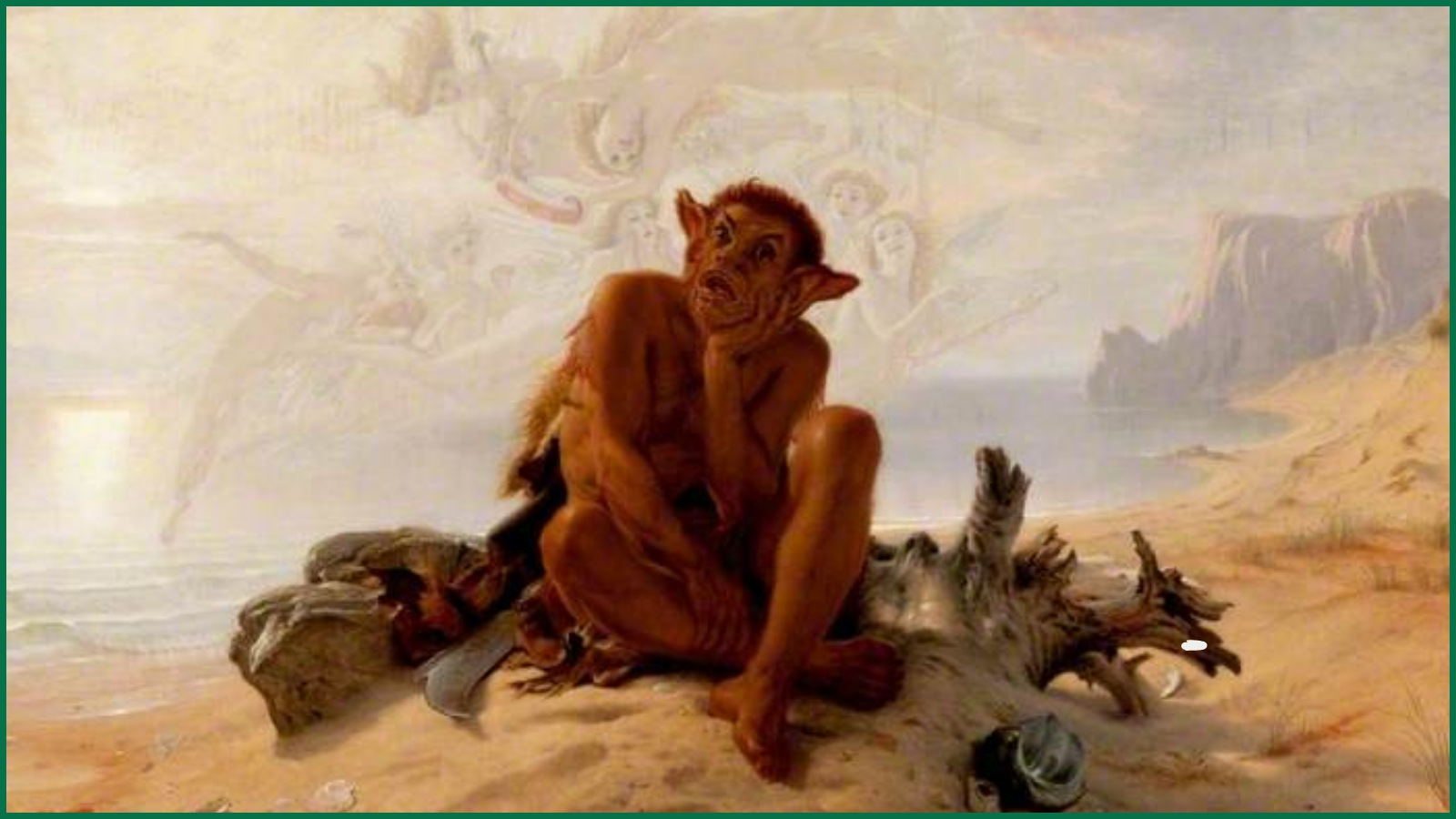
Prospero’s island is nominally in the Mediterranean but references to Bermuda, South American deities and west “Indians” indicate a New World inspiration.2 The supernatural is strong here, as the island is meant to invoke a mythical space in the minds of the audience. The island is inhabited by the former Duke of Milan, Prospero, who was overthrown at home by his brother. He is there with his daughter Miranda, an airy spirit named Ariel and Caliban, a “savage and deformed slave.”3
We learn that Prospero and Miranda had themselves washed up on this island in the wake of his overthrow in Milan. With magic, Prospero is able to keep Caliban in servitude as a slave and impress the powerful native spirit Ariel into his service. The play begins when a boat carrying the King of Naples and his son, Prospero’s usurping brother Antonio and a small coterie of servicemen, lesser lords and councillors pass by the island. With Ariel’s help, Prospero kicks up a storm—a tempest—in order to maroon the ship and exact a long-awaited revenge over his deposal.
It is this mystical, vaguely New World premise of The Tempest that gathers the most interest from a Marxist perspective. Large economic and cultural changes were well-underway during Renaissance England, as New World discovery and plunder began filling merchant coffers. Accustomed to filthy cities, rampant disease, backbreaking rural labour, a stifling social hierarchy and the pervasive threat of war, there was a European imagination full of awe by accounts of voyagers trickling back: empty, far-away lands overgrown with verdant leaves, soils with rippling veins of gold, oceans teeming with fish and small communities of peaceful people living half-naked.
The abundance of nature and freedom afforded by open spaces posed a radically unique situation for Europeans settlers in the New World: the complete absence of Old World class relations. This was a primary differentiation that Marx flagged in Capital when discussing the trajectories of capitalist development in the Old World and the New. For example, he relates the story of one Mr. Peel:
Mr. Peel, he moans, took with him from England to Swan River, West Australia, means of subsistence and of production to the amount of £50,000. Mr. Peel had the foresight to bring with him, besides, 300 persons of the working class, men, women and children. Once arrived at his destination, ‘Mr. Peel was left without a servant to make his bed or fetch him water from the river.’ Unhappy Mr. Peel, who provided for everything except the export of the English relations of production to Swan River!4
The abundance of readily-available means of subsistence meant that feudal and capitalist relations were simply not compatible with the newly broken lands of the New World. Because almost all European land was titled and cities were crowded, they transitioned to wage labour quickly and en masse once industrial technology was developed. But these conditions could not be exported to the New World and the colonies leaned much more heavily on forced labour in the form of race-based slavery and indentured servitude.5 As far as free labour was concerned, it was generally much more palatable to become a yeoman farmer than it was to toil for a wage.
The Powerful Illusion of Class
Shakespeare was writing from pre-revolutionary England, decades before the bourgeois Glorious Revolution. As such, his work largely reflects ruling class attitudes of his time, relegating working people to secondary roles and ignoring the large peasant class altogether. The theoretical framework of economic relations and forces of production were obscure in his era and he hewed the line of social expectations. Shakespeare was thus presented with a problem: if Prospero was a righteous duke in Italy, how can this dignified standing be portrayed in the context of largely uninhabited island?
Shakespeare devises a clever workaround to a setting absent class relations—he grants Prospero magical powers. Practicing magic was suppressed in Europe and outlawed in the England of Shakespeare’s day, but the unexplored island setting grants Prospero an unbridled freedom to practice sorcery. With these powers he proceeds to repeat a rather typical colonial pattern by ruthlessly exploiting nature and indigenous slave labour. Nature is represented in the play by Ariel, who is able to clap thunder, command winds and soothe men to sleep with susurrating blows of air to the ear. These powers are harnessed by Prospero who uses sorcery to release Ariel from the oak tree where the spirit had been imprisoned. With magic as a substitute for advanced European technology and command of labour, the free gifts of nature open up to the “civilized” man when his instruments meet the bountiful oceans and lands of the New World.
Then there is the “savage and deformed” Caliban, whose physical grotesqueness attaches a heavy stigma to his being throughout the play.6 He was discovered on the island by Prospero and he stands in as a native inhabitant. He says to Prospero in the opening act:
And then I loved thee,
And showed thee all the qualities o’ th’ isle,
The fresh springs, brine pits, barren place and fertile.
Cursed be that I do so!
For I am all the subjects that you have,
Which first was mine own king; and here you sty me
In this hard rock, whiles you do keep from me
The rest o’ th’ island.
This recalls the many accounts of indigenous assistance provided to alien settlers, only for it to blow back on the native population time and time again. Shakespeare had demonstrated sensitivity to slavery throughout his work, in particular during Shylock’s courtroom speech in The Merchant of Venice. Caliban was enslaved specifically as punishment for attempting to violate Prospero’s daughter Miranda and people “this isle with Calibans.”
This plot device morally justifies Prospero’s enslaving of Caliban, retaining audience sympathy for the main protagonist. But Shakespeare relies on serious stereotypes to accomplish this, drawing on differing sexual mores between “primitive” and “civilized” cultures set by the standards of Christian Europe: Caliban’s “attempt to ‘violate the honour’ of Miranda may have seemed, from his point of view, less like an attempted rape than the response of a natural sexuality that cannot comprehend the concern with sexual honour so dear to Prospero and his culture.”7
Whereas Europeans enslaved by way of cargo ships and the bullwhip, Prospero does it with sorcery—threatening to deliver cramps and stinging pinches should Caliban refuse an order. Unwittingly, Shakespeare upholds a Marxian standard of productive relations throughout the play by substituting magic for the means of production.
Liberation at Last?
The final characters to note in the play are that of Trinculo and Stephano. A jester and a butler, respectively, they recognize a newfound freedom from Milanese class relations upon their stranding on the island. Resorting to another trope, Shakespeare has his butler and jester win Caliban’s favour with a drink of “celestial liquor.” The trio then decide they no longer have to toil in the service of a king, as this new, unspoiled environment affords them the chance to shed their masters and be rulers themselves.
As we saw in Marx’s anecdote about Mr. Peel, Stephano and Trinculo were transported to the island as servicemen. But once landed on this uninhabited island, they were suddenly free of their Old World bonds and underwent a revolution of consciousness. This situation obviously could not be endured by Shakespeare’s Renaissance English audience and so the social hierarchy is restored by the discipline of Prospero’s magic at the play’s end.
The Tempest is a terrific historical product that helps to backtest Marxist theories. Shakespeare himself was not a revolutionary in any modern sense of the word. With his incredible talent, he captured the social relations of the proto-capitalist mode of production, providing dramatic examples of Marx’s bold proclamation: “It is not the consciousness of men that determines their existence, but their social existence that determines their consciousness.”8
Thanks for reading!

See Charles Frey, “The Tempest and the New World,” Shakespeare Quarterly, Vol. 30, No. 1: 29–41 for more on this subject. In particular, the island of Bermuda is a notable influence. ↩︎
Ibid, 29. ↩︎
This is the description of Caliban given to us in the dramatis personae. ↩︎
Karl Marx, Capital Vol. One (Ancient Wisdom Publishing, 2019): 543. ↩︎
Further explored in the following pages of ibid, 544-5. ↩︎
Jeffrey Wilson compares Caliban’s state to a variety of disability and racial stigmas in “‘Savage and Deformed’: Stigma as Drama in The Tempest,” Medieval & Renaissance Drama in England, Vol. 31: 146–177. ↩︎
Peter Holland in The Tempest (The Pelican Shakespeare, 2016): xxxiv. ↩︎
From the preface to Marx’s A Contribution to the Critique of Political Economy. ↩︎